
Wood rots. Steel rusts. A concrete post does neither, and that is why growers who plan to keep a dragon fruit plant for decades build with concrete. A concrete post trellis for dragon fruit is heavier to build and harder to move, but once it is in the ground it will outlast the plant it supports, through storms, wet seasons and years of heavy fruiting stems leaning on it.
This guide explains how to build a concrete post trellis for dragon fruit from start to finish: when concrete is the right choice, what post and footing to use, how to set it, how to build the top frame, and how to train the plant onto a support that will never need replacing.
In This Guide
- Why choose concrete over wood or steel
- The right post size and shape
- How tall the post should be
- Materials and tools you need
- Building the trellis step by step
- The top frame: wheel, cross or ring
- Training stems on a concrete post
- Care and common mistakes
- Frequently asked questions
Why Choose Concrete Over Wood or Steel
The case for a concrete post trellis for dragon fruit is simple: permanence. A wooden post rots at ground level within a decade, and a steel post rusts in the same place, especially in wet or coastal gardens. Both fail without warning, usually in a storm, when a heavy plant pulls the weakened post over.
A concrete post trellis for dragon fruit has no such weak point. It does not rot, rust, or attract termites, and it stands in wet soil for decades without losing strength.
A concrete post trellis for dragon fruit is also the strongest option for a heavy, mature plant. A full-grown dragon fruit, with water-filled stems, a season of fruit and wet soil after rain, can weigh a great deal, and it leans. A concrete post, set deep in a concrete footing, does not lean, bend or creep over time the way a wooden post can.
The trade-off is effort: a concrete post is heavy to move and set, it cannot be moved once the footing has cured, and it costs more than timber. For a plant you expect to keep for twenty years, that trade is worth making. For a trial plant or a rented garden, wood is the better choice.
The Right Post Size and Shape
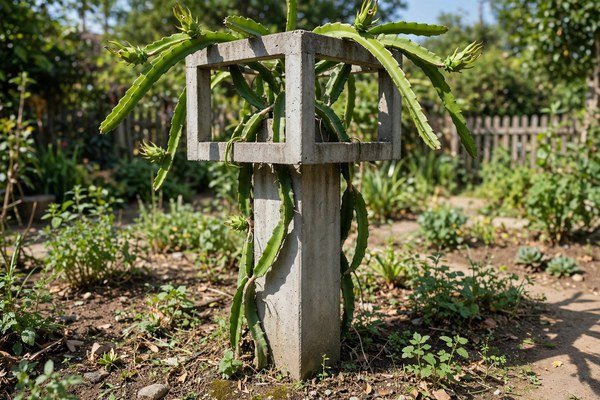
A concrete post trellis for dragon fruit starts with the post itself, and the size matters more than the shape. A square post of 10 by 10 centimetres is the standard choice: strong, easy to cast or buy, and simple to fix a frame to.
A round post of the same diameter works just as well, and some growers prefer it because there are no corners for stems to catch on. Avoid posts thinner than 10 centimetres: a slim post looks neat when new, but it is the first thing to crack under a leaning plant.
You can buy ready-made concrete posts from a building supplier, which saves the work of casting your own, or you can cast one yourself in a simple timber mould. A bought post is usually reinforced with steel inside, which is worth paying for, since an unreinforced post can crack if it is knocked or if the ground moves.
If you cast your own, lay two lengths of steel reinforcing bar inside the mould before pouring, and let the post cure for at least a week before moving it. Check the post for cracks before installation: a cracked post is a weak post, and it should not go in the ground.
How Tall the Post Should Be
Height is the same question for concrete as for wood, and the answer is the same: about 1.8 metres above the ground is ideal for a concrete post trellis for dragon fruit. That height lets the stems climb, drape over the top frame and fruit within easy reach, without a ladder.
A taller post grows more stems, but every job on the plant, from pruning to picking, becomes harder, and a tall concrete post trellis for dragon fruit is harder still to set straight.
A concrete post trellis for dragon fruit needs at least 60 centimetres in the ground, in a footing of concrete that spreads the load. In soft or sandy soil, go deeper, to 75 centimetres, and make the footing wider.
The total post length for a 1.8 metre trellis is therefore about 2.4 to 2.5 metres. If you buy a ready-made post, check its length before delivery: a post that is too short cannot be extended, and a post that is too long can be cut, but cutting reinforced concrete is hard work.
Materials and Tools You Need
Gather everything before you dig, because a concrete footing waits for no one once it is mixed.
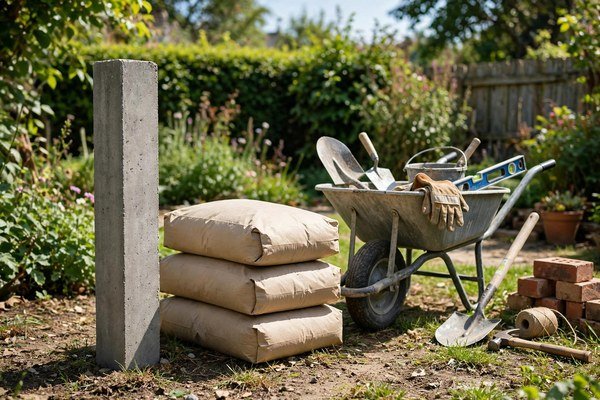
For one concrete post trellis for dragon fruit you need: one reinforced concrete post, about 2.4 metres long and 10 by 10 centimetres; two bags of premixed concrete for the footing; four lengths of timber or steel for the top frame, each about 90 centimetres; exterior bolts or heavy screws for fixing the frame; a post-hole digger or a spade; a spirit level; a wheelbarrow and a bucket for mixing; a tape measure; and soft plant ties for training.
You will also want help: a concrete post trellis for dragon fruit is heavy, and setting one straight while holding it upright and filling the hole is a two-person job at least. Wear gloves and eye protection when handling concrete, and wash concrete dust off your skin promptly, since wet concrete irritates the skin. Keep the bags of premixed concrete dry until you are ready to mix, and mix only as much as you can place in half an hour.
Building the Trellis Step by Step
Start by digging the hole. A concrete post trellis for dragon fruit needs a hole about 60 to 75 centimetres deep and 40 centimetres wide, wider at the bottom than at the top if you can manage it, since a wider base resists leaning better.
Put a layer of gravel at the bottom for drainage, then lower the post into the hole with help, checking with the spirit level that it is vertical in both directions. Brace the post with timber props on two sides so it cannot move while you work.
Mix the concrete to a stiff consistency, not a runny one, and fill the hole around the post in layers, tamping each layer down firmly with a piece of timber to remove air pockets. Fill to just above ground level, and shape the top of the footing into a slight dome so rain runs away from the post instead of pooling against it.
Check the level once more before the concrete starts to set, and adjust the props if the post has moved. Leave the footing alone for at least 48 hours, and do not hang anything on the post or train stems to it until the concrete has cured. The UF IFAS growing guide recommends a strong, permanent support for dragon fruit, since a mature plant is heavy and a weak support fails under it. You can read the full guide through UF IFAS.

The Top Frame: Wheel, Cross or Ring
The top frame is where the fruiting happens, so it deserves as much thought as the post. A concrete post trellis for dragon fruit usually carries one of three frames: a cross, a wheel, or a ring. A cross frame, two lengths of timber or steel crossed at right angles, is the simplest to build and fix, and it suits a single plant.
A wheel rim, an old car or bicycle wheel bolted to the top of the post, is a favourite among experienced growers because it is round, strong and spreads the stems evenly. A ring of bent steel or thick wire, about 60 to 90 centimetres across, does the same job and is lighter than a wheel.
Whichever frame you choose, fix it firmly to the top of the post with bolts, not screws alone, since the frame carries the full weight of the hanging stems and fruit. The frame should sit flat and level, with no rocking, and its edges should be smooth: wrap sharp metal edges with old hose or cloth tape so they do not cut into the stems.
For other frame shapes and layouts, see our guide to dragon fruit trellis ideas, which compares posts, frames and arches for different gardens.

Training Stems on a Concrete Post
Training on a concrete post trellis for dragon fruit is the same as training on wood, with one difference: the post is hard and rough, so ties matter more. A concrete post trellis for dragon fruit needs soft, wide ties, because a thin tie pulled tight against rough concrete will cut into the stem as it thickens. Use strips of old cloth, soft plant tape or wide rubber ties, and check them every few months, loosening any that have grown tight.
Let one strong stem grow up the post, tying it loosely every 30 centimetres, and pinch out low side shoots that compete with the main stem. When the main stem reaches the top frame, let it grow over the edge and hang down, and train two or three side stems over the frame in different directions.
The hanging stems are the ones that flower and fruit, so space them evenly around the frame rather than letting them bunch on one side, which would unbalance the plant and load one side of the post. For the full routine, see our guide on how to train dragon fruit on a trellis, which covers tying, spacing and the first year of growth.
Care and Common Mistakes
A concrete post trellis for dragon fruit needs almost no care, which is the point, but the plant on it still needs attention. The most common mistake with a concrete post trellis for dragon fruit is setting the post too shallow, which lets it lean as the plant grows heavy.
If the post starts to lean, brace it immediately with a diagonal timber prop and consider adding a second post beside it with a crossbeam: a leaning concrete post is very hard to straighten once the footing has cured.
Another mistake is planting the cutting too close to the post, so the young stem is shaded and damp against the concrete. Plant the cutting about 15 centimetres from the post, on the sunny side, and tie it to the post only once it is long enough to reach without bending.
Do not paint the post with a dark colour, which absorbs heat and can scorch stems touching it in hot sun; a light colour, or no paint at all, is better. For the complete growing routine once the trellis is up, start with our guide on how to grow dragon fruit, which covers soil, watering, feeding and the first flowering season.
Frequently Asked Questions
Is a concrete post trellis for dragon fruit worth the extra work?
Yes, if you plan to keep the plant for many years. A concrete post does not rot, rust or attract termites, and it will outlast the plant it supports. For a trial plant, a rented garden, or a plant you may move, a wooden post is cheaper and easier. For a permanent planting, concrete is the best investment.
How deep should the footing be for a concrete post?
At least 60 centimetres deep in firm soil, and 75 centimetres in soft or sandy soil, with a footing about 40 centimetres wide. A deeper, wider footing resists leaning far better than a shallow one, and it is the part of the job that is hardest to fix later, so do not rush it.
Can I cast my own concrete post?
Yes. Build a simple timber mould 10 by 10 centimetres in section and 2.4 metres long, lay two steel reinforcing bars inside, pour concrete, and let it cure for at least a week before moving it. A bought, factory-made post is usually stronger and more consistent, and it saves a week of waiting, so compare the price before deciding.
What top frame works best on a concrete post?
A wheel rim or a steel ring about 60 to 90 centimetres across works best, because it spreads the hanging stems evenly and is strong enough to carry a mature plant. A timber cross frame is simpler to build and works well for a single plant, but it may need replacing before the post does.
Will the concrete harm the plant?
No. Cured concrete is safe for dragon fruit, and the plant’s aerial roots will grip it readily. Keep the cutting about 15 centimetres from the post when planting, use soft ties, and avoid dark paint that absorbs heat. Fresh, uncured concrete can irritate skin, so let the footing cure for 48 hours before planting beside it.
Conclusion
A concrete post trellis for dragon fruit is the last trellis you will ever build for that plant: heavy to set, impossible to move, and still standing decades later while wooden posts around it have rotted away. Dig deep, set the post straight, fix a strong top frame, and train the stems early. A concrete post trellis for dragon fruit is not the cheapest support and not the quickest to build, but for a plant you intend to keep, it is the support that lets you forget about the trellis entirely and spend your time on the plant itself.