Table of Contents
- Introduction
- How to Identify Mealybugs on Dragon Fruit
- Why Mealybugs Attack Dragon Fruit
- Step 1: Isolate and Inspect the Plant
- Step 2: Remove Mealybugs by Hand
- Step 3: How to Get Rid of Mealybugs on Dragon Fruit With Safe Sprays
- Step 4: Bring in Natural Predators
- Step 5: How to Get Rid of Mealybugs on Dragon Fruit for Good
- When to Give Up on a Stem
- Frequently Asked Questions
- Conclusion
Introduction
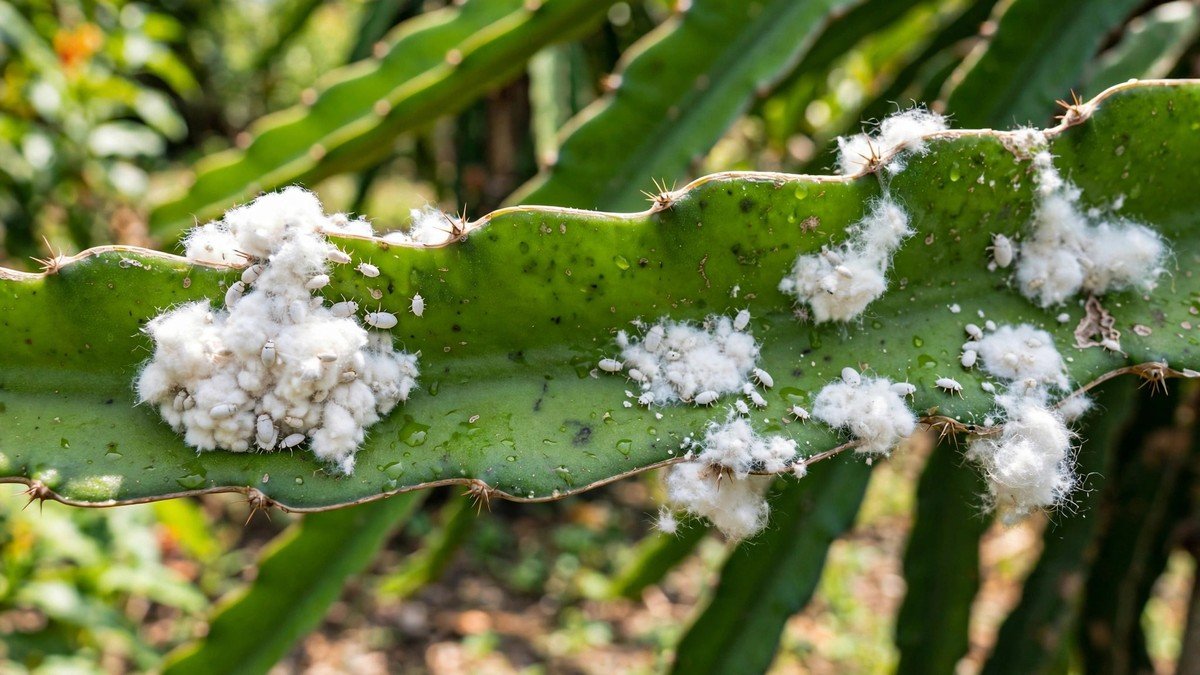
Learning how to get rid of mealybugs on dragon fruit starts with spotting them: mealybugs on dragon fruit look like tiny pieces of white cotton wool stuck to the stems, usually in the joints, under the spines and around new growth and flower buds. Under that cottony coating is a small, soft, oval insect that feeds on the plant’s sap, and a bad infestation can weaken the whole plant, distort new growth, cover the stems in sticky honeydew and attract sooty mould.
The good news is that mealybugs are one of the easier dragon fruit pests to beat, because they are slow, they are visible, and they have no wings in their feeding stage. The bad news is that they hide well, they spread to nearby plants, and a treatment that kills the bugs you can see will miss the eggs hidden in the cotton.
This guide explains how to identify mealybugs correctly, why they appear on dragon fruit, and how to get rid of mealybugs on dragon fruit step by step, from hand removal and safe sprays to natural predators and the habits that stop them coming back. It uses methods that are safe for a plant you will eat from, and it explains what to do when the infestation is small, when it is large, and when a stem is too far gone to save. For background on the plant itself, the University of Florida IFAS Extension publication on growing dragon fruit is a useful reference.
How to Identify Mealybugs on Dragon Fruit
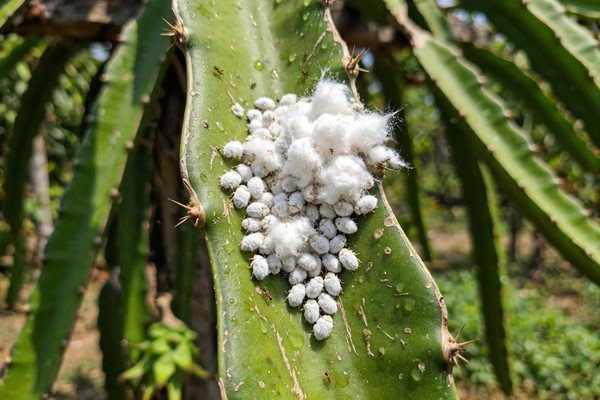
Mealybugs are small, usually 3 to 5 millimetres long, soft-bodied and oval, covered in a white, waxy, cotton-like coating. On dragon fruit they gather in sheltered places: the joints where stem segments meet, the base of spines, the underside of new growth, and around flower buds and young fruit. A single mealybug is easy to miss. A colony looks like a patch of cotton wool, and a bad infestation can cover a whole joint.
Do not confuse mealybugs with other white things on dragon fruit. Sunburn can leave pale patches, but those are flat and dry, not cottony. Scale insects are hard, round bumps that do not look like cotton. Fungus can leave white growth, but it does not have the segmented, insect shape underneath. If you poke the white patch gently with a stick and it is soft, waxy and slightly sticky, and you can see tiny legs or a segmented body underneath, it is mealybugs. A magnifying glass helps, and it is worth checking, because how to get rid of mealybugs on dragon fruit differs from the treatment for fungus or sunburn.
The other signs are just as useful as the bugs themselves. Mealybugs feed on sap and excrete a sticky, sugary liquid called honeydew. Honeydew makes the stems feel sticky, it attracts ants, and it grows a black, sooty mould that looks like dirt on the plant. If you see ants marching up your dragon fruit, follow them, because they are often farming mealybugs or aphids for honeydew, and they will lead you to the colony.
New growth that is twisted, stunted or yellowing, and flower buds that drop before they open, are also signs of a heavy infestation. Our guide to why dragon fruit cuttings are not rooting covers weak growth from other causes, so check the stems for cottony patches before you blame the soil or the watering.
Mealybugs spread slowly on their own, because the feeding insects do not fly, but they spread fast with help. Ants carry them to new stems, wind blows the tiny crawlers to nearby plants, and a gardener moves them on hands, tools and clothing. When you are working out how to get rid of mealybugs on dragon fruit, check every dragon fruit plant you own when you find mealybugs on one, and check nearby plants too, especially other cacti and succulents.
Why Mealybugs Attack Dragon Fruit
Learning how to get rid of mealybugs on dragon fruit starts with knowing why they attack: mealybugs attack dragon fruit for the same reasons they attack most soft-stemmed plants: the stems are full of sap, the joints give them shelter, and the plant is often kept in warm, still conditions that suit them. They are most active in warm weather, and they breed fastest in the growing season, when new growth is soft and full of sap. A plant that is already stressed, by overwatering, by too little light, or by too much nitrogen fertiliser that pushes soft, sappy growth, is more attractive to them than a healthy, sturdy plant.
Overfeeding is a common cause that growers miss. Too much nitrogen fertiliser makes the plant grow fast and soft, with thin stems full of sap, and mealybugs love soft growth. If you are feeding heavily and mealybugs keep coming back, cut the fertiliser back and let the plant grow slower and tougher. A plant that is growing steadily in bright light with free-draining soil and careful watering is harder for mealybugs to colonise than a plant that is pushing soft growth in shade.
Ants make the problem worse, and they are part of the problem, not a separate one. Ants protect mealybugs from predators, carry them to new stems, and farm them for honeydew. If you kill the mealybugs but leave the ants, the ants will bring more mealybugs back. Deal with the ants as well, by removing the honeydew, by blocking their path with a sticky barrier around the pot or the post, and by removing the mealybugs they are farming. Do not use ant poison on a plant you will eat from unless the product is labelled safe for food plants, and follow the label exactly.
Step 1: Isolate and Inspect the Plant
The first step in how to get rid of mealybugs on dragon fruit is to isolate the infested plant if you can, before you treat anything. Move a potted dragon fruit away from your other plants, and do not take cuttings from an infested plant until it is clean. This one step stops the infestation spreading while you treat it, and it is the step most growers skip.
Then inspect the whole plant, slowly, in good light. Check every joint, the base of every spine, the underside of every stem, and every flower bud and young fruit. Mealybugs hide in the places you do not look, and a treatment that misses a hidden colony will fail. Use a magnifying glass if you have one, and a torch to light the undersides. Note where the worst colonies are, and whether the infestation is on one stem or the whole plant. That tells you whether hand removal will be enough, or whether you need to spray the whole plant.
Wash your hands and your tools after the inspection, and do not touch a healthy plant with hands that have just handled an infested one. The tiny crawlers are almost invisible, and they travel on skin, clothing and tools.
Step 2: Remove Mealybugs by Hand
For a small infestation, hand removal is the fastest and safest way to learn how to get rid of mealybugs on dragon fruit, and it should always be the first step, even if you plan to spray afterwards.
To start learning how to get rid of mealybugs on dragon fruit by hand, take a cotton bud or a small, soft brush, dip it in rubbing alcohol, and dab each mealybug directly. The alcohol dissolves the waxy coating and kills the insect on contact. Work through the whole plant, joint by joint, and dab every bug you can see. For a larger patch, use a soft toothbrush dipped in alcohol and brush the colony off gently, taking care not to damage the stem. Do not use a hard brush, and do not scrub, because dragon fruit stems bruise easily and a bruised stem is open to infection.
Alternatively, blast the bugs off with a strong jet of water from a hose. This works well on a sturdy, outdoor plant, and it removes the cottony coating and many of the insects at once. It does not kill them all, and it will not reach the ones hidden in joints, so follow it with alcohol dabbing or a spray. Do not use a pressure washer, which will damage the stems.
After hand removal, prune away any stem that is heavily infested and badly weakened, if the plant can afford to lose it. A stem covered in mealybugs, sticky with honeydew and black with sooty mould is doing the plant more harm than good, and removing it takes hundreds of bugs and eggs off the plant in one cut. Cut back to healthy tissue, seal the cut by letting it dry in the air, and put the removed stem in a sealed bag in the bin, not on the compost heap, where the bugs will survive and spread.
Step 3: How to Get Rid of Mealybugs on Dragon Fruit With Safe Sprays
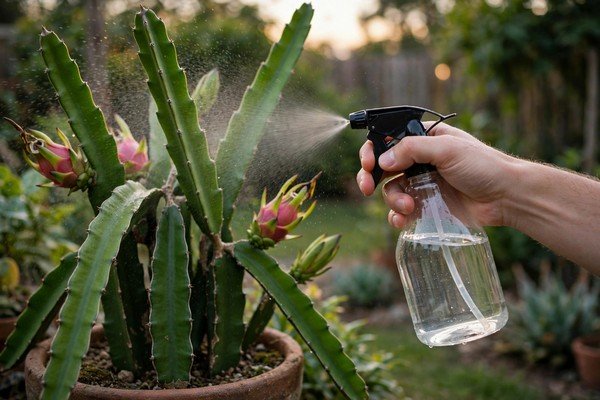
Hand removal kills the bugs you can see. When you are learning how to get rid of mealybugs on dragon fruit, a spray kills the ones you missed, including the tiny crawlers that are too small to see. Spray the whole plant, not just the patches you found, because the crawlers hide everywhere.
The safest spray for a food plant is insecticidal soap, which you can buy ready-made or make by mixing a small amount of pure liquid soap with water. Use a soap with no added fragrance, moisturiser or antibacterial chemicals, and test it on a small part of the plant first, because some soaps can burn dragon fruit stems in hot sun.
Spray in the evening, when the sun is off the plant, and coat the stems thoroughly, especially the joints and the undersides. Repeat the spray every five to seven days for three weeks, because insecticidal soap kills on contact but does not kill eggs, and the eggs will hatch over the next two weeks. Three sprays, a week apart, catch each new generation as it hatches.
Neem oil is the other safe option, and it works differently. Neem does not kill on contact as fast as soap, but it disrupts the insects’ feeding and breeding, and it has some effect on eggs. Mix neem oil with water and a little soap to help it spread, following the product label exactly, and spray in the evening. Do not spray neem in hot sun, because it can burn the stems. Neem and soap can be used in alternate weeks, but do not mix them in the same spray unless the label says you can.
Do not use a broad-spectrum insecticide on dragon fruit unless you have no other option and the product is labelled safe for food plants. Broad insecticides kill the predators that eat mealybugs, including ladybugs and lacewings, and they can leave residues on fruit. If you do use one, follow the label exactly, respect the waiting period before harvest, and do not spray when the plant is in flower, because you will kill the pollinators the plant needs to set fruit.
Step 4: Bring in Natural Predators
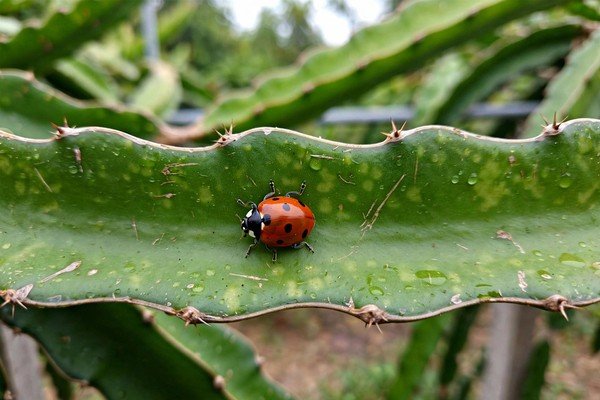
Natural predators are the long-term answer when you are learning how to get rid of mealybugs on dragon fruit, because they keep working after you stop spraying. Ladybugs, lacewing larvae and mealybug destroyer beetles all eat mealybugs, and they are available from garden suppliers in many countries. Release them in the evening, after you have sprayed, and do not spray insecticidal soap for a few days after you release them, or you will kill the predators as well.
You can also encourage the predators that are already in your garden. Ladybugs and lacewings visit gardens with flowers, so plant flowers near your dragon fruit, leave some leaf litter and shelter for them, and avoid broad insecticides that kill them. A garden with predators will still get mealybugs sometimes, but the predators will keep the numbers low enough that the plant is not harmed.
Ants are the enemy of this step, because ants protect mealybugs and chase predators away. Deal with the ants first, or the predators will not be able to work. A sticky barrier around the pot or the post, made from a commercial tree band or a ring of petroleum jelly on a smooth surface, stops ants climbing to the plant. Renew the barrier after rain, and check it weekly.
Step 5: How to Get Rid of Mealybugs on Dragon Fruit for Good
Learning how to get rid of mealybugs on dragon fruit is only half the job. Stopping them coming back is the other half, and it is mostly about habits.
To keep on top of how to get rid of mealybugs on dragon fruit, check your plants every week in the growing season, and every two weeks in winter. Look at the joints, the new growth and the flower buds, and catch a new colony when it is five bugs, not five hundred. A weekly check takes two minutes, and it is the single most effective habit in this whole guide.
Quarantine new plants. A new dragon fruit cutting or a new pot plant can carry mealybugs with it, and putting it straight next to your healthy plants is how infestations start. Keep a new plant separate for two to three weeks, inspect it closely, and only move it next to your other plants when you are sure it is clean. Do not take cuttings from a plant with mealybugs, and do not share cuttings from an infested plant with other growers.
Feed carefully. Use a balanced fertiliser at the recommended rate, and do not push the plant with heavy nitrogen. A plant growing steadily in bright light is tougher than a plant growing fast and soft in shade. Water carefully too. Dragon fruit needs free-draining soil and watering only when the soil is dry. Overwatering stresses the plant and makes it more attractive to pests, and it causes root problems of its own. If your plant has brown spots as well as mealybugs, check the watering and the drainage first, because the two problems often have the same cause.
Clean your tools, because this is part of how to get rid of mealybugs on dragon fruit: pruners, brushes and pots can carry mealybugs and their eggs. Clean tools with alcohol or soapy water between plants, and do not reuse a pot from an infested plant without washing it first.
When to Give Up on a Stem
Most mealybug infestations can be beaten, but some stems are not worth saving. Give up on a stem if it is covered in mealybugs from end to end, if the stem is soft, yellow and collapsing, if it is black with sooty mould and the tissue underneath is rotting, or if you have treated it three times and the colony keeps coming back stronger. Cut the stem back to healthy tissue, dispose of it in a sealed bag, and let the plant put its energy into the healthy stems that are left.
Do not give up on the whole plant because one stem is bad. Dragon fruit is a vigorous grower, and a plant that loses a stem will grow new ones. A plant with mealybugs on every stem, with no healthy growth left, is a harder case, but even then, a hard prune back to the healthiest stems, followed by three weeks of spraying, will often save it. Only compost a plant if the roots are rotting as well, and the whole plant is collapsing.
Frequently Asked Questions
How do I know if my dragon fruit has mealybugs?
Look for white, cottony patches on the stems, especially in the joints, under the spines and around new growth and flower buds. The stems may feel sticky from honeydew, ants may be marching up the plant, and new growth may be twisted or stunted. Poke the white patch gently. If it is soft and waxy with tiny insects underneath, it is mealybugs.
Does rubbing alcohol kill mealybugs on dragon fruit?
Yes. Rubbing alcohol dissolves the waxy coating and kills the insect on contact. Dab it directly onto each bug with a cotton bud, and repeat the treatment every few days until no new bugs appear. Do not pour alcohol over the whole plant, and do not use it in hot sun, because it can damage the stems.
Will neem oil get rid of mealybugs?
Neem oil helps when you are learning how to get rid of mealybugs on dragon fruit, but it is not instant. It disrupts feeding and breeding, and it has some effect on eggs, but it does not kill adult mealybugs on contact as fast as insecticidal soap. Use neem as part of a plan, with hand removal first and repeat sprays every week, and do not expect one spray to finish the job.
How long does it take to get rid of mealybugs?
Plan for three weeks. Hand removal and the first spray kill the adults you can see, but the eggs hatch over the next two weeks, so you need to repeat the spray every five to seven days for three weeks to catch each new generation. Check the plant weekly after that, and treat any new colony while it is still small.
Do mealybugs spread to other plants?
Yes. The tiny crawlers move on wind, on ants, and on hands, tools and clothing. Isolate an infested plant, check every nearby plant, especially other cacti and succulents, and wash your hands and tools after handling an infested plant. Quarantine new plants for two to three weeks before you put them next to your healthy plants.
Are mealybugs harmful to humans or pets?
Mealybugs do not bite humans or pets, and they are not poisonous. They are a plant pest, not a health risk. Wash fruit before you eat it, as you should anyway, and wash your hands after handling an infested plant.
Conclusion
Mealybugs on dragon fruit look worse than they are, because the white cottony patches are hard to miss and the sticky honeydew and black mould make the plant look sick. In practice they are one of the easier pests to beat, because they are slow, visible, and vulnerable to simple treatments. To sum up how to get rid of mealybugs on dragon fruit: isolate the plant, remove the bugs you can see with alcohol or water, spray the whole plant with insecticidal soap or neem oil every week for three weeks, and bring in predators to keep the numbers down.
The habits that stop them coming back matter as much as the treatment. Check your plants every week, quarantine new plants, feed carefully, deal with the ants, and clean your tools. A plant that is checked weekly will never have a bad infestation, because you will catch the first five bugs before they become five hundred. Start with the worst stem, work through the plant joint by joint, and give it three weeks. Most plants are clean by then, and growing strongly again.
1 thought on “How to Get Rid of Mealybugs on Dragon Fruit”