Table of Contents
- Introduction
- How Fast Should a Dragon Fruit Plant Grow?
- Reason 1: Not Enough Light — Why Is My Dragon Fruit Plant Not Growing
- Reason 2: Pot Too Small or Roots Crowded
- Reason 3: Wrong Soil or Poor Drainage
- Reason 4: Watering Problems
- Reason 5: Not Enough Food
- Reason 6: No Support to Climb
- Reason 7: Cold Weather or Wrong Season
- Reason 8: Pests or Disease You Cannot See
- The Quick Checklist: Why Is My Dragon Fruit Plant Not Growing
- Frequently Asked Questions
- Conclusion
Introduction
If you are wondering why is my dragon fruit plant not growing, you are not alone. Dragon fruit is a fast-growing cactus when it is happy, and a cutting can grow several feet in a single season, so a plant that sits still for months is telling you something is wrong. The good news is that the cause is usually simple: not enough light, a pot that is too small, poor soil, not enough food, or roots that are struggling underground where you cannot see them.
This guide works through the most common reasons in order, from the easiest to check to the ones that need a closer look, with a simple checklist at the end so you can work out why is my dragon fruit plant not growing and fix it. Most stalled dragon fruit plants start growing again within a few weeks of fixing the real cause. A plant that has been still for months is not necessarily dying, but it does need you to change something, because doing the same thing and waiting longer rarely works.

How Fast Should a Dragon Fruit Plant Grow?
Before you worry, check whether your plant is actually stalled. A healthy dragon fruit cutting in warm weather should produce new growth every few weeks during the growing season, with stems lengthening noticeably and new branches appearing from the joints. In peak summer, a vigorous plant can grow several inches in a week. Growth slows or stops in cold weather, and a plant will barely grow at all when temperatures stay below about 15 degrees Celsius, which is normal and not a problem.
A new cutting also needs time. A fresh cutting spends its first weeks growing roots, not stems, and you may see nothing above the soil for a month or more while the roots establish. That is normal. If the cutting is still firm and green, it is probably rooting, and patience is the right response. Our guide to why dragon fruit cuttings are not rooting covers the early stages, when weak roots are the limiting factor rather than anything above ground.
A plant that has been in the same pot for a year or more and has not grown at all through a full warm season is genuinely stalled, and something in its conditions needs to change. That is the plant this guide is for, and the answer to why is my dragon fruit plant not growing is usually one of the reasons below.
Reason 1: Not Enough Light — Why Is My Dragon Fruit Plant Not Growing
Light is the most common answer to why is my dragon fruit plant not growing, and it is the first thing to check. Dragon fruit is a cactus that comes from sunny, open places, and it needs at least 6 to 8 hours of direct sunlight a day to grow well. A plant on a shaded balcony, under a tree, or in a bright room without direct sun will survive, but it will barely grow, and its stems will be thin, pale and stretched as it reaches for the light.
The fix is simple: move the plant to the sunniest spot you have. A south-facing position in the northern hemisphere, or a north-facing position in the southern hemisphere, is ideal. If you move a plant that has been in shade into full sun all at once, do it gradually over a week, because a sudden move can scorch the stems.
Start with morning sun, which is gentler, and add afternoon sun over several days. If your stems are thin and pale, that is the plant telling you it needs more light, and the new growth after the move should come in thicker and greener.
Indoor plants are the hardest case. A dragon fruit plant kept indoors will almost always grow slowly, even in a bright window, because glass cuts out a large part of the light. If you can move it outdoors for the warm months, do that. If it must stay indoors, put it in the sunniest window you have and accept slower growth.
Reason 2: Pot Too Small or Roots Crowded
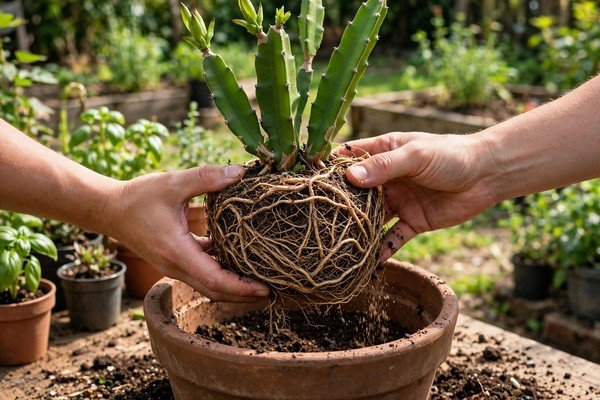
Dragon fruit grows fast above ground, and its roots grow fast too. A plant that has been in the same pot for a year or more may be root-bound, with the roots circling the inside of the pot and no room left to grow. A root-bound plant cannot take up enough water or nutrients, so it stops growing even if you feed and water it correctly, and it is a common reason people ask why is my dragon fruit plant not growing.
Check by gently tipping the plant out of its pot. If you see a dense mat of roots with little soil visible, or roots coming out of the drainage holes, the plant needs a bigger pot. Move it up one or two sizes, to a pot at least 30 to 40 cm across for a young plant, and larger for a mature one. Use fresh cactus or succulent soil, tease the outer roots loose gently so they can grow into the new soil, and water it in well. A repotted plant often starts growing within a few weeks, because the roots finally have somewhere to go.
The pot also needs drainage holes. Dragon fruit hates sitting in water, and a pot without drainage will keep the roots wet and stop growth long before it kills the plant. If your pot has no holes, repot into one that does, or drill holes if the material allows it.
Reason 3: Wrong Soil or Poor Drainage
If you are asking why is my dragon fruit plant not growing, check the soil first: dragon fruit needs loose, free-draining soil. Heavy garden soil, or a potting mix that stays wet for days after watering, suffocates the roots and stops growth. The roots need air as well as water, and soil that stays soggy gives them neither.
The right mix is simple: a cactus or succulent potting mix, or ordinary potting soil mixed with about a third perlite, coarse sand or small gravel to open it up. The soil should feel moist after watering but not wet, and water should drain out of the bottom within seconds, not sit on the surface.
If your soil stays wet for days, repot into a freer mix. If your soil dries out within hours and the stems look shrivelled, the mix may be too free-draining, and adding a little compost will help it hold moisture without staying soggy.
While you are checking the soil, check the roots. Healthy roots are firm and pale. Soft, dark, mushy roots are rotting, and a plant with rotting roots will not grow until the rot is dealt with. Trim away the soft roots with clean scissors, let the cut ends dry for a day, and repot into fresh dry mix. Our guide on how to fix dragon fruit root rot covers this in detail, step by step.
Reason 4: Watering Problems
Both too much water and too little water will stop a dragon fruit plant from growing, and the symptoms look similar from above, so you have to check the soil. Watering is a common answer when you ask why is my dragon fruit plant not growing.
Overwatering is the more common problem. Dragon fruit is a cactus, and it stores water in its stems, so it needs far less water than most garden plants. Watering every day, or keeping the soil constantly wet, rots the roots and stops growth. Water only when the top few centimetres of soil are dry, and water deeply when you do, so the water reaches the roots and drains out of the bottom. In winter, when the plant is barely growing, water even less.
Underwatering is the other side. A plant that goes weeks without water in hot weather will stop growing to protect itself, and its stems will look thin and wrinkled. If the soil is bone dry all the way through and the stems are shrivelling, give the plant a deep soak and then return to a regular schedule: water when the top soil is dry, not on a fixed calendar. A plant that has been underwatered usually recovers quickly once it gets regular water again.
Reason 5: Not Enough Food
Dragon fruit is a hungry plant when it is growing, and a plant in a pot will use up the nutrients in its soil within a few months. A plant that has not been fed for a year or more, or that is growing in old, exhausted soil, will stop growing simply because it has nothing left to grow with. Hunger is a simple answer to why is my dragon fruit plant not growing.
Feed during the growing season, from spring through to early autumn, with a balanced fertiliser or a fertiliser made for cactus and succulents. A liquid feed every two to four weeks is enough for most plants, and a slow-release fertiliser applied in spring will feed the plant for months. Do not feed in winter, when the plant is not growing, because the unused fertiliser can build up in the soil and damage the roots.
And do not overfeed to compensate for months of neglect: a heavy dose of fertiliser on a stressed plant can burn the roots. Start with a half-strength feed, and build up to full strength over a few weeks.
Yellow or pale stems can be a sign of hunger, but they can also be a sign of too much sun or cold damage, so do not feed a plant that is also showing sunburn or cold damage until you have fixed the light and temperature first. Our guide to why your dragon fruit plant has brown spots covers the marks that feeding will not fix.
Reason 6: No Support to Climb
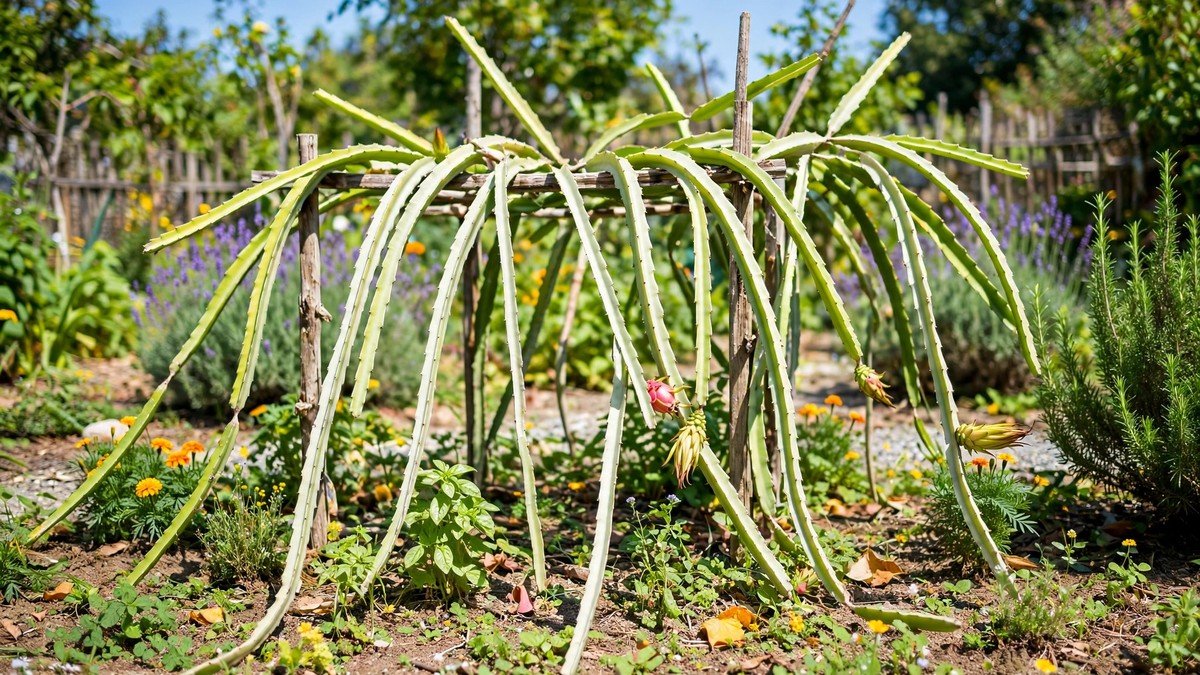
Dragon fruit is a climbing cactus, and in nature it grows up trees and rocks. A plant with nothing to climb on will often grow slowly and produce weak, sprawling stems, because it has no structure to support its weight. Give your plant a strong post, trellis or fence to climb, and tie the stems loosely to the support as they grow.
The support should be sturdy: a mature dragon fruit plant is heavy, and a flimsy stake will bend or break under its weight. A wooden post, a concrete post or a metal trellis will all work. Train the main stem up the support and let the branches hang over the top, because dragon fruit usually flowers and fruits on the stems that hang down. A plant that is properly supported grows faster, flowers more reliably, and is much easier to look after.
Reason 7: Cold Weather or Wrong Season
Cold is another answer to why is my dragon fruit plant not growing: dragon fruit stops growing when it gets cold. Growth slows below about 15 degrees Celsius and stops almost completely below 10 degrees, and a frost can damage or kill the stems outright. If your plant stopped growing in autumn and has not started again, it may simply be waiting for warm weather, and the right response is to protect it from frost and wait for spring.
Check the stems for cold damage: soft, dark or blackened patches after a cold night are frost damage, and those parts should be cut away with clean scissors so the damage does not spread.
Move a potted plant to a sheltered spot or indoors during cold snaps, and cover a plant in the ground with frost cloth on cold nights. Once warm weather returns and night temperatures stay above 15 degrees, a healthy plant should start growing again within a few weeks. Do not feed or repot a cold-stressed plant until it is growing again, because it cannot use the food or the new soil while it is dormant.

Reason 8: Pests or Disease You Cannot See
Pests and disease can stall a plant without any obvious marks on the stems. Root mealybugs, nematodes and fungal infections in the soil all damage the roots where you cannot see them, and the only sign above ground is a plant that stops growing and slowly declines. They are a hidden answer to why is my dragon fruit plant not growing.
If you have fixed the light, the pot, the soil, the water and the feeding, and the plant still does not grow, tip it out of its pot and look at the roots. White cottony clusters on the roots are root mealybugs, and they should be washed off and the plant repotted into fresh soil.
Soft, dark roots are rot. Tiny knots or swellings on the roots suggest nematodes, and the best response is fresh soil and a clean pot, because there is no easy spray for them. Above ground, check the joints and the undersides of the stems for scale insects and mealybugs, which drain the plant slowly and are easy to miss. Treat what you find, repot into fresh mix, and give the plant a few weeks to respond.
The Quick Checklist: Why Is My Dragon Fruit Plant Not Growing
Work through this list in order, and fix the first problem you find before moving on, because it usually answers why is my dragon fruit plant not growing. Most stalled plants have one main cause, not five.
- Light: is the plant getting 6 to 8 hours of direct sun a day? If not, move it.
- Pot: is the plant root-bound, or in a pot without drainage holes? If so, repot.
- Soil: does water drain freely, or does the soil stay wet for days? If it stays wet, repot into a freer mix.
- Roots: are the roots firm and pale, or soft and dark? If they are rotting, trim and repot.
- Water: are you watering only when the top soil is dry? Adjust the schedule.
- Food: have you fed the plant this growing season? If not, start with a half-strength feed.
- Support: does the plant have something strong to climb? If not, add a post or trellis.
- Temperature: is it warm enough to grow, above 15 degrees at night? If not, wait for spring and protect from frost.
- Pests: check the roots and the stem joints for mealybugs, scale and rot.
If you fix the problem and the plant still does not grow after a month of warm weather, go back to the start of the list and check again. The cause is usually the thing you assumed was fine.

Frequently Asked Questions
How long does it take for a dragon fruit plant to start growing again?
A plant that has had its real problem fixed usually shows new growth within two to four weeks in warm weather. A new cutting can take a month or more to root before it grows above ground. If nothing has changed after a month of warm weather, the cause has not been fixed yet, or there is a second problem.
Why is my dragon fruit plant growing thin stems?
Thin, pale, stretched stems almost always mean not enough light. The plant is reaching for the sun. Move it to a sunnier spot gradually, and the new growth should come in thicker and greener. Thin stems can also mean the plant is hungry, but light is the cause to check first.
Should I prune a dragon fruit plant that is not growing?
Do not prune a stalled plant hard. Pruning is for shaping a healthy, growing plant, not for fixing a stalled one. Remove only dead or damaged stems, fix the real cause, and let the plant grow. Once it is growing well again, you can prune it into shape.
Can I save a dragon fruit plant that has not grown for a year?
Yes, in most cases. Dragon fruit is tough, and a plant that is still firm and green is alive. Work through the checklist, fix the light, pot, soil and feeding, and give it a full warm season. A plant that is soft, blackened or completely dried out is much harder to save, and a fresh cutting may be the faster path.
Does dragon fruit grow in winter?
Dragon fruit grows very slowly or not at all in winter, especially when night temperatures drop below 15 degrees Celsius. That is normal. Protect the plant from frost, water it sparingly, do not feed it, and wait for spring. Growth should restart when warm weather returns.
Conclusion
If you are still asking why is my dragon fruit plant not growing, it is almost always missing one of the basics: enough light, room for its roots, free-draining soil, the right amount of water, regular feeding, something to climb, or warm weather. Work through the checklist in order, fix the first problem you find, and give the plant a few weeks of warm weather to respond.
Most stalled plants recover quickly once the real cause is fixed, and they often grow faster than before, because the fix removes the limit that was holding them back. Be patient with a new cutting, be honest about the light and the pot, and do not expect a plant to grow in conditions it is only surviving in. Give it sun, space, food and support, and it will grow.