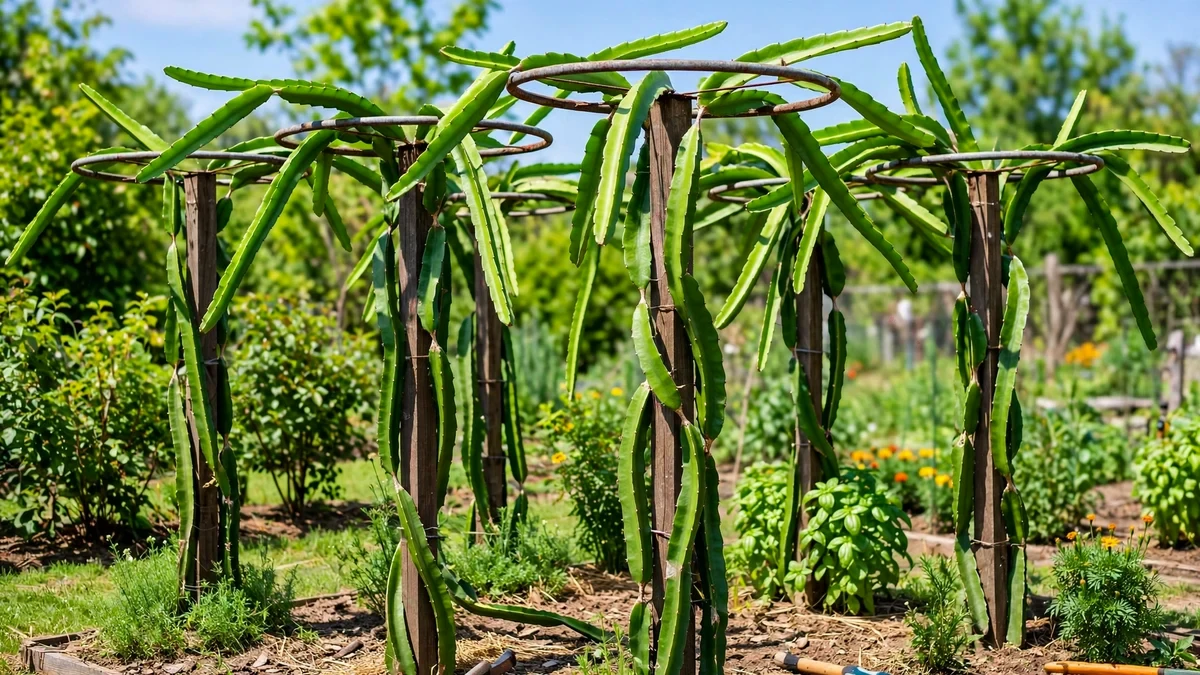
A trellis is not an optional extra. Dragon fruit is a climbing, vine-like cactus whose stems grow fast, spread wide, and become very heavy as the plant matures. Without a strong support, the stems sprawl across the ground, where they root where they touch, get damaged by mowers and foot traffic, stay damp, and fruit poorly. With the right support, the plant climbs to a manageable height, branches at the top, and hangs its fruiting stems down where you can see them, prune them, and pick the fruit.
Choosing a trellis is therefore one of the most important decisions in growing this plant, and it is best made before planting, because a support installed after the plant is established risks cutting its shallow roots and snapping stems that have already grown in the wrong direction. This guide compares the common dragon fruit trellis designs — the single post, the T-post, the pergola or arbour, the fence or wall, and the living support — and explains the materials, height, strength, and spacing that make each one work, so you can choose a design that suits your space, your budget, and your climate.
For how to plant beside a support, see how to plant dragon fruit in ground and how to grow dragon fruit in pots. For how to guide the plant up the support once it is built, see how to train dragon fruit on a trellis.
Table of Contents
- Why a Dragon Fruit Trellis Must Be Strong
- The Single-Post Trellis: The Classic Choice
- T-Posts, Pergolas and Arbours
- Fences, Walls and Living Supports
- Materials That Last Outdoors
- Choosing the Right Trellis for Your Space
- What to Avoid in a Dragon Fruit Trellis
- Frequently Asked Questions
Why a Dragon Fruit Trellis Must Be Strong
The first thing to understand about any trellis is the weight it must carry. A young plant looks light, but a mature plant is large and heavy. UF IFAS states that a strong trellis should be established that may withstand several hundred pounds of stem weight, and warns that a weak trellis may buckle under the weight of a mature pitaya plant. Stems can reach about 6 metres long, and a plant that is allowed to grow unchecked produces a dense mass of fleshy stems that catches wind like a sail. In a storm, that wind load adds to the weight, and a post that was adequate in calm weather can lean, snap, or pull out of the ground.
The Hong Kong AFCD describes two main cultivation methods, the trellis-climbing method and the post-climbing method, with the post method more commonly adopted because of lower production cost and higher land utilisation, and gives spacings of 2.5 by 2.5 metres for trellis climbing and 3.2 by 2.8 metres for post climbing. Those figures come from production orchards, but the principle applies in a home garden too: each plant needs its own strong support and its own space, and the support must be built for the mature plant, not the young one. A trellis also shapes how the plant fruits. For how to plant beside a support, see how to grow dragon fruit.
The Single-Post Trellis: The Classic Choice
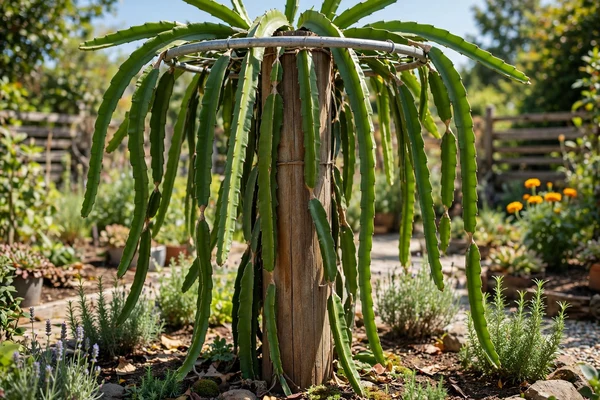
The single-post trellis is the most common trellis in home gardens, and for good reason: it is simple, strong, cheap to build, and easy to manage. It consists of one sturdy vertical post, usually 1.5 to 2 metres tall above the ground, with a strong frame at the top. UF IFAS describes a four- to six-inch diameter pressure-treated pole with a strong metal grid attached to the top, set 10 to 15 feet away from other plants and structures.
The top frame can be a round ring, a square grid, a cross, or a small wheel, and its job is to give the stems somewhere to branch and hang down. A ring about 60 to 90 centimetres across suits a single plant, while a larger grid suits several plants on one post.
The AFCD notes that three to four seedlings can be planted on each post, which is a production practice that gives a fuller canopy faster, though a single plant per post is easier to manage in a home garden and less likely to become overcrowded. To build a single-post trellis, set the post at least 60 centimetres into firm ground, deeper in loose or sandy soil, and pack the soil firmly around its base or set it in concrete.
T-Posts, Pergolas and Arbours

A T-post trellis is a variation on the single post, with a horizontal crossbar at the top forming a T shape. The crossbar, usually 60 to 120 centimetres wide, gives the stems a wider frame to branch over than a single post alone, and it suits a row of plants trained along the bar. Several T-posts in a line, joined by a top rail, form a simple trellis row that is easy to walk along, prune, and harvest from.
A pergola or arbour takes the same idea further: a series of posts joined by overhead beams creates a shaded walkway or a covered growing area, with dragon fruit stems trained over the top. This looks attractive and provides shade below, but it has practical drawbacks. The canopy overhead is hard to reach for pruning and harvesting, fallen stems and fruit land on the structure, and the weight of several mature plants on one frame is very large, so the pergola must be built like a building, not like a garden decoration, with deep footings and strong joints. A pergola also shades the ground below it, which may suit a seating area but will not suit other sun-loving plants underneath.
Fences, Walls and Living Supports
A fence or a wall can serve as a dragon fruit trellis, and it is tempting because the structure is already there. A strong fence, a brick wall, or a concrete block wall gives the plant a large surface to climb, and the aerial roots that grow from the stems will grip rough surfaces readily. There are real drawbacks, though. A plant on a fence is hard to prune from the far side, fruit that ripens on the neighbour’s side of the fence is hard to reach, and the plant’s weight and moisture can damage a wooden fence over time.
Planting against a house wall is not recommended: UF IFAS advises against planting beside homes and buildings, because a mature plant can press stems against gutters, shade windows, and make maintenance difficult, and the plant needs air circulation on all sides to stay healthy. A freestanding trellis panel a short distance from a wall is a better compromise than the wall itself. Living supports are another traditional option. In its native range, dragon fruit climbs trees and rocks, and UF IFAS notes that individual plants growing on a short tree or on a pile of rocks or blocks could be used as supports for a few plants.
Materials That Last Outdoors

The material of a dragon fruit trellis decides how long it lasts and how much maintenance it needs. Treated timber is the most common choice for home gardens: it is easy to cut and fix, looks natural, and is strong enough when the post is thick enough. Use pressure-treated timber rated for ground contact, with a diameter of at least 10 to 15 centimetres for the main post, and check the treatment rating rather than assuming any outdoor timber will last. Untreated softwood rots at ground level within a season or two and should be avoided.
Hardwood posts last longer but cost more and are harder to work with. Galvanised steel is stronger than timber for its size, lasts for decades, and does not rot, but it is more expensive, needs cutting and welding or bolting, and can get hot in strong sun where stems touch it. A steel post with a steel top frame is a good choice for a permanent planting, especially in windy areas. Concrete posts are very strong and rot-proof, and they are common in production orchards, but they are heavy to transport and install, and fixing a top frame to concrete needs brackets and bolts.
Choosing the Right Trellis for Your Space
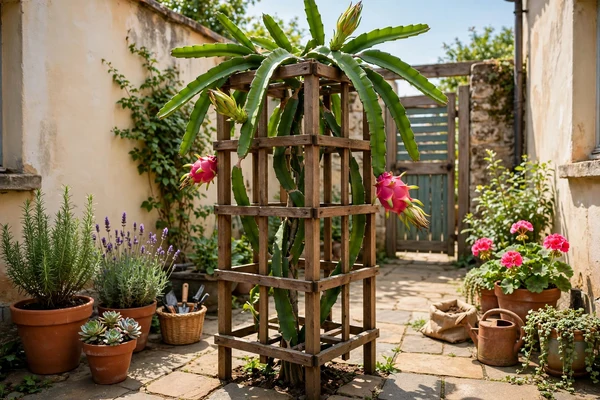
Choosing a dragon fruit trellis starts with measuring your space and being honest about how many plants you will actually manage. A single-post trellis suits a small garden, a courtyard, or a large pot on a patio, because it takes up little ground and gives one plant a clear, manageable canopy. A row of T-posts suits a larger garden or a small orchard, because it holds several plants in a line that is easy to walk along and harvest from, and the spacing between posts can be set to match the canopy size.
A pergola suits a garden where the trellis is also a feature, and where you are willing to build it strongly and accept that harvesting overhead is harder. A fence panel suits a narrow garden where ground space is scarce, provided you can reach both sides. Climate matters too. In windy areas, a low, sturdy post with a compact canopy is safer than a tall pergola that catches the wind. In hot, sunny areas, a trellis that allows some air movement around the stems reduces sunburn and disease, while in cold areas a trellis that can be covered with frost cloth on cold nights is valuable.
Budget matters as well: a single treated-timber post with a metal ring is one of the cheapest strong options, while a steel pergola is one of the most expensive. Think about the variety too: the guide to the best dragon fruit varieties can help you match the plant to the support, and if you grow in a pot, the trellis must be anchored to the pot, as explained in the guide on how to grow dragon fruit in pots.
What to Avoid in a Dragon Fruit Trellis
Some support mistakes are easy to avoid once you know them. The first is building too weak: a thin post, a light frame, or a post set only a few centimetres into the ground will lean or fall as the plant gains weight. Build for several hundred pounds, set the post deep, and use bolts rather than nails alone. The second is using bare wire, which cuts into thickening stems; cover any wire with plastic hose, or use wide timber or metal instead. The third is building too tall. A trellis that needs a tall ladder for every harvest is a trellis that will not be pruned or harvested properly, and the canopy will become a dense tangle.
Keep the top within easy reach. The fourth is placing the trellis too close to a house, a fence, or another plant, so the canopy has nowhere to spread and the plant competes for light and air. Give each trellis its own clear space. The fifth is installing the trellis after planting, which risks cutting shallow roots and snapping stems; install it first, before the plant goes in. Pruning and support go together, and the guides on when to prune dragon fruit and how to support heavy dragon fruit stems explain that work, while the guides on how to harvest dragon fruit and harvest dragon fruit from a trellis cover the harvest stage.
Frequently Asked Questions
How tall should a dragon fruit trellis be?
A post 1.5 to 1.8 metres tall above the ground suits most home gardens, because the top frame is within easy reach for pruning and harvesting. Taller trellises put fruit out of reach and make the canopy harder to manage, while shorter trellises leave the canopy brushing the ground.
How strong does a dragon fruit trellis need to be?
Very strong. UF IFAS states that a trellis should withstand several hundred pounds of stem weight, and a weak trellis may buckle under a mature plant. Use a thick post set deep in the ground or in concrete, a firmly bolted top frame, and durable materials such as treated timber or galvanised steel.
Can I use a fence as a dragon fruit trellis?
A strong fence can work, but it has drawbacks: the far side is hard to reach, fruit may ripen out of reach, and the plant’s weight and moisture can damage a wooden fence. A freestanding post trellis a short distance from the fence is usually easier to manage, and planting against a house wall is not recommended.
How many dragon fruit plants can go on one trellis?
One plant per single-post trellis is easiest to manage in a home garden. The AFCD notes that three to four seedlings can be planted on each post in production orchards, but that gives a fuller canopy faster and needs more pruning to avoid overcrowding, so start with one plant unless you are confident about regular pruning.
A dragon fruit trellis is a long-term structure, and the time spent choosing and building it well pays off for years. Pick a design that suits your space, build it strong enough for a mature plant, set it deep, use materials that last outdoors, and keep the top within easy reach. The plant will do the rest, climbing its post, branching over the frame, and hanging its fruiting stems down where you can reach them. Plan the support with the seasonal work in mind, using the dragon fruit plant care calendar to schedule pruning, tying, and inspection.
3 thoughts on “Dragon Fruit Trellis Ideas: Choosing the Right Support”