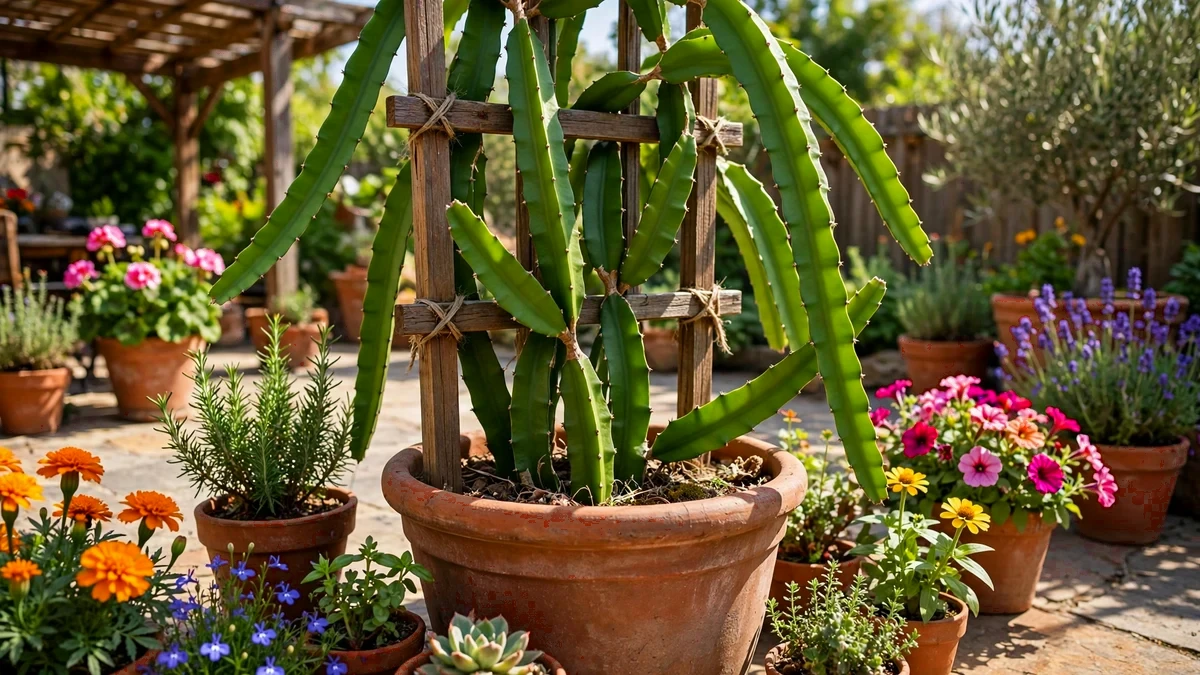
How to Grow Dragon Fruit in Pots and Containers
To grow dragon fruit in pots is one of the most practical ways to enjoy this climbing cactus when garden space is limited, the soil drains badly, or winters turn cold. A container lets you control the soil, move the plant to the sunniest spot, and bring it under cover when frost threatens. It also lets you grow dragon fruit on a balcony, a patio, a rooftop, or a small courtyard where planting in the ground is simply not possible.
When you grow dragon fruit in pots well, a single plant can climb a sturdy post, branch at the top, and flower and fruit over several seasons. When you grow dragon fruit in pots badly — in a pot that is too small, with soil that holds water, or with a support that topples — the plant stays stunted, its roots rot, or the whole arrangement falls over in the first strong wind.
This guide explains how to grow dragon fruit in pots: choose the pot, mix the soil, set up support, plant, water, feed, and look after a potted dragon fruit plant through its first seasons, so the container works for the plant instead of against it. If you have open garden space and warm winters, planting in the ground may suit you better — see how to plant dragon fruit in ground. For the wider first-year picture, see how to grow dragon fruit.
Table of Contents
- Why Grow Dragon Fruit in Pots?
- Choosing the Right Pot
- A Soil Mix That Drains Freely
- Support: The Post Goes In First
- Planting in the Pot Step by Step
- Watering, Feeding and Sunlight for Potted Plants
- Repotting, Moving and Winter Care
- Common Mistakes with Potted Dragon Fruit
- Frequently Asked Questions
Why Grow Dragon Fruit in Pots?
The main reason to grow dragon fruit in pots is control. In a pot, you choose the soil exactly, so drainage problems in the garden do not matter. You can move the plant to follow the sun through the seasons, shift it out of a cold wind, or bring it into a greenhouse, a covered porch, or a bright indoor spot when frost is forecast.
That flexibility matters because dragon fruit prefers warm, frost-free conditions: UF IFAS notes optimum growth temperatures of roughly 18°C to 25°C and damage from long exposure below freezing, while the Hong Kong AFCD warns that temperatures below 5°C cause serious damage.
A potted plant can be sheltered in a way a plant in the ground cannot. Pots also suit renters and small-space gardeners, because the plant can move house with you, and they suit
anyone whose garden soil is heavy clay, shallow rock, or prone to flooding. A container also makes it easy to start with a cutting: UF IFAS notes that cuttings take about four to six months to develop a good root system in pots before they are ready for planting out, so a pot is the natural first home for a young plant in any case.
The trade-off is that a potted plant depends on you more completely than a plant in the ground. Choose a compact variety where possible; the guide to the best dragon fruit varieties can help, and the best climate for dragon fruit explains the warmth it needs.
Choosing the Right Pot

When you grow dragon fruit in pots, the pot is not a minor detail; it is the plant’s whole root zone for years, so start large. A mature dragon fruit plant needs a container of at least 40 to 60 litres, and many growers use 75-litre pots or half wine barrels for a single plant that will stay in the pot long term.
A small 10- or 20-litre pot may suit a young cutting for its first months, but the plant will outgrow it quickly, dry out constantly, and need repotting at an awkward stage. Starting in the final large pot avoids disturbing the roots later and gives the plant room to build the root system it needs to support a heavy canopy.
The pot must have drainage holes, and large ones: at least four holes of 2 centimetres or more across the base, plus holes low on the sides if possible. A pot with no drainage, or with a single small hole that blocks easily, will hold water and rot the roots. Raise the pot slightly off the ground on pot feet, bricks, or a wheeled plant caddy so water can escape freely and air can reach the base. Material matters as well. Terracotta is attractive, breathable, and heavy, which helps stability, but it dries out faster and can crack in a hard frost.
A Soil Mix That Drains Freely

Soil is where potted dragon fruit most often fails, because ordinary garden soil in a pot compacts, holds water, and suffocates the shallow roots. Dragon fruit roots spread widely in the top few centimetres of soil and need air as well as moisture, and the AFCD notes that roots cannot stand immersion in water and may be damaged if immersed for 24 hours. In a pot there is no deeper soil for excess water to escape into, so the mix itself must drain freely.
A good container mix is light, coarse, and rich in organic matter. A practical recipe is roughly equal parts good-quality potting compost, coarse perlite or pumice, and well-decomposed compost or aged bark, with a handful of coarse sand or grit mixed in. The perlite or pumice creates air pockets that do not collapse when wet, the compost feeds the soil life and holds some moisture, and the bark or grit keeps the mix open.
Avoid fine, dusty potting mixes that set like concrete when dry and turn to slurry when wet, and avoid using garden soil on its own in a pot. For more on soil, drainage, and pH, see the guide to the best soil for dragon fruit.
Support: The Post Goes In First
A dragon fruit plant in a pot needs the same strong support as a plant in the ground, and the support is harder to provide in a container because there is no deep soil to anchor a post. Install the support before you plant, and anchor it to the pot itself, not just to the soil in the pot.
The classic design is a single sturdy post, about 1.5 to 1.8 metres tall above the soil, fixed through the base of the pot or bolted to a heavy frame, with a strong ring, cross, or square grid at the top for the stems to branch over. A post that is simply pushed into the potting mix will lean and eventually fall as the canopy grows heavy, because a mature plant may weigh several hundred pounds and the mix offers little resistance.
Better options include a post that passes through a hole in the base of the pot and is held by a crosspiece underneath, a metal post welded or bolted to a flat steel base that sits under the pot, or a wooden post screwed to the outside of a half barrel. For a full comparison of designs, see dragon fruit trellis ideas, and for how to guide the stem up
the support, see how to train dragon fruit on a trellis.
Planting in the Pot Step by Step
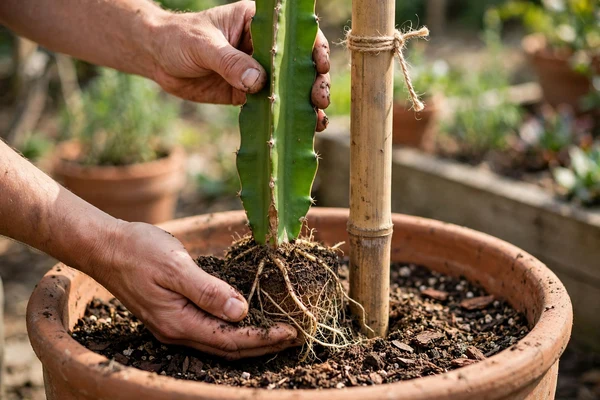
Start with a rooted plant or a well-rooted cutting, because a fresh, unrooted cutting in a large pot is slow to establish and easy to overwater. The propagation guide on how to propagate dragon fruit from cuttings explains how to root cuttings first. Fill the pot with your soil mix to about 10 centimetres below the rim, leaving room for watering and mulch, and set the support post in place and check that it stands straight and firm before you add the plant.
Water the plant in its nursery pot an hour or two before you start so the root ball holds together. Tip it gently out of the pot, keeping the root ball intact, and do not pull the plant by its stem.
Place the root ball in the centre of the large pot, at the same depth it sat in its nursery pot, with the top of the root ball level with the soil surface and the stem a few centimetres from the post. Fill around the root ball with mix, pressing it down lightly with your hands, not your feet, so the soil is firm enough to hold the plant upright but still loose enough for air and water to pass.
Watering, Feeding and Sunlight for Potted Plants
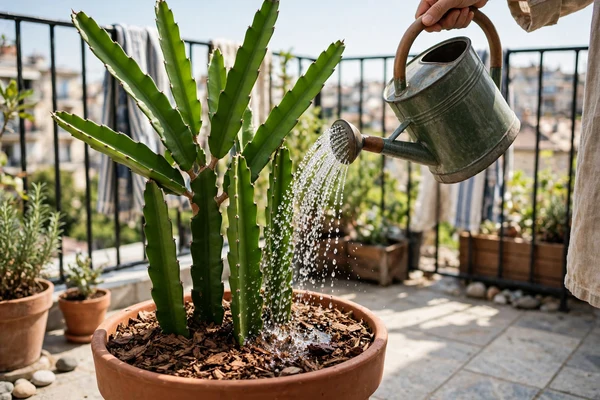
Watering is the daily discipline when you grow dragon fruit in pots, because a pot holds far less water than garden soil and dries out much faster in sun and wind. In warm, dry weather a large pot may need watering every two to three days, and a small pot may need water daily, while in cool or rainy weather it may need little or no water for a week.
The rule is to check the soil, not the calendar: push a finger a few centimetres into the mix, and water only when it feels dry at that depth. Water thoroughly when you do water, until it runs from the drainage holes, so the whole root zone is moistened and salts are flushed out, then let the pot drain and do not water again until the surface has dried slightly.
Shallow, frequent sprinkles encourage roots to stay near the surface and leave the lower mix dry. Although dragon fruit is a cactus and tolerates dry periods, it has a fairly high water requirement when growing, and drought during flowering and fruiting can reduce production, while excessive moisture encourages disease. The guide on how often to water dragon fruit explains how to adjust for weather, soil, and season.
Feed a potted plant more regularly than a plant in the ground, because nutrients wash out of a pot with every watering. The guide to the best fertilizer for dragon fruit covers nutrient needs in detail.
Repotting, Moving and Winter Care
A dragon fruit plant will eventually outgrow its pot, but repotting a large, climbing plant is awkward, so plan to avoid it as much as possible by starting in a large pot. If the plant does need a bigger pot, repot in the warm season when it is growing actively, and do it before the canopy becomes too heavy to handle safely.
Water the plant the day before, lay the pot on its side, slide the root ball out with help, and move it into the new pot with fresh mix at the same depth, keeping the support post in place if you can. If the support is fixed to the old pot, you may need to build a new support in the new pot first, or transfer the whole post-and-plant assembly together.
Prune back some of the longest stems before you move a large plant, both to reduce weight and to make it easier to handle without snapping stems. Moving a potted plant is one of its great advantages: use a wheeled caddy, a trolley, or two people to lift it, and never drag a heavy pot across a patio, which can crack the pot and damage the roots. See the guide on how to protect dragon fruit from cold for more winter steps, and use the dragon fruit plant care calendar to plan feeding and repotting.
Common Mistakes with Potted Dragon Fruit
The most common mistake when you grow dragon fruit in pots is choosing a pot that is too small. A small pot dries out daily in summer, restricts the roots, and topples easily once the canopy grows, so start with at least 40 to 60 litres and accept that the pot will look oversized for the young plant. The second mistake is soil that holds water: ordinary garden soil, fine potting mix with no perlite, or a pot with blocked drainage holes will rot the roots. Use a coarse, free-draining mix and check the holes every season.
The third is a weak support, or no support at all. A thin cane may hold a young stem, but it will not hold a mature plant, and a post that is only pushed into the mix will lean and fall. Anchor the support to the pot or to a heavy base before you plant. The fourth is overwatering, especially in winter.
Frequently Asked Questions
What size pot do I need to grow dragon fruit in pots?
Use at least a 40 to 60 litre pot for a plant that will stay in the container long term, and larger if you have space. A small pot dries out too fast, restricts roots, and topples once the canopy grows heavy.
How often should I water dragon fruit in pots?
Check the soil, not the calendar. Push a finger a few centimetres into the mix and water thoroughly only when it feels dry at that depth, until water runs from the drainage holes. In warm, dry weather that may be every two to three days; in cool or rainy weather, much less often.
Can dragon fruit fruit in a pot?
Yes, a healthy potted plant can flower and fruit, provided it gets full sun, a strong support, regular water and feeding in the growing season, and enough time to mature. A cutting-grown plant may fruit within its first year or two under good conditions, but timing varies with variety, climate, and care, and some varieties set fruit better with cross-pollination from a different variety.
Do I need to bring potted dragon fruit indoors in winter?
In frost-free climates, no, but move the pot to the warmest, most sheltered spot. Where frost is possible, move it under cover or into a greenhouse or bright indoor spot on cold nights, cover the canopy with frost cloth, and water much less until growth resumes in spring.
To grow dragon fruit in pots well is to give a climbing cactus a home that suits it: a large pot with drainage, a coarse soil mix, a strong anchored support, full sun, and steady water and feeding in the growing season. Choose the pot and support for the mature plant, not the young one, and the plant will reward you by climbing, branching, and in time flowering at night and setting fruit, all from a container on a patio or balcony.
2 thoughts on “How to Grow Dragon Fruit in Pots and Containers”