
Dragon fruit is a fast-growing plant that can put on metres of new stem in a season and produce a heavy crop of fruit, and all that growth has to come from somewhere. The plant needs a steady supply of nutrients, but it is easy to get the balance wrong: too little and the stems go pale and thin, too much and you get soft, leafy growth that splits, sunburns, and flowers poorly.
Choosing the best fertilizer for dragon fruit is less about finding a magic product and more about giving the right nutrients, in the right amounts, at the right times of year. This guide explains what the plant needs, which formulas work, how much to apply at each age, and which mistakes to avoid.
Table of Contents
- What Dragon Fruit Plants Actually Need
- The Best Fertilizer for Dragon Fruit: Balanced Formulas That Work
- How Much Fertilizer to Apply and How Often
- Organic Options: Compost, Manure and Natural Feeds
- Minor Elements and Iron: The Hidden Hunger
- Fertilizing Through the Seasons
- Mistakes That Harm More Than They Help
- Frequently Asked Questions
- Related Guides
What Dragon Fruit Plants Actually Need
Like all plants, dragon fruit needs the three major nutrients: nitrogen for stem and leaf growth, phosphorus for roots and flowering, and potassium for fruit quality and disease resistance. It also needs magnesium, calcium, and a range of minor elements, including iron, zinc, manganese, and boron. Because it grows fast and fruits heavily, it uses these nutrients quickly, and a plant in poor soil will show it within a season: pale stems, thin growth, few flowers, and small fruit.
The plant’s needs change with its age and with the season. A young plant needs enough nitrogen to build stems and climb the trellis. A mature plant in flower needs more phosphorus and potassium to set and size its fruit. A plant in poor, sandy soil needs more feeding than one in rich, compost-heavy soil, because sandy soil holds few nutrients. A plant in alkaline, chalky soil may have plenty of nutrients in the soil but be unable to take up iron, which is a different problem that fertiliser alone will not fix.
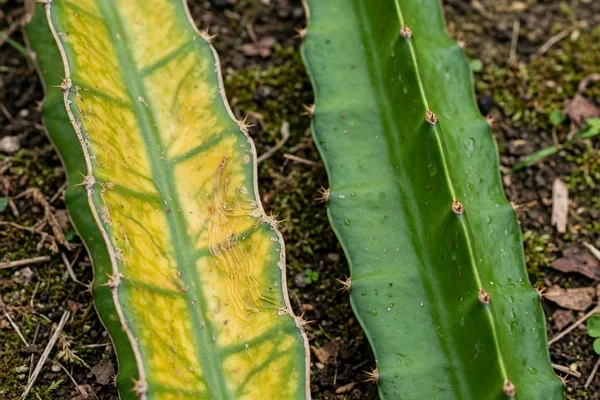
Before you choose the best fertilizer for dragon fruit, look at your plant and your soil. Pale, thin stems suggest hunger. Dark green, soft, floppy growth suggests too much nitrogen. Yellowing between the veins suggests an iron or magnesium shortage. The plant’s appearance is the best guide to what it needs, and it is more reliable than any fixed schedule. That is the first step in choosing the best fertilizer for dragon fruit for your own garden.
The Best Fertilizer for Dragon Fruit: Balanced Formulas That Work
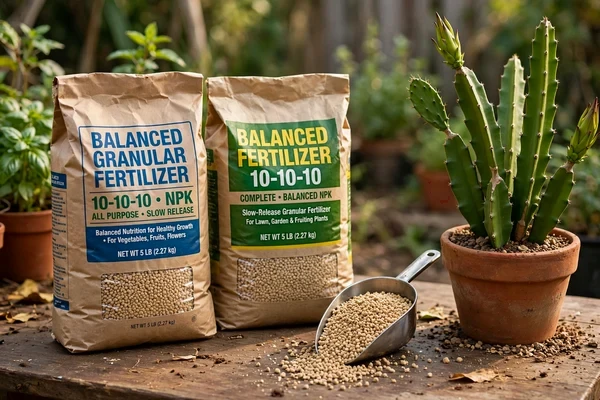
For most home growers, a balanced granular fertiliser is the simplest and most reliable choice. UF IFAS recommends formulas such as 6-6-6, 8-3-9, or 8-4-12, the last of these being a palm special, with 2 to 3 percent magnesium, or a similar formula. The numbers on the bag are the percentages of nitrogen, phosphorus, and potassium, so 6-6-6 means six percent of each.
A balanced formula like this feeds the whole plant evenly, without pushing soft, leafy growth the way a high-nitrogen lawn fertiliser would. If you can find a formula that also contains magnesium and minor elements, so much the better, because dragon fruit in poor soils often runs short of these.
Slow-release granular fertiliser is a good option for busy growers, because it feeds the plant gradually over two or three months and reduces the risk of burning the roots with a sudden dose. Liquid fertiliser works faster and is useful for a quick boost, for example when a plant looks pale in the middle of the growing season, but it washes out of sandy soil quickly and needs to be applied more often.
Whichever type you choose, buy a product meant for fruiting plants or palms rather than one meant for lawns, because lawn fertilisers are high in nitrogen and low in potassium, which is the opposite of what a fruiting cactus needs. The best fertilizer for dragon fruit is a balanced one, applied little and often, not a strong one applied rarely.
How Much Fertilizer to Apply and How Often
The amount of the best fertilizer for dragon fruit depends on the age of the plant, and UF IFAS gives a clear schedule that works well as a starting point. Wait about a month after planting, or until the plant begins to grow, before you start fertilising.
In the first year, feed frequently, every two months, with light applications of about 0.25 pounds (118 grams) per plant. In the second and third years, gradually increase the amount to about 0.3 to 0.4 pounds (136 to 182 grams) per plant every two months. From the fourth year onwards, apply about 0.5 to 0.75 pounds (227 to 341 grams) per plant, in three to four applications per year. Your local conditions may call for adjustment, but the pattern is the same everywhere: small, frequent feeds for young plants, and larger, less frequent feeds for mature ones.
Spread the fertiliser evenly around the base of the plant, in a ring starting a few centimetres from the stem and extending out to the edge of the root zone, and water it in well.
Never pile fertiliser against the stem, because it can burn the tissue and hold moisture against it. Do not fertilise a dry plant: water first, then feed, so the roots can take up the nutrients without being scorched. If you are using a liquid feed, apply it to damp soil in the morning, not in the heat of the day.
Keep a simple record of what you applied and when, because it is easy to forget, and a plant that is fed twice by accident is worse off than one that is fed a week late. Getting the amount right matters as much as choosing the best fertilizer for dragon fruit in the first place.
Organic Options: Compost, Manure and Natural Feeds
Compost and well-rotted manure are the backbone of organic feeding, and they do more than supply nutrients: they improve the soil, hold moisture, and feed the soil life that helps the plant take up minerals.
UF IFAS recommends about 4 pounds (1.2 kilograms) of well-decomposed manure or compost around the base of the plant in the first year, increasing to about 6 pounds (2.7 kilograms) per plant in the second and third years, and about 5 pounds (2.2 kilograms) per application, twice per year, from the fourth year onwards. Spread it in a ring around the base, keeping it a few centimetres away from the stem, and water it in.
Other organic options include seaweed extract, which supplies minor elements and growth hormones, and fish emulsion, which is a gentle source of nitrogen. Both are useful as occasional supplements, but they are not a complete feed on their own.
Wood ash supplies potassium and raises soil pH, so it can help in acidic soils but should be used sparingly and never on alkaline soil. Banana skins, eggshells, and coffee grounds are popular home remedies, but their nutrient content is low and variable, so treat them as soil improvers rather than as fertiliser. The best organic approach is a base of compost and manure, topped up with the best fertilizer for dragon fruit as a balanced mineral fertiliser when the plant shows it needs more.

Minor Elements and Iron: The Hidden Hunger
The most common nutrient problem in dragon fruit is not a shortage of nitrogen, phosphorus, or potassium. It is a shortage of minor elements, especially iron, and it is most common in alkaline or chalky soils. The sign is distinctive: the stems turn yellow between the veins while the veins themselves stay green, a pattern called interveinal chlorosis. The plant may still grow, but slowly, and flowering drops. The cause is usually not that the soil lacks iron, but that the high pH makes the iron unavailable to the roots.
UF IFAS recommends four to six minor element sprays from late spring to early autumn, applied to the stems, and a soil drench of chelated iron for plants in high-pH soils, about 0.25 to 0.5 ounces (7 to 15 grams) per plant in the early years, increasing gradually as the plant grows. In neutral and low-pH soils, small amounts of ferrous sulfate at the base of the plant can help instead.
A chelated iron product is worth the cost, because ordinary iron sulfate locks up quickly in alkaline soil and does little good. If your stems are yellowing between the veins, read the guide on why dragon fruit stems turn yellow, which explains how to tell an iron shortage from other causes, and treat the soil pH as well as the symptom: adding compost and organic matter helps lower pH gradually and makes minor elements more available over time.
Fertilizing Through the Seasons
Fertilising with the best fertilizer for dragon fruit follows the seasons. In spring, as new growth starts, give the plant a balanced feed and a layer of compost to support the flush of stems. Through late spring and summer, while the plant is flowering and fruiting, feed lightly and regularly, because this is when the plant uses the most nutrients. The minor element sprays belong in this period, from late spring to early autumn, when the plant is actively growing and can take them up through the stems.
Water the fertiliser in well, and do not feed during a heatwave, when the plant is stressed and the roots can burn.
In autumn, after the harvest, give a lighter feed and a layer of compost to help the plant recover, but do not push soft new growth late in the season, because soft growth is the first to be damaged by cold. In winter, stop fertilising almost entirely. The plant needs a dry rest to flower well, and feeding in winter encourages soft growth at the wrong time. Resume feeding in spring when you see new growth.
A simple seasonal rhythm for the best fertilizer for dragon fruit, feed in spring and summer, light feed after harvest, rest in winter, keeps the plant in step with its own growth cycle, and it is far more effective than feeding the same amount every month of the year.

Mistakes That Harm More Than They Help
The most common fertiliser mistake is using too much. A heavy dose of fertiliser, especially a high-nitrogen one, burns the roots, pushes soft growth that sunburns easily, and can delay flowering. If the stem tips go brown or the plant wilts after feeding, you have probably overfed: water deeply to wash the excess away from the roots, and wait before feeding again. The second mistake is feeding a dry plant, which scorches the roots. Always water first, then feed.
The third mistake is piling fertiliser or fresh manure against the stem. Fresh manure is too strong and too wet for direct contact, and it can burn the stem and encourage rot. Use only well-rotted manure, and keep it away from the stem. The fourth mistake is fertilising in winter, when the plant should be resting. The fifth is relying on a single product, such as a lawn fertiliser, that gives the plant too much nitrogen and too little potassium. A balanced feed, applied little and often, with compost as the base, is safer and more effective than any single heavy dose.
Frequently Asked Questions
What is the best fertilizer for dragon fruit plants?
A balanced granular fertiliser such as 6-6-6, 8-3-9, or 8-4-12 with 2 to 3 percent magnesium is a good choice for most home growers, combined with compost or well-rotted manure. Feed little and often, and add minor element sprays through the growing season, especially if your soil is alkaline.
How often should I fertilize dragon fruit?
Young plants benefit from the best fertilizer for dragon fruit as a light feed every two months in the growing season. Mature plants need three to four feeds per year. Reduce feeding after harvest and stop almost entirely in winter, when the plant needs a dry rest to flower well.
Can I use only compost and no chemical fertilizer?
You can, if your soil is rich and you apply plenty of compost. But in poor or sandy soil, compost alone may not supply enough nutrients for heavy fruiting, and a balanced mineral fertiliser as a supplement will improve growth and yield. Many growers use both.
Why are my dragon fruit stems yellow even though I fertilize?
Yellowing between the veins is often an iron shortage caused by alkaline soil, not a lack of fertiliser. The iron is in the soil but the plant cannot take it up. A chelated iron drench and minor element sprays help, and adding compost gradually improves the soil.
Related Guides
- How Often To Water Dragon Fruit
- Best Soil For Dragon Fruit
- When To Prune Dragon Fruit
- Dragon Fruit Stems Turning Yellow
- Dragon Fruit Plant Not Flowering
- Dragon Fruit Plant Care
- What To Do After Harvesting Dragon Fruit
DragonFruitGrow.online is an independent gardening information website and is not affiliated with any nursery, fruit brand, or agricultural supplier. Growing conditions vary by cultivar, climate, soil, and plant age, so treat this guide as general information and adjust the advice to your own garden.