
A dragon fruit plant not flowering is one of the most frustrating problems a home grower can face, because the plant itself often looks perfectly healthy: green stems, vigorous growth, new shoots everywhere — and not a single flower bud.
The good news is that a plant in that state is rarely sick, and the cause is usually one of a small set of conditions that can be corrected: the plant is too young, it is short of light, the canopy is too crowded, the feeding is unbalanced, or the season and watering pattern have not given it the dry rest it needs to trigger buds.
This guide works through those causes in the order you should check them, explains what the plant needs at each stage, and gives you a simple checklist to follow before the next flowering season. Flowering depends on cultivar, climate, soil and plant age, so no two gardens will see buds in exactly the same month.
Table of Contents
- Why Is My Dragon Fruit Plant Not Flowering? Check Age First
- Sunlight: The Flowering Switch
- Pruning and Canopy Shape
- Feeding: Too Much Nitrogen, Too Little Support
- Water, Season and Temperature
- A Checklist for the Next Flowering Season
- Frequently Asked Questions
Why Is My Dragon Fruit Plant Not Flowering? Check Age First
The most common reason for a dragon fruit plant not flowering is simply that it is too young, and this is the first thing to check before changing anything else. How long a plant takes depends on how it was started. Plants grown from stem cuttings are the fastest: the University of Florida IFAS Extension notes that many produce fruit in six to nine months after planting, provided they are healthy and well grown, while longer cuttings reach the trellis sooner and may flower earlier than short ones.
Plants grown from seed are far slower, taking up to seven years to produce fruit, and seed-grown plants may also differ from the parent in growth habit and fruit quality. If your plant came from seed and is only two or three years old, a lack of flowers is normal, not a problem to fix.
Age is not only about years; it is also about size and structure. A cutting must first grow up its support, reach the top of the trellis, and branch out into a canopy before it is ready to flower in earnest. A plant that is still a single stem climbing a post has not yet built the mature, branching wood that carries most flowers.
The variety matters too: some cultivars are naturally slower to mature than others, and a plant grown from a cutting of a slow cultivar will take longer than one from a vigorous, early-flowering type. If a dragon fruit plant not flowering has not yet filled the top of its trellis, give it another season of good growth before worrying about flowers.
Sunlight: The Flowering Switch
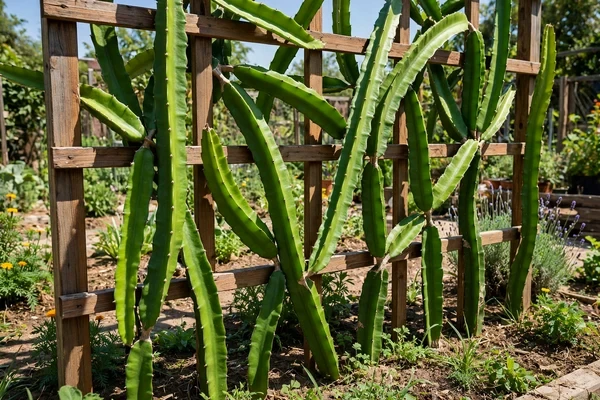
If the plant is old enough and still has no flowers, light is the next thing to check, and it is the cause most often found in home gardens. Dragon fruit is a long-day plant, which means longer daylight periods are required for flowering and fruiting, and the University of Florida IFAS Extension recommends full or almost full sun for the best growth and fruit production.
A plant growing in the shade of a wall, a tree, or a neighbouring building may grow long, thin, pale stems as it reaches for light, but it will rarely flower, because flower buds form on mature stems that have received enough direct sun. Even partial shade can delay flowering, and a dragon fruit plant not flowering in deep shade is not sick; it is simply short of the light that triggers buds.
Check how many hours of direct sun the plant actually receives, rather than guessing. Six or more hours of direct sun is a reasonable target for flowering, and the sunniest spot in the garden is usually the right one, provided the plant is protected from the fiercest afternoon heat in very hot climates. A potted plant can be moved to a sunnier position, but move it gradually over a week or two, since a sudden move into strong sun can scorch stems that grew in shade.
For a dragon fruit plant not flowering in deep shade in the ground, the only real fix is to remove the source of shade or to move the plant, and neither is quick — but a plant that has flowered before and then stopped after a tree grew over it is telling you exactly what changed. Our guide to dragon fruit sunlight requirements explains light needs and shade protection in more detail.
Pruning and Canopy Shape

A dragon fruit plant not flowering despite plenty of sun may be suffering from its own growth: a dense, unpruned canopy. Dragon fruit grows fast, and without pruning it becomes a tangled mass of stems that shade each other, so the inner stems never receive enough light to form flower buds.
The UF IFAS guide recommends production pruning one to three times a year, removing damaged, diseased and dead stems, stems that reach the soil, and stems that crowd the canopy, and it notes that pruning induces flowering as well as branching. In practice, the most productive stems are the mature, hanging branches at the top of the trellis, which receive full sun and have had time to ripen, while the shaded stems in the middle of a tangle rarely flower at all.
The aim is an open canopy, not a small plant: keep the strongest stems, tie them to the trellis so they are spaced apart, and remove the weak, crossing and inward-growing stems that block light and air. Tipping the main stem once it reaches the top of the trellis encourages the side branches that carry flowers.
Prune soon after harvest, or in the dormant period before the growing season, and remove all pruned stems from the area rather than leaving them under the plant. A heavily pruned dragon fruit plant not flowering may take a season to rebuild its canopy, so do not expect flowers the week after a hard prune. Our guide to when to prune dragon fruit explains timing and technique in more detail.
Feeding: Too Much Nitrogen, Too Little Support
Feeding is a quieter cause of a dragon fruit plant not flowering, but it is a real one, and it usually works in one direction: too much nitrogen. A plant fed heavily with a high-nitrogen fertiliser, or with large amounts of fresh manure, will often respond with lush, soft, green growth and very few flowers, because nitrogen pushes leafy stem growth at the expense of flowering. This is most common where a plant is fed the same rich fertiliser all year round. The stems look vigorous, which makes the problem confusing, but the energy is going into new stems rather than buds.
The correction is to feed for flowering rather than for growth. The UF IFAS guide recommends light, frequent applications of a balanced fertiliser in the first year, increasing gradually as the plant matures, with well-decomposed manure or compost around the base but not touching the stem. As the plant approaches flowering age, a fertiliser with relatively more potassium and phosphorus than nitrogen suits flowering better than a nitrogen-heavy feed, and minor element sprays during the warm season help in soils where trace elements are short.
Do not try to force flowers with a heavy dose of any fertiliser: over-feeding can burn roots, and a stressed plant will not flower well. If a dragon fruit plant not flowering is in a pot, check whether it has outgrown its container, since a root-bound plant may also struggle to flower, and our guide to the best fertilizer for dragon fruit explains feeding choices and schedules in more detail.
Water, Season and Temperature
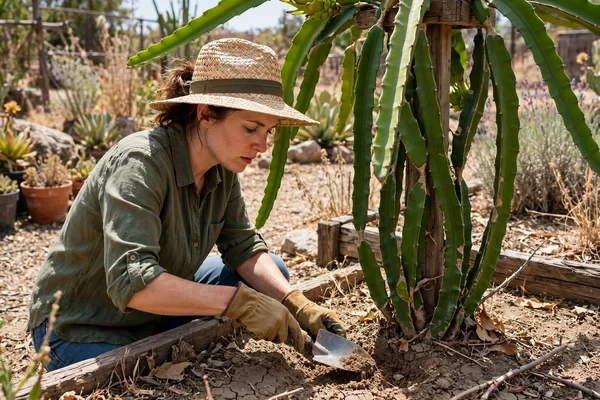
Watering and season work together to trigger flowering, and a dragon fruit plant not flowering is often one that was watered generously all year. The UF IFAS guide is clear that a dry period in winter and early spring is required for abundant bloom induction, and that once plants flower, drought may reduce production, so watering should increase from flowering through harvest.
A plant that is watered heavily through the cool season may stay in leafy growth and never receive the dry signal that prompts buds. This means easing back on water during the cool, dormant months, letting the soil dry between waterings, and watering well again as the weather warms and buds appear.
Season and temperature set the window in which flowering can happen at all. Dragon fruit is a long-day plant, so flowering follows the lengthening days of late spring and summer, and the timing varies by region: the SARE factsheet records flowering and fruiting from April to November in Guam, peaking in July to September, while cooler regions will see a shorter season.
The plant grows best between roughly 18°C and 25°C, tolerates warmer conditions below about 38°C, and can be damaged by long exposure below about -2°C. A cold winter can delay the season, and a plant that has been checked by frost may spend the spring recovering rather than flowering. None of this can be hurried: if your dragon fruit plant not flowering is healthy, well lit and mature, the most useful thing you can do in the cool season is to hold back water, keep the plant warm, and wait for the days to lengthen.
A Checklist for the Next Flowering Season

Work through this checklist for a dragon fruit plant not flowering in order, and change one thing at a time, so you can tell what helped. First, confirm the plant’s age and origin: a seed-grown plant under five years old, or a cutting that has not yet filled the top of its trellis, simply needs more time.
Second, check the light: the plant should receive six or more hours of direct sun, and if it does not, move a potted plant gradually or remove the shade. Third, open the canopy: prune out crowded, weak and inward-growing stems, tip the main stem at the top of the trellis, and tie the remaining stems apart so light reaches the mature branches.
Fourth, review the feeding: ease back on nitrogen-heavy fertiliser, use a balanced feed, and add compost rather than large doses of fresh manure. Fifth, adjust the watering: let the soil dry between waterings in the cool season, then water well as the weather warms and buds appear. Sixth, be patient: buds form over weeks, not days, and a dragon fruit plant not flowering corrected in spring may not flower until the following flush.
One distinction matters here: flowers and fruit are different problems. If your plant does produce flowers but they fall off or no fruit follows, the issue is usually pollination, since some cultivars are self-incompatible and need pollen from a different variety, and our guide to dragon fruit pollination explains hand pollination and compatible varieties. If buds fall before opening, our guide to why dragon fruit flowers fall off covers the likely causes. A plant with no buds at all, though, is almost always a maturity, light, pruning, feeding or seasonal problem — and the checklist above covers each one.
Frequently Asked Questions
Why is my dragon fruit plant not flowering after one good season?
A dragon fruit plant not flowering after one good season has usually lost one of the conditions that allowed that first flowering. The most common change is shade: a tree, a new fence, or a neighbouring plant has grown over it, cutting the direct sun the buds need. Next, check whether the canopy has become crowded since it last flowered, whether feeding has shifted towards nitrogen, and whether the plant was watered heavily through the cool season. Correct the change, and the plant will often flower again in the following season.
Will moving my plant into more sun make it flower this season?
It can help, but it will not guarantee flowers in the same season. A potted plant moved into full sun will grow stronger stems, and those stems may flower in the current season if they are mature and the move happens early, before buds would normally form. A plant moved late will usually flower in the following season instead. Move the plant gradually over a week or two to avoid sunburn, and do not expect a single change to override the plant’s age or the season.
Should I use a bloom-boosting fertilizer to force flowers?
A bloom-boosting fertiliser can support flowering, but it cannot force a dragon fruit plant not flowering that is too young, too shaded, or too crowded to flower, and it can do harm if it is overused. Use it only as part of a balanced feeding plan, at the rate on the label, and only after the basics are right. A heavy dose on a stressed plant can burn roots and set flowering back rather than bringing it forward. If the plant is already growing vigorously on a balanced feed, extra fertiliser is unlikely to help.
My plant has buds, but they fall off before opening. Is that the same problem?
No, it is a different problem, and it needs a different response. A plant with no buds at all is usually held back by maturity, light, pruning, feeding or season, while a plant whose buds fall off has already flowered in the sense that buds formed, and the loss is usually caused by something else: failed pollination, a sudden change in weather, water stress, or a pest or disease affecting the bud. Check the buds for insects and damage, keep watering even, and protect the plant from strong wind and sudden cold. Our guide to why dragon fruit flowers fall off explains the likely causes in detail.
DragonFruitGrow is an independent gardening information resource. Growing results vary with cultivar, climate, soil and plant age.