
Dragon fruit plants look tough, with thick, fleshy stems and waxy skin, and compared with many soft fruit crops, dragon fruit pests are usually a manageable problem rather than a constant battle.
Yet insects do feed on dragon fruit, and the damage often starts in hidden places — under a stem joint, inside a flower bud, or on the shaded side of a fruit — so it can spread for weeks before a grower notices.
Learning the early signs is the most useful skill a home grower can develop, because a small colony found early is far easier to deal with than a large one found late. This guide covers the insects most often reported on dragon fruit, the marks each one leaves, and a practical monitoring routine, focusing on identification, sanitation, airflow, drainage and integrated pest management.
Any control product must be approved for your area and crop, and used exactly as its label and local rules direct.
Table of Contents
- Why Dragon Fruit Pests Are Easy to Miss
- Mealybugs and Scale Insects: The Waxy Sap Feeders
- Aphids, Thrips and Mites: Tiny Sap Feeders and Their Marks
- Ants, Leaf-Footed Bugs, Slugs and Other Feeders
- How to Inspect Your Plant: A Simple Weekly Monitoring Routine
- Prevention and Response: Airflow, Sanitation and IPM
- Frequently Asked Questions
Why Dragon Fruit Pests Are Easy to Miss
Dragon fruit pests are easy to miss for three reasons, all coming from the shape of the plant. The thick, three-sided stems have wavy ribs and joints where one segment meets the next, and those joints and the undersides of hanging stems create sheltered pockets where small insects feed out of sight.
Many common feeders are also tiny: aphids, thrips and mites are only a few millimetres long, and their first signs are often indirect, such as a distorted shoot tip, a silvery patch, or a sticky film.
Fast summer growth can hide older, damaged stems behind a curtain of new green, so a plant can look healthy from the path while carrying a colony deep inside the canopy.
A mature plant can also become a dense mass of overlapping stems, and UF IFAS notes that a dense tangle reduces light penetration and increases insect and disease problems.
It helps to know what normal looks like: healthy stems are firm, evenly green and plump, with a smooth waxy surface, and new growth is lighter green and slightly softer at the tip.
Once you know that baseline, changes stand out — a soft stem, a patch that has lost its gloss, white fluff where there should be bare green skin, or a shoot tip that has stopped growing and curled.
Mealybugs and Scale Insects: The Waxy Sap Feeders
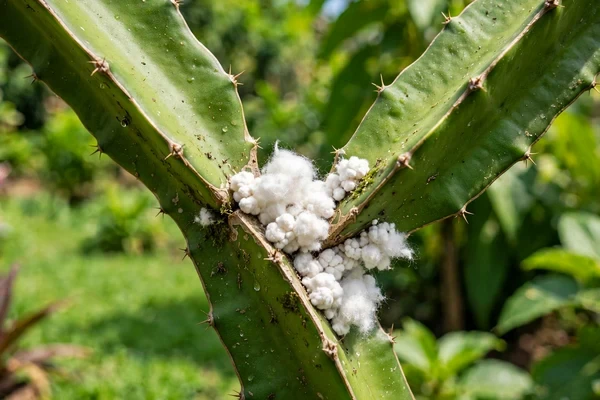
Mealybugs are among the most common dragon fruit pests in home gardens, and among the easiest to identify once you know what to look for. They are small, soft-bodied insects covered in white, powdery wax, gathering in clusters that look like tiny tufts of cotton wool.
You will most often find them in stem joints, at the base of flower buds, and where fruit scales meet the skin. Mealybugs feed by piercing the stem or fruit surface and sucking sap, and a heavy colony can weaken a stem, cause yellowing, and reduce flowering on that branch.
They also excrete honeydew, a sticky liquid that attracts ants and can support black sooty mould. Small clusters can be removed with a cotton bud dipped in water or a firm jet of water, but re-check the spot every few days, since eggs hidden in the waxy tufts often produce a second wave.
Scale insects are close relatives of mealybugs, but harder to spot because they do not move once they settle. An adult scale looks like a small bump on the stem — round or oval, often brown, grey or cream-coloured, and only a few millimetres across — and growers often mistake it for part of the plant until the stem beneath yellows.
Like mealybugs, scales feed on sap, and a heavy infestation along a rib can drain a whole stem segment, leaving it pale, thin and slow to grow. The tiny, pale young scales, called crawlers, spread to new stems before settling, so an infestation can appear on a neighbouring stem a few weeks later.
Find scale by feeling along the ribs for slightly raised, firm bumps that will not wipe off like dust, especially on the shaded side and near joints. Scrape small numbers off gently with a soft brush, and check again after a week.

Aphids, Thrips and Mites: Tiny Sap Feeders and Their Marks

Aphids, thrips and mites are the smallest of the common dragon fruit pests, and they are usually identified by their damage rather than by the insect itself. Aphids are small, soft, pear-shaped insects, often green or black, that cluster on young shoot tips and flower buds, where the tissue is softest.
They suck sap, and heavy numbers can distort new growth, causing shoot tips to curl, twist or stop elongating. A firm spray of water can dislodge aphids from shoot tips.
Thrips are even smaller — slender, fast-moving insects barely two millimetres long — and they feed by rasping the surface of stems, buds and young fruit, leaving silvery or bronze streaks, roughened skin, or deformed buds that fail to open. Because thrips hide inside buds, they are rarely seen without close inspection.
Mites are smaller still, and their feeding can cause fine stippling, a dusty or bronzed look on the stem surface, and a general loss of gloss, sometimes with fine silk webbing in dry weather.
Avoid handling buds roughly, since thrips damage is often done inside the bud before it opens; a distorted bud is best removed and disposed of.
Ladybirds, lacewings and predatory mites feed on these small dragon fruit pests, so a garden with varied planting nearby and no broad, indiscriminate spraying often keeps numbers lower on its own.
Ants, Leaf-Footed Bugs, Slugs and Other Feeders
Ants are not usually the main problem among dragon fruit pests, but they are the best early warning system a grower has. The ants reported on dragon fruit are mostly there for honeydew, and a steady trail of ants up a trellis post almost always leads to a sap-feeding colony above.
Ants can also protect mealybugs, aphids and scales from predators, so a large ant presence can allow a colony to grow faster than it otherwise would. Reducing the sap-feeders usually reduces the ants, and removing the honeydew source matters more than chasing the ants themselves.
Leaf-footed bugs are larger and easier to see: flat, brownish insects with a distinctive flattened, leaf-like widening on the hind legs. They feed by piercing stems and young fruit, leaving small, sunken spots, deformed fruit, or a stem that fails to develop normally at the puncture point.
Because they are strong fliers, they are harder to control by removal alone, but hand-picking the slow-moving adults and nymphs in the cool early morning, when they are sluggish, can reduce numbers on a small home plant.
Caterpillars are another occasional feeder, chewing notches from stem margins and leaving clean edges and dark droppings below the site; hand removal is usually enough.
Slugs and snails are reported as dragon fruit pests in several growing regions, feeding at night and rasping shallow patches from stems and shoot tips; the reliable sign is a silvery slime trail found in the morning, and clearing their daytime shelters under pots and boards near the base is the first step.
Birds and rats target the fruit instead, pecking or gnawing ripening fruit, so netting fitted carefully over the canopy and prompt harvesting are the practical defences.
How to Inspect Your Plant: A Simple Weekly Monitoring Routine
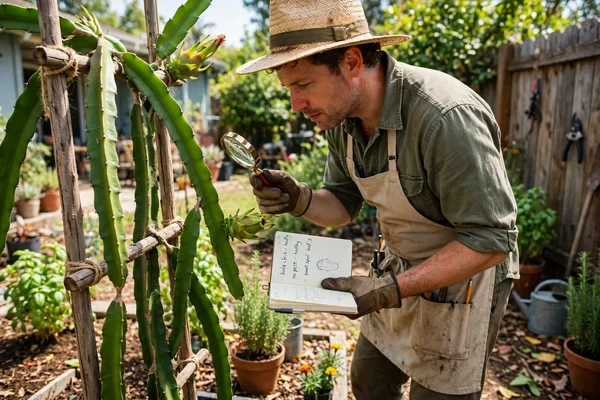
A weekly inspection takes ten to fifteen minutes for a single home plant, and it is the most effective pest management habit you can build. Choose the same day each week, and work in good light.
Start at the base and work upwards, stem by stem, checking the front and the back of every stem. Look at every joint, every shoot tip, and every flower bud.
Lift hanging stems gently so you can see their undersides, and check the fruit at every stage, paying attention to the places where scales overlap the skin.
Keep a simple notebook, or a phone note, and record what you find: the date, the stem, what you saw, and how large the affected area was. A note like “three mealybug clusters on the lower east stem, 12 May” is far more useful than a vague memory, because it tells you whether the problem is growing, shrinking or moving.
Take a photograph of anything unfamiliar, with a coin or your finger beside it for scale, before you remove it. Inspect more often in warm, humid weather and during flowering and fruiting.
The routine matters more than the tools: a grower who looks closely every week will find dragon fruit pests while they are still small, and that single habit prevents most serious infestations.
Prevention and Response: Airflow, Sanitation and IPM
Prevention is where most dragon fruit pest control actually happens, and it rests on four conditions that the plant’s own growing guides repeat. The first is airflow: the UF IFAS guide recommends pruning one to three times a year, removing damaged, diseased and dead stems, stems that reach the soil, and stems that crowd the canopy, so light reaches the stems and air moves through them.
The second condition is drainage: dragon fruit needs regular water while growing and fruiting, but that water must drain away, and a plant weakened by wet roots is more vulnerable to insect attack.
Plant in well-drained soil or a free-draining container mix, never let a pot stand in a saucer of water, and let the surface of the soil dry between waterings; our guide to how often to water dragon fruit explains how to judge timing for your soil and weather.
The third condition is sanitation — remove pruned stems from the area, clear fallen fruit and dead leaves from the base, and clean tools after cutting infested growth — and the fourth is plant vigour, since a well-fed, well-watered plant in good light grows firm stems that tolerate light insect feeding.
When pests do appear, integrated pest management, or IPM, gives the order of work: identify first, then use the least disruptive action that works, and only consider a product if the earlier steps are not enough.
Confirm what you are dealing with, using the descriptions in this guide and a clear photograph, because a spray chosen for aphids will do little against scale insects protected under their covers.
Next, fix the conditions that allowed the build-up by opening the canopy, improving drainage, clearing debris, and checking your watering, since a colony that returns to the same stem again and again is telling you something about that stem’s position.
This is also the point to check the plant’s wider health, because yellowing or softening stems may signal a different problem, and our guides to Dragon Fruit Plant Diseases: Common Signs and Causes and Dragon Fruit Stem Rot: Causes, Prevention and Care can help you tell insect damage from disease or rot.
Only if the earlier steps are not enough should you consider a product approved in your area for use on dragon fruit, used exactly as its label directs; our guide to why dragon fruit stems turn yellow can help you separate insect damage from other causes of yellowing.
Frequently Asked Questions
How can I tell dragon fruit pests apart from sunburn or disease?
Insect damage usually has a visible cause if you look closely: the insects themselves, their waxy coverings, sticky honeydew, or a pattern such as chewed edges and sunken spots. Sunburn tends to appear as a pale, bleached patch on the sun-facing side of a stem, often after a sudden move into strong sun, while disease often brings soft, wet or spreading patches with an unusual smell.
When in doubt, compare the affected area with a healthy stem on the same plant.
Do dragon fruit pests spread to other plants in the garden?
Some do and some do not. Mealybugs, aphids, scales and mites feed on many different plants, so they can move to nearby ornamentals, vegetables or other cacti, especially if stems touch or plants are crowded together.
Thrips and leaf-footed bugs also use a wide range of hosts, which is one reason to remove infested prunings from the area and to keep some space and airflow between the dragon fruit and neighbouring plants.
Why do pests keep coming back to the same stem after I clean it?
A stem that is repeatedly re-infested is usually in a position that suits the pest: deep shade, poor airflow, a joint that stays damp, or a spot where honeydew collects. Cleaning removes the insects but not the conditions, so crawlers or new arrivals settle in the same place.
Open up the canopy around that stem, check that water is not pooling near its base, and consider pruning the stem back to a healthier position.
Is fruit safe to eat if the plant had insects on it?
Fruit that has been damaged by insects should be inspected carefully before eating: wash it well, cut it open, and discard any fruit that is soft, discoloured inside, or smells unusual. Fruit from a plant that had a light insect problem on its stems is not automatically unsafe, but fruit that was itself heavily infested, pierced or partly eaten should not be eaten.
If any spray was used, follow the waiting period on the product label before harvesting.
DragonFruitGrow is an independent gardening information resource. Growing results vary with cultivar, climate, soil and plant age.