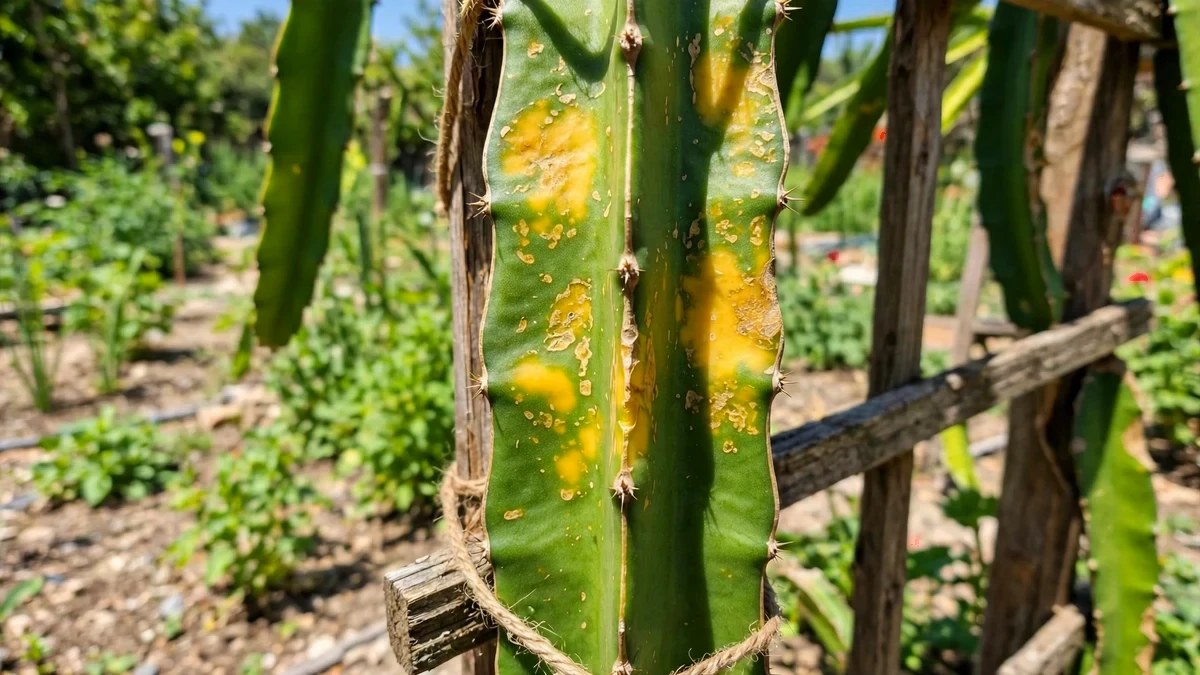
Yellow stems worry every dragon fruit grower: the plant’s stems are its leaves, its food factory and its structure all in one, so a change in their colour feels like a serious problem. The good news is that dragon fruit stems turning yellow is a symptom, not a diagnosis, and in many cases the cause is a growing condition you can correct. The stems may be reacting to too much sun, too much water, too little water, a nutrient shortage, cold, pests, or physical damage.
This guide works through those patterns one by one, so you can match what you see on your plant to the most likely cause, check it with a few simple tests, and take the right action instead of guessing.
Yellowed tissue often recovers slowly, and some badly damaged stems will not re-green at all, but a plant whose conditions are corrected will usually push out healthy new growth.
Table of Contents
- Why Are Dragon Fruit Stems Turning Yellow? Start With the Pattern
- Too Much Sun and Heat: Light Stress and Sunburn
- Too Much Water: Wet Roots and Stem Stress
- Too Little Water: Drought Stress and Shrivelled Stems
- Nutrient Shortages: Iron, Magnesium and General Feeding
- Damage, Pests and Disease: When Yellow Means Something Else
- How to Diagnose Yellow Stems Step by Step
- Frequently Asked Questions
Why Are Dragon Fruit Stems Turning Yellow? Start With the Pattern
Before reaching for a fertiliser or a spray, look at the pattern of dragon fruit stems turning yellow, because the pattern narrows the list of causes more than any single test. Ask four questions. First, which stems are yellow: one stem, a few stems on one side, or the whole plant? Second, where on the stem: the sun-facing side, the base, the tip, or the whole segment?
Third, how does the stem feel: firm and plump, thin and shrivelled, or soft and mushy? Fourth, how fast did it happen: overnight after a cold snap, over a week of rain, or slowly over a month? A single yellow stem on the sunny side points in a different direction from a whole plant that has paled gradually, and a soft stem points somewhere different again.
Feel the stem first: firm yellow stems usually point to light, nutrient or age-related causes, while soft or mushy yellow stems point to water or rot problems and need attention sooner. Then look at the newest growth: if new shoots are coming through green and healthy while older stems yellow, the plant is often coping and the problem may be limited to the older growth. Write down what you see, including the date and the weather of the past two weeks, because the cause is often something that happened days earlier.
Too Much Sun and Heat: Light Stress and Sunburn

Dragon fruit is a full-sun plant in its native range, but it can still be scorched, and sunburn is one of the most common reasons for dragon fruit stems turning yellow in hot, bright gardens. The classic sign is a pale, bleached yellow patch on the side of the stem that faces the afternoon sun, while the shaded side stays green.
Young stems and plants that were recently moved from shade into strong sun are the most vulnerable, and the damage often appears after a sudden change: a heatwave, the removal of a neighbouring tree, or a plant moved from a sheltered spot to an open one. The University of Florida IFAS Extension recommends about 30% shading during the first three to four months after planting, and where sunlight reaches damaging levels.
Heat adds to the problem, since dragon fruit tolerates temperatures up to about 38°C but grows best between roughly 18°C and 25°C. In a heatwave, a stem can yellow even without direct scorching, especially if the plant is also short of water. Give the plant light shade cloth or afternoon shade, and let it acclimatise gradually over one to two weeks before returning it to full sun. Badly bleached patches may stay pale, but new growth is usually green if the shade is adequate. Our guide to how to protect dragon fruit plants from sunburn explains shade and acclimatisation in more detail.
Too Much Water: Wet Roots and Stem Stress

Overwatering is the other common cause of dragon fruit stems turning yellow, and it is the one most likely to become serious if it is ignored. Dragon fruit is a cactus, but it is not a desert cactus: it needs regular water while growing and fruiting, and it also needs that water to drain away.
The UF IFAS guide is clear that excessive soil moisture leads to bacterial and fungal disease, and the first visible sign is often yellowing that starts at the base of the stem and spreads upwards, with the stem feeling soft or swollen rather than firm. In a pot, the signs may appear after a rainy spell or when a saucer has been left full. In the ground, the risk is highest where water pools after rain or where the soil is heavy clay.
Check the soil before watering again: push a finger a few centimetres into the mix, and if it feels wet, do not water. Tip a potted plant slightly and check that water runs freely from the drainage holes, and empty any saucer after watering. If the soil is waterlogged, let it dry out, improve drainage, or raise the plant on a mound. A stem that has gone soft and yellow at the base may already be rotting; our guide to Dragon Fruit Stem Rot: Causes, Prevention and Care explains how to tell rot from simple overwatering. Our guide to how often to water dragon fruit explains how to judge watering for your soil and weather.
Too Little Water: Drought Stress and Shrivelled Stems
Underwatering is another cause of dragon fruit stems turning yellow, and it looks quite different from overwatering, so telling the two apart matters, because the treatments are opposites. A thirsty dragon fruit stem turns a dull yellow-green, feels thin and slightly shrivelled rather than soft, and the ribs may look more pronounced as the stem loses plumpness. The newest shoot tips are often affected first: they stop growing, pale, and may dry at the very tip. This is most common in hot, windy weather, in small pots that dry out fast, and in sandy soils that hold little moisture, especially during flowering and fruiting, when the plant’s water needs are highest.
Water thoroughly until it runs from the drainage holes, then wait and check the soil before watering again, so the roots get moisture without sitting in water. Mulching around the base of an in-ground plant helps the soil hold moisture, and a larger pot, or a pot moved out of the fiercest afternoon sun, dries out more slowly.
Recovery is usually visible within one to two weeks: the stems plump up and new growth comes through green, although a stem that has dried and yellowed badly may stay pale at the tip. The key distinction to remember is feel: thin and shrivelled points to too little water, while soft and swollen points to too much, and when the soil itself is dry to the touch, underwatering is the more likely cause.
Nutrient Shortages: Iron, Magnesium and General Feeding

When the soil, water and light all seem right and you still see dragon fruit stems turning yellow, nutrients are the next place to look. The pattern gives the clue. Iron shortage, which the UF IFAS guide links to the poor, high-pH calcareous soils of south Florida, typically shows as yellowing between the veins of young growth while the veins stay green, because iron is hard for the plant to take up when the soil pH is high.
Magnesium shortage tends to show on older stems first, with yellowing that starts at the edges and moves inward. A general nitrogen shortage, usually from a plant that has not been fed at all, shows as a pale, even yellowing of older stems while new growth stays small. These are tendencies, not certainties: only a soil test can confirm a shortage.
The response depends on the cause, so avoid guessing with heavy fertiliser. If your soil is alkaline and young growth is yellowing between the veins, the UF IFAS guide recommends a chelated iron drench around the plant, and minor element sprays during the warm, rainy season.
For general feeding, it recommends light, frequent applications of a balanced fertiliser, increasing gradually as the plant matures, with well-decomposed manure or compost around the base. Do not over-feed in response to yellowing: too much fertiliser can burn roots and make the problem worse. Our guide to the best fertilizer for dragon fruit explains feeding schedules and choices in more detail, and if you are unsure, a local soil test is cheaper than a season of wrong fertiliser.
Damage, Pests and Disease: When Yellow Means Something Else
Not all cases of dragon fruit stems turning yellow come from light, water or nutrients. Physical damage is a common cause on its own: a stem that was bent, cut, tied too tightly, or bruised during handling may yellow around the injury as the tissue dies back. Check for tight ties or wire cutting into a stem, and loosen anything constricting growth. Cold is another cause: dragon fruit can be damaged by long exposure below about -2°C, although light frost damage is often followed by rapid recovery. Cold-damaged stems often yellow and soften a day or two after the cold night, rather than during it.
Sap-feeding insects can also yellow a stem, usually in a patch around the colony rather than across the whole plant. Mealybugs and scale insects drain sap from the stem, and heavy colonies leave the stem pale, thin and slow to grow; look for white cottony clusters, small bumps along the ribs, sticky honeydew, or ants travelling up the post.
Disease is the final possibility, and it usually brings extra signs beyond yellowing: soft, wet patches, a spreading discolouration, or an unusual smell. Our guides to Dragon Fruit Plant Diseases: Common Signs and Causes and Dragon Fruit Stem Rot: Causes, Prevention and Care explain how to separate disease from stress, and when a yellow stem is also soft, wet or foul-smelling, treat it as a possible rot problem and act sooner rather than later.
How to Diagnose Yellow Stems Step by Step
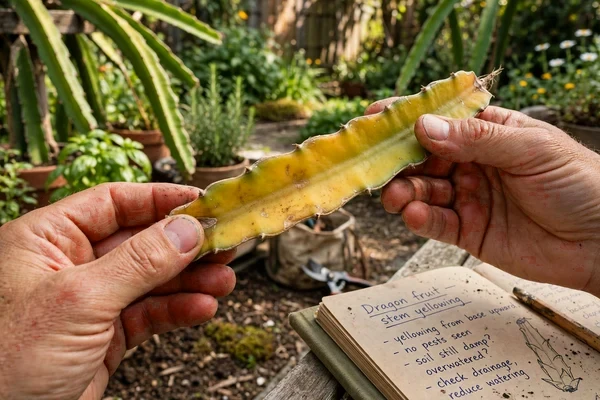
Work through the causes of dragon fruit stems turning yellow in order, and change one thing at a time, so you can tell what helped. First, feel the stem: soft and swollen means too much water or rot, thin and shrivelled means too little water, and firm points to light, nutrient or damage causes.
Second, check the soil with your finger, and look at the drainage: wet soil with a soft stem confirms overwatering, while dry soil with a shrivelled stem confirms underwatering. Third, note the position: dragon fruit stems turning yellow only on the sun-facing side points to sunburn, while yellowing at the base points to water or rot, and yellowing of young growth between the veins points to iron shortage in alkaline soil.
Fourth, look closely for insects, tight ties, cuts and cold damage, and think back over the past two weeks. Then act on the most likely cause only: shade a sunburned plant, let a wet plant dry out, water a dry plant thoroughly, or feed a hungry plant lightly. Give the change two to three weeks before judging it, since yellowed stems recover slowly. Prune away only stems that are soft, rotten or fully dead, cutting back to firm, healthy tissue and disposing of the removed piece away from the plant. If yellowing keeps spreading despite corrected conditions, take clear photographs and a note of your soil, watering and recent weather to a local nursery or extension service.
Frequently Asked Questions
Can dragon fruit stems turning yellow ever turn green again?
It depends on how badly the tissue is damaged. When dragon fruit stems turning yellow is caused by a mild, short-lived stress, they often re-green slowly over several weeks once conditions are corrected. Stems that are bleached by severe sunburn, dried out, or softened by rot will not re-green, and the plant recovers instead by pushing out new green growth. Judge by feel: a firm yellow stem may recover, while a soft or papery stem will not.
Should I cut off yellow stems?
Not always, and not immediately. A yellow stem that is still firm may recover, so leave it while you correct the cause and watch for two to three weeks. Cut back a stem only when it is soft, rotten, foul-smelling, or fully dry and dead, and cut to firm, healthy green tissue with a clean tool. Dispose of the removed piece away from the plant.
Does yellowing mean my plant is going to die?
Usually not, on its own. Most plants recover once the cause is corrected, especially if new growth is still coming through green. The warning signs that matter more are soft, mushy stems, a smell of rot, or yellowing that spreads quickly across the whole plant. If several of those appear together, act quickly and consider local advice, since a spreading rot problem can kill a plant that a simple watering mistake would not.
Why is only the new growth on my plant yellow?
Yellow new growth points to a different set of causes than yellow old growth. The most common is iron shortage in alkaline soil, which shows first in young growth, leaving new stems yellow between green veins while older stems stay green. Sunburn can also strike new growth first, since young stems are softer and less protected. Check the soil pH and the plant’s sun exposure before feeding, and avoid heavy fertiliser until the cause is clear.
DragonFruitGrow is an independent gardening information resource. Growing results vary with cultivar, climate, soil and plant age.