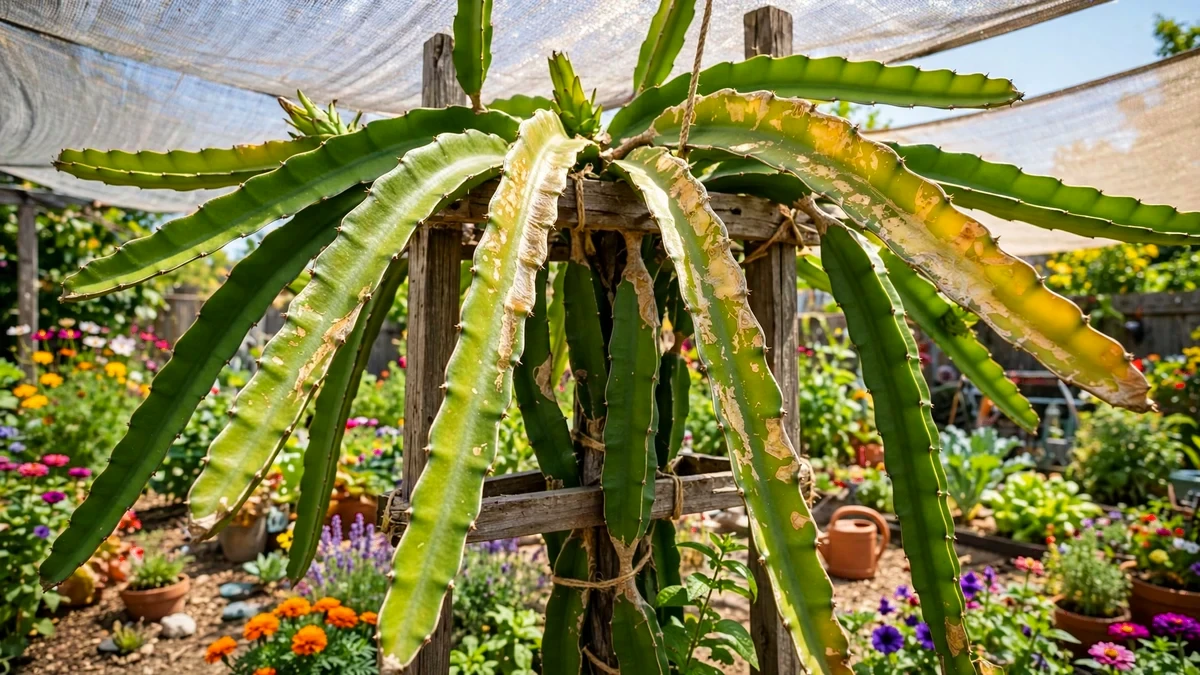
Dragon fruit loves bright light, yet its fleshy green stems can still burn. Dragon fruit sunburn usually appears as pale, bleached or yellow patches on the side facing the sun, and in severe cases the damaged tissue turns brown, dries out or rots. It is most common on young plants, on stems suddenly moved into full sun, and in hot, dry or high-altitude gardens where sunlight is intense and humidity is low. The good news is that most sunburn is preventable, and a plant that has burned lightly can often recover if the cause is corrected and the damaged stems are cared for properly.
The UF IFAS pitaya guide states the balance clearly: pitaya grows best in full or almost full sun, tolerates some shade, and may be injured by extreme sunlight. Severe stem damage from dragon fruit sunburn has been reported in regions with low humidity or high altitude, and UF IFAS recommends about 30 percent shading during the first three to four months after planting and where sunlight reaches damaging levels. Too much shade reduces production and fruit quality, so protection means managing light, not removing it.
Table of Contents
- What Dragon Fruit Sunburn Looks Like
- Why Some Plants Burn While Others Do Not
- How Much Sun Dragon Fruit Really Needs
- Shade Cloth, Timing and Gradual Exposure
- Water, Mulch and Cooling the Plant
- Helping a Sunburned Plant Recover
- Sunburn or Something Else? Telling Damage Apart
- A Simple Sun-Protection Routine
What Dragon Fruit Sunburn Looks Like
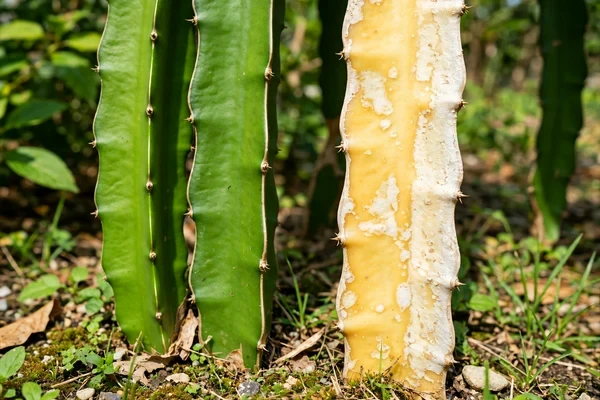
Dragon fruit sunburn most often starts as a pale yellow or whitish patch on the sun-facing side of a stem, usually along the flat face or the raised rib. The patch may feel slightly soft or papery, and the green colour fades to cream. If exposure continues, the patch can turn tan or brown, dry out and become sunken. In the worst cases the dead tissue cracks, lets in infection, and the stem rots from that point. Because only the sunny side is affected, the opposite side of the same stem often stays green and healthy, which is a useful clue.
Young growth is most vulnerable: tender new stems and fresh cuttings have thin tissue, so they can scorch in a single hot afternoon. Older, thicker stems tolerate more sun if they hardened gradually. Dragon fruit sunburn also tends to appear after a change — a plant moved from nursery shade to open garden, a tree removed, shade taken down too early, or a heatwave after cloudy weather. Damage may appear a day or two later, so check stems after very bright, hot days.
Sunburn is usually worst on the upper, outer stems facing the afternoon sun; lower stems shaded by the canopy are often untouched. If yellowing is even all over the plant, or starts at the base, the cause is more likely water, nutrition or roots than sun — and shading an over-watered plant will not fix it.
Why Some Plants Burn While Others Do Not
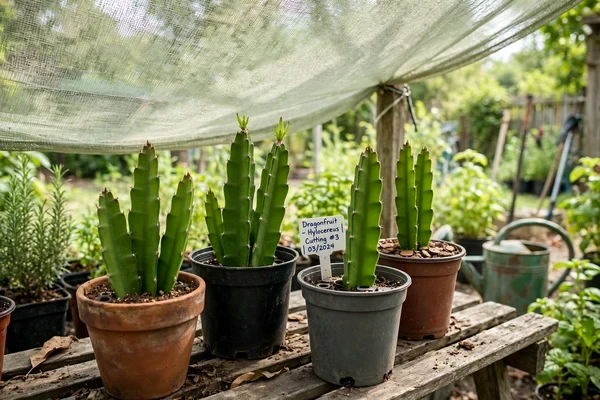
The same garden can burn one dragon fruit plant and spare another, because several factors change how much heat and light a stem actually receives. Age is the first: UF IFAS recommends shading for the first three to four months after planting, when cuttings and young plants are establishing roots and have not yet hardened. A young plant in a small pot is also at risk, because its roots dry out quickly and it cannot cool itself as well as a plant in the ground with a deep root system.
Climate and position matter just as much. Gardens at high altitude, in dry inland areas or with low humidity get stronger, harsher sunlight than humid coastal gardens at the same temperature. A south- or west-facing wall in the northern hemisphere reflects extra heat onto a plant, and light-coloured paving or a metal fence can bounce sunlight onto stems from below. Afternoon sun is usually stronger and hotter than morning sun, so a plant that gets gentle morning light and shade in the afternoon often fares better than one in full sun all day.
Plant condition is the third factor. A drought-stressed plant burns more easily, because dry tissue heats up faster. A plant just heavily pruned is also vulnerable, because stems shaded inside the canopy are suddenly exposed. No common variety is immune to dragon fruit sunburn, and all benefit from gradual hardening and shade during establishment.
How Much Sun Dragon Fruit Really Needs
Dragon fruit is described by UF IFAS as a full-sunlight crop in its native countries, and in most gardens it needs at least six hours of direct sun a day to grow strongly and flower well. Light drives the growth of new stems, and flowering is linked to long daylight periods, so a plant kept in deep shade will grow thin, pale stems and flower poorly, if at all. The aim is bright light most of the day, with protection from the most intense midday sun in the hottest climates.
In a mild, humid climate, full sun all day is usually fine. In a hot, dry climate, the same plant may need light shade during the hottest part of the day, especially in summer. The SARE dragon fruit factsheet notes that plants can grow well under full sunlight where temperature and moisture are adequate — moisture being the key condition. A well-watered plant in moist, well-drained soil tolerates sun far better than a dry plant in the same spot. This is why watering and shade work together: neither alone is enough in extreme heat.
Season also changes the need: temporary shade is most valuable in peak summer, and can usually be reduced in autumn and winter so the plant gets maximum light. A fixed, heavy shade structure that stays up all year often gives too little light in cooler months, so adjustable shade is better. For light levels, see dragon fruit sunlight requirements.
Shade Cloth, Timing and Gradual Exposure

Shade cloth is the most practical protection for dragon fruit sunburn, because it cuts light and heat without blocking airflow. A light cloth giving about 30 percent shade is the level UF IFAS suggests for young plants and for damaging sunlight, and it is a good starting point for established plants in hot climates too. Heavier cloth, at 50 percent or more, is usually too much for a fruiting plant and can reduce flowering. Choose a light-coloured, breathable cloth, fix it above the plant rather than on the stems, and leave a gap for air so heat does not build up.
Timing matters as much as the cloth itself. Shade is most useful from late morning to mid-afternoon, when the sun is strongest, and during heatwaves. A cloth that can be rolled back on cloudy days or in cooler months gives the plant full light when it is safe. For a new plant, keep light shade in place for the first three to four months, then remove it gradually: a few hours of extra sun each day over one to two weeks, rather than all at once. Watch the stems during that period; if pale patches appear, restore the shade for a few more days before trying again.
Gradual exposure also applies when moving a plant. A cutting grown indoors or under nursery shade should spend a week or two in bright, indirect light, then a few hours of morning sun, before full sun. A trellis, light fence or shrub casting afternoon shade can also reduce the harshest light without deep shade. Avoid wrapping stems in plastic or dark material, which traps heat and can scorch the plant more than the sun alone.
Water, Mulch and Cooling the Plant
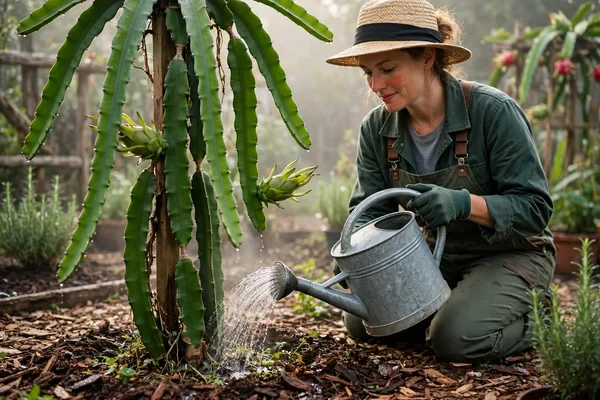
Water is the plant’s main defence against dragon fruit sunburn, because a well-hydrated stem stays cooler. UF IFAS describes pitaya as having a fairly high water requirement, despite being a cactus. Water deeply at the base in the early morning, so soil is moist before the hottest part of the day. Avoid overhead watering in the evening, as wet stems staying damp overnight invite disease.
Check the soil before watering, rather than watering on a fixed schedule. The top few centimetres should dry between waterings, but the deeper soil should stay moist. In containers, this may mean watering more often in summer, sometimes every few days in hot weather, while in the ground a deep watering once or twice a week may be enough. Drainage must stay free: soil that stays soggy suffocates roots and makes the plant weaker, not stronger. Practical detail is in how often to water dragon fruit.
Mulch helps by keeping the root zone cool and moist. Organic mulch, such as compost, straw or bark, around the base — kept a few centimetres from the stem — reduces soil temperature and slows evaporation. Whitewashing is sometimes used commercially, but is not recommended for home plants without local advice, because a coating can hide disease and block light. Shade, water and mulch are safer and usually enough.
Helping a Sunburned Plant Recover
A plant with light dragon fruit sunburn usually recovers on its own once the cause is fixed. The first step is to give it shade and steady water, as described above, and to stop any further stress: do not prune heavily, do not feed heavily, and do not move the plant again until it has stabilised. The pale patch itself will not turn green again — the damaged tissue is dead — but the stem around it can stay healthy, and new growth will come from the tips and from buds below the damage.
Leave mildly damaged stems in place. They can still support the plant, carry water and nutrients, and produce new branches. Only remove a stem if the burned area has turned soft, brown and rotten, or if it is spreading. If you must cut, use a clean, sharp knife or secateurs, cut back into firm, healthy green tissue, and let the cut dry in the air. Remove the cut material from the garden rather than leaving it at the base, where it can harbour disease. Do not seal the cut with paint or tar unless a local extension service advises it; a clean cut that dries is usually best.
Feeding should be light during recovery: a small amount of balanced fertiliser or compost once new growth shows is enough, as a heavy dose can burn roots. New shoots over the following weeks are the best sign of recovery. If none appear after a month, or rot spreads from the burned area, seek local advice.
Sunburn or Something Else? Telling Damage Apart
Sunburn is often confused with other problems, and the treatment is different, so it is worth checking before acting. Yellowing from over-watering usually starts at the base, affects the whole stem evenly, and comes with soggy soil and soft tissue. Yellowing from nutrient deficiency is often more even across the plant, or follows a pattern on older stems first, and the soil is usually dry or poor. Sunburn, by contrast, is one-sided: it faces the sun, is worst on the outer and upper stems, and the shaded side stays green. The full comparison of yellow stems is covered in why dragon fruit stems are turning yellow.
Disease can follow sunburn, because the dead patch is an entry point for fungi and bacteria. If a pale patch turns black, soft and wet, cut the damaged part away promptly. Cold damage looks different: it affects tips after a cold night, and tissue turns dark and water-soaked rather than pale and papery. Pest damage is usually small and scattered, with insects or sticky residue. If in doubt, photograph the damage and note recent weather — a hot spell points to sun, a cold night to frost, wet weather to disease.
A Simple Sun-Protection Routine
A practical routine needs no expensive equipment. In spring, check new growth weekly and give young plants light shade. In summer, keep shade cloth ready, water deeply in the morning, and mulch the root zone. After a heatwave, inspect sun-facing stems. In autumn, reduce shade for ripening; in winter remove temporary shade unless frost protection is needed.
For a new planting: choose morning sun with some afternoon shade in very hot climates, add light shade cloth for the first three to four months, water steadily, and harden gradually before removing it. For an established plant, avoid sudden exposure — do not remove a neighbouring tree or shade structure in midsummer without replacing it — and avoid heavy pruning just before a heatwave, because newly exposed inner stems burn first. With those habits, dragon fruit sunburn becomes rare, and the plant keeps the bright light it needs to flower and fruit.
Frequently Asked Questions
How much shade prevents dragon fruit sunburn in summer?
About 30 percent shade is a good starting point in hot, dry or high-altitude gardens, and for young plants in their first three to four months. In mild, humid climates an established plant often needs no shade at all. Give shade mainly in the hottest part of the day, and avoid heavy shade that blocks flowering.
Will a sunburned dragon fruit stem turn green again?
No, the pale or brown burned patch itself will not turn green again, because that tissue is dead. The stem around it can stay healthy, and new growth usually appears from the tips and from buds below the damage once shade and watering are corrected.
Can I use sunscreen or whitewash on dragon fruit stems?
Whitewash is used in some commercial growing, but it is not recommended for home plants without local advice. It can hide disease, block light and be hard to remove. Light shade cloth, steady watering and mulch are safer and usually enough.
Is morning sun or afternoon sun better for dragon fruit?
Morning sun is gentler and usually safer, because the air is cooler and the plant is hydrated from the night. Afternoon sun is stronger and hotter, so a plant that gets full morning sun and light afternoon shade often does best in very hot climates.
DragonFruitGrow is an independent gardening information resource. Growing results vary with cultivar, climate, soil and plant age.