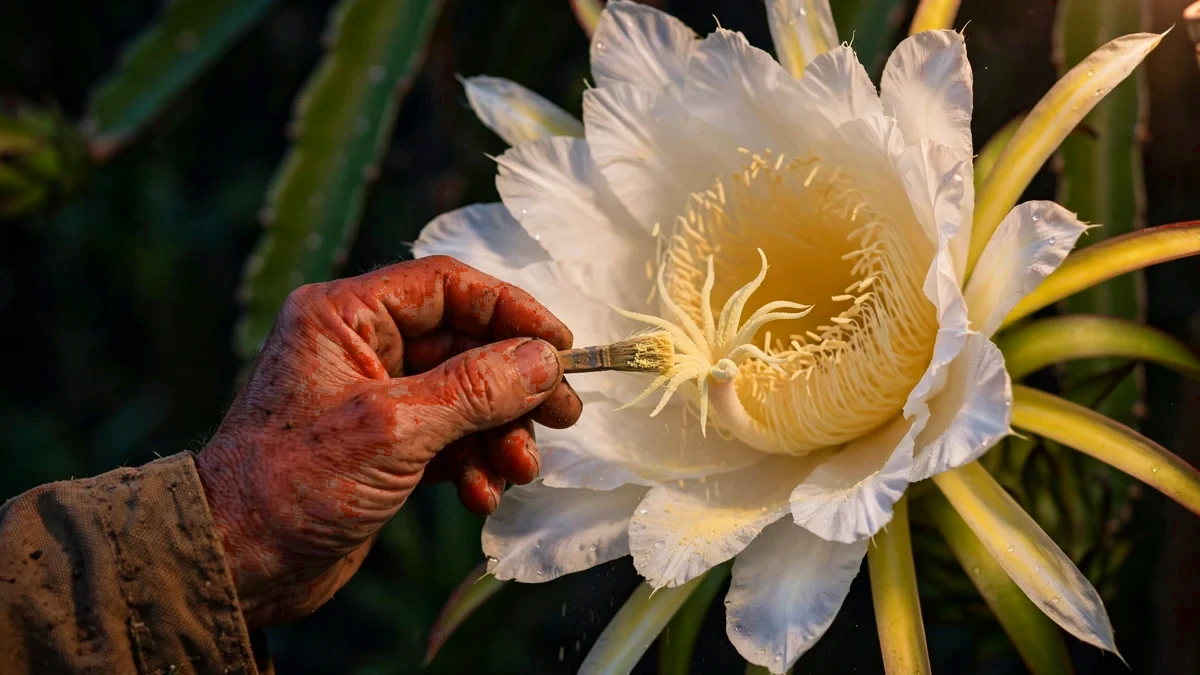
Dragon fruit pollination is the step that turns a spectacular flower into a fruit, and it is the step most often misunderstood by new growers. A plant can be healthy, well-fed, and covered in flowers, yet produce nothing if pollination fails — and the reason is usually not poor care but a mismatch between the variety’s pollination needs and the pollen available on the night the flower opened.
This guide explains how dragon fruit pollination works, the difference between self-pollination and cross-pollination, which varieties can manage alone and which need a partner, and how to hand-pollinate when nature does not deliver. Pollination needs vary by variety, and because information on many cultivars is poorly documented, this guide gives you principles and tests you can apply to your own plants rather than a promise about any single named variety.
Table of Contents
- How Dragon Fruit Pollination Works
- Self-Pollination: Which Varieties Can Do It?
- Cross-Pollination: When a Second Variety Is Needed
- Hand Pollination Step by Step
- Natural Pollinators: Moths, Bats and Bees
- Signs Pollination Failed
- Choosing Varieties for Reliable Fruit Set
- Frequently Asked Questions
How Dragon Fruit Pollination Works
Dragon fruit flowers are hermaphroditic: each flower carries both male parts and female parts. The male parts are the stamens, a ring of slender stalks tipped with pollen-producing anthers, and the female part is the pistil, topped by the stigma — a lobed, cream-coloured tip at the centre of the flower. Pollination is the transfer of pollen from the anthers to the stigma. When compatible pollen lands on the stigma, pollen tubes grow down through the pistil to the ovary, fertilisation occurs, and the ovary begins to swell into a fruit.
Timing is tight because the flowers open at night and last a single night. The stigma is receptive while the flower is open and fully fresh, during the night and into the early morning for flowers that stay open late. Pollen delivered after the flower closes is wasted. This one-night window means pollination is an event, not a process spread over days, and it is why a plant can flower heavily yet set little fruit if pollinators are absent on the critical nights.
Compatibility is the second constraint. In self-fertile varieties, the flower’s own pollen can fertilise its own stigma, so dragon fruit pollination can happen within a single flower. In self-incompatible varieties, the flower’s own pollen is recognised and rejected, and only pollen from a genetically different plant can fertilise it.
Self-incompatibility is a genetic trait, not a disease or a defect: it evolved to encourage cross-breeding and genetic diversity. But for a grower with a single plant of a self-incompatible variety, it means flowers without fruit, year after year, unless compatible pollen is brought in. Our guide to why dragon fruit flowers open at night explains the night-blooming habit that frames this whole process.
Self-Pollination: Which Varieties Can Do It?
Many dragon fruit varieties are self-fertile, or at least partly so, and can set fruit with their own pollen. In these varieties, a single plant can fruit alone, and a moth, a bee, or even wind and gravity moving pollen within the flower may be enough. Self-fertile varieties are the simplest choice for a home grower with room for only one plant, and they are the reason many first-time growers succeed at dragon fruit pollination without ever thinking about it.
However, “self-fertile” does not mean “pollination-proof”. Even self-fertile varieties set fruit better when pollen is moved onto the stigma effectively. A flower left entirely to itself may set a small or misshapen fruit, while a flower that receives a generous load of its own pollen — by hand or by a visiting moth — often sets a larger, better-shaped fruit.
The difficulty is knowing which varieties are self-fertile. UF IFAS warns that information on the self-incompatibility of the many named cultivars and selections in circulation is not well documented, which makes variety recommendations difficult and potentially unreliable.
Nursery labels are sometimes wrong, and a variety described as self-fertile in one region may behave differently in another. The practical test is observation: if your single plant flowers and sets fruit reliably without help, it is effectively self-fertile in your garden. If it flowers well but sets little or no fruit, treat it as needing cross-pollination rather than waiting another season to find out.

Cross-Pollination: When a Second Variety Is Needed
Cross-pollination means pollen from one variety fertilising the flower of a different variety. For self-incompatible varieties, it is not optional — it is the only way fruit sets. UF IFAS advises planting two or three different genetic types, not the same clone or variety, so that cross-pollination between the different types assures better fruit set and size. The key phrase is “different genetic types”: two plants of the same variety, grown from cuttings of the same parent, are genetically identical, and pollen between them is treated by the plant as its own pollen. It will not overcome self-incompatibility.
Cross-pollination also benefits self-fertile varieties. Flowers that receive pollen from a different variety often set larger fruit with better shape than flowers pollinated with their own pollen, because cross-pollen tends to fertilise more ovules more completely. Commercial growers use this effect deliberately, planting mixed varieties so that each benefits from the other’s pollen.
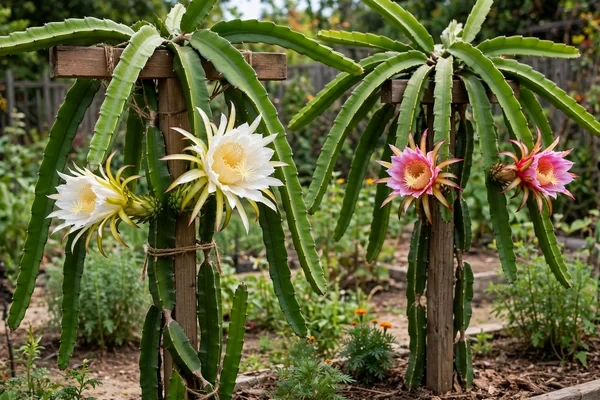
For the home grower, the practical setup is simple: grow at least two different varieties near each other, on separate trellises or posts, so that their flowering periods overlap and dragon fruit pollination can happen naturally between them.
When choosing the second variety, pick one known to flower in the same season as the first, and ask the nursery whether it is a good polliniser for your main variety. Flowering overlap matters: a compatible variety that flowers a month earlier or later is no use on the night your main variety opens. If space is tight, a second variety can be grown in a large pot beside the main plant’s trellis — it does not need its own full-size planting to supply pollen, though it will fruit in its own right as well.
Hand Pollination Step by Step
Hand pollination is the most reliable way to guarantee fruit set, and it puts dragon fruit pollination directly under your control. You will need a small soft brush, a cotton bud, or a clean container for collecting pollen, plus a torch.
First, check your plants in the late afternoon during flowering season and note which buds will open that night. They will be large, swollen, and showing white petal tips. Second, after dark when the flowers are open, collect pollen from a flower of the polliniser variety: brush the anthers gently so pale pollen gathers on the brush, or remove a few stamens and tap the pollen into a small container. If you are pollinating a self-fertile variety with its own pollen, collect from the same flower or another flower on the same plant.
Third, transfer the pollen to the stigma of the target flower. The stigma is the lobed, cream-coloured tip at the centre of the flower, standing slightly above the stamens. Dab or brush the pollen generously onto its lobes so it is visibly coated. Be gentle: the stigma is delicate, and rough handling can damage it. Fourth, if you want to be thorough, repeat with pollen from a second flower to increase the load. There is no need to cover the flower afterwards, though some growers mark pollinated flowers with a small tag or ribbon so they can track which ones were done.
Work during the night or in the very early morning while flowers are still open. Pollen can be stored briefly — a few hours in a cool, dry container — but fresh pollen works best, and pollen collected one night should not be relied on for a flower opening days later. If you have many flowers opening on the same night, prioritise the healthiest and best-positioned ones; a plant cannot support unlimited fruit, and thinning to a manageable number gives better-sized fruit.

Natural Pollinators: Moths, Bats and Bees
In the plant’s native range, the main natural pollinators are moths and bats. Large moths are attracted by the flower’s white colour and strong scent, and as they feed on nectar they carry pollen between flowers. Bats do the same at a larger scale. Both are active during the hours the flower is open, which is exactly why the flower opens at night. In regions where these pollinators are abundant, natural pollination can be reliable.
In many gardens outside the native range, natural dragon fruit pollination is less dependable. UF IFAS notes that moth and bat pollination has not been commonly observed in Florida plantings, and the SARE factsheet similarly records that flowers are documented as pollinated by moths and bats in other areas, while recommending hand pollination for improved fruit production.
Moths are present in most regions and do visit the flowers, but their numbers may not be enough to service every flower on a heavily blooming plant, and bats may not visit garden plantings at all.
Bees contribute in the early morning. Flowers that remain open into the early to mid-morning hours may be visited by bees before they wither, and bees can carry pollen effectively. But most flowers are already closing by the time bees become active, so bee pollination is a partial supplement rather than a reliable system.

Signs Pollination Failed
Failed dragon fruit pollination announces itself within days. The flower wilts as usual after its single night, but instead of its base swelling into a young fruit, the whole flower — including the small ovary at its base — turns yellow, softens, and drops off the stem. This is normal for an unpollinated flower, and a plant may drop many flowers in a season without anything being wrong with its health. Flower drop is only a problem when it happens to most or all flowers, season after season.
A partly successful dragon fruit pollination produces a different signal: a fruit that begins to swell but stays small, lopsided, or drops while still young. This usually means only some ovules were fertilised, often because too little pollen reached the stigma or the pollen was incompatible. Hand pollinating generously with compatible pollen is the usual fix, and it often improves fruit size and shape noticeably in the next flowering wave.
Distinguish pollination failure from other causes of flower drop. Flowers can also drop after heavy rain, strong wind, a cold night, or severe water stress. If flowers drop after a storm, the cause may be weather rather than pollen. If flowers drop on calm, warm nights when pollinators should have been active, pollination is the more likely cause. Our article on why a dragon fruit plant is not flowering covers the cases where no flowers appear at all, which is a different problem from flowers that appear and then fail.
Choosing Varieties for Reliable Fruit Set
Variety choice is the longest-lasting dragon fruit pollination decision you will make, so it deserves care at purchase time. For a first plant, a variety known to be self-fertile in your region is the safest single choice. Ask the nursery for evidence: has this exact variety fruited alone in local conditions? A label claim without local experience is a weak basis. If you have room for two plants, choose two different varieties that flower in the same season, and confirm with the nursery that one is a suitable polliniser for the other.
Think about your goal as well. If you want maximum reliability with minimum work, plant a self-fertile variety and hand-pollinate during the peak flowering waves. If you enjoy the process and have space, plant two or three different varieties and let cross-pollination lift fruit size and set across all of them.
Either way, keep a simple record: which variety, when it flowered, whether you hand-pollinated, and how many fruit set. Within one season that record tells you more about your plants’ pollination needs than any catalogue. For a broader comparison of varieties, see our guide to the best dragon fruit varieties, and once fruit sets, our guide to the days after flowering to harvest explains the wait that follows.
Frequently Asked Questions
Can I use pollen from the same flower for dragon fruit pollination?
Yes, if the variety is self-fertile — its own pollen can fertilise its own stigma, and many growers simply brush pollen from a flower’s stamens onto its own stigma. If the variety is self-incompatible, its own pollen will be rejected and no fruit will set, so you need pollen from a different variety. When in doubt, use pollen from a different variety: it works on both self-fertile and self-incompatible flowers.
How long is pollen good for after I collect it?
Fresh pollen used within the same night works best. Pollen kept cool and dry may remain usable for a few hours, but its viability drops quickly, especially in heat or humidity. Do not rely on pollen collected one night for flowers opening several days later. Collect fresh pollen each night you hand-pollinate.
Will one bee visit be enough to pollinate a flower?
A single bee visit can deliver pollen, but a heavy pollen load generally gives better fruit set and larger, better-shaped fruit, because more ovules are fertilised. This is why hand pollination, which lets you coat the stigma generously, often outperforms a casual insect visit. If you see bees working your flowers in the early morning, that is helpful, but do not treat it as a substitute for hand pollination on a variety that needs reliable set.
Do I need to hand-pollinate every flower on the plant?
No. Hand-pollinate the flowers you most want as fruit — the healthiest, best-positioned ones — and let the rest rely on natural pollinators or drop. A plant cannot support unlimited fruit, and a manageable number of well-pollinated fruit will be larger and better than a large number of poorly set ones. During peak flowering, when many flowers open on one night, prioritise rather than trying to do them all.
Disclaimer: DragonFruitGrow.online is an independent gardening information resource. Growing conditions vary by climate, cultivar, and site, so observe your own plants and adapt this general guidance to local conditions.