Counting dragon fruit days after flowering is the simplest way to predict when a fruit might be ready. You note the day a flower opens, count forward, and start checking when the count reaches the expected range. It sounds precise, but the count is a guide, not a guarantee: the number changes with variety, weather and plant condition, so it must always be checked against the fruit itself.
Table of Contents
- What “Days After Flowering” Actually Means
- Dragon Fruit Days After Flowering: The Commonly Reported Range
- Why the Count Changes by Cultivar
- How Climate and Season Stretch or Shorten the Count
- How to Track Flowering Dates in a Home Garden
- Using the Day Count as an Estimate, Not a Rule
- What to Do When the Count and the Colour Disagree
What “Days After Flowering” Actually Means
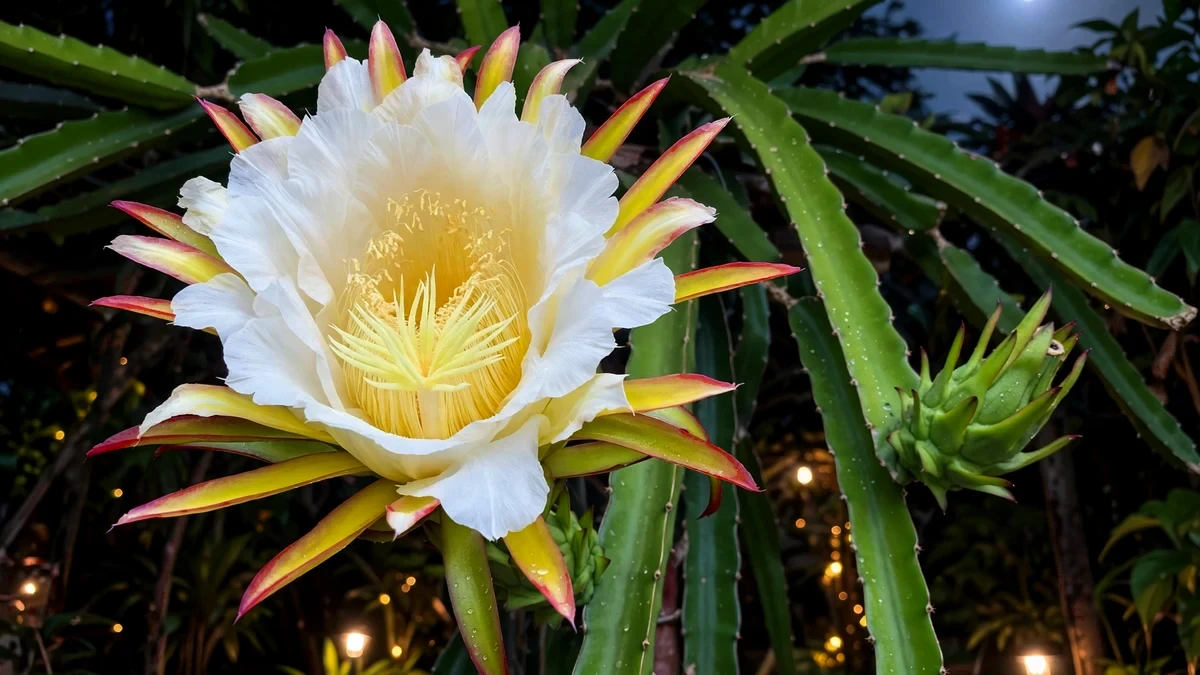
The dragon fruit days after flowering count starts on the night a flower opens. Dragon fruit flowers are large, white and night-blooming, opening for a single night and usually wilting by the following morning. If pollination succeeds, the flower base swells and a small green fruit begins to form over the next few days. That swelling is called fruit set, and it happens a few days after flowering, so “days after flowering” and “days after fruit set” are not the same thing — a source that says 30 days after fruit set is describing a slightly later starting point than one that says 30 days after flowering.
For home growers, the flowering date is easier to record, because the flower is large and hard to miss, while fruit set is gradual and easy to overlook. Count from the night the flower was open, not the day you first noticed the swelling fruit; if you are unsure of the exact night, use your best estimate.
The count is useful because fruit development follows a fairly steady pattern: the fruit grows, fills out, then begins to colour. The day count tells you roughly where a fruit is in that pattern, but not the sugar level inside, which is why it is a maturity index — a helpful indicator — rather than a ripeness test on its own. See the dragon fruit pollination guide for how flowering leads to fruit set.

Dragon Fruit Days After Flowering: The Commonly Reported Range
Two widely cited sources give ranges that look different at first glance, and understanding why they differ is the key to using them well. UC Davis Postharvest lists days after flowering as a commonly used maturity index, with a minimum of 27 to 33 days depending on cultivar and production area. That is a minimum: fruit harvested earlier than that is unlikely to be mature, whatever it looks like.
The University of Guam extension factsheet, drawing on the same UF IFAS research, reports that fruits can be harvested around 30 days after fruit set, but recommends delaying harvest to about 50 days after fruit set to allow sugars to develop. That longer figure reflects a different goal: not the earliest date a fruit can be picked, but the date when flavour is likely to be at its best in that growing region.
These figures are not in conflict; they describe different points on the same timeline, for different purposes. A grower harvesting for a distant market may pick near the minimum, while a home grower eating the fruit the same day can wait for full flavour. Start checking seriously from about four weeks after flowering, and expect many fruits to need five to seven weeks. The dragon fruit days after flowering range is a starting point for observation — the fruit’s colour, bracts and firmness decide the actual picking day.

Why the Count Changes by Cultivar
Variety is the largest single reason the day count varies. The common red-skinned white-fleshed type, Hylocereus undatus, the red-fleshed Hylocereus polyrhizus types, and the yellow-skinned Selenicereus megalanthus do not develop at the same speed, and cultivars within one species can differ too. UC Davis states the minimum plainly as a range — 27 to 33 days — precisely because cultivar and production area change the number.
Yellow-skinned types are often slower, and their green-to-yellow change can be subtle at first, which makes the day count more useful for them. Red-fleshed types often colour early and strongly, so a fruit can look ready while the flesh is still building sugars. White-fleshed types can be the opposite: the skin may colour fully while the inside is still mild.
Pollination adds another layer: some varieties are self-fertile, while others need pollen from a different variety. A well-pollinated flower usually produces a larger fruit that develops more evenly, while a poorly pollinated one may set a small fruit that ripens unevenly or drops early. If you grow several varieties, note the flowering and picking dates for each separately; after a season or two you will know whether your red variety is usually ready near four weeks and your yellow one nearer six.
How Climate and Season Stretch or Shorten the Count
Weather is the second major reason the count shifts. Warm, sunny weather generally speeds fruit development, while cool or cloudy weather slows it. A fruit that flowered during a hot spell may reach full colour several days earlier than one that flowered during a cool, overcast period, even on the same plant. Temperature, light and rainfall all play a part, and they vary from week to week, so two flushes of flowers in one season can have quite different counts.
Season matters in the same way: early-season fruit forming on cool nights often takes longer than mid-summer fruit, and late-season fruit can slow down again as days shorten. Where the warm season is long, flowering and fruiting can run from late spring through autumn, and the day count is shortest near the warmest peak.
Water and plant health also affect the pace. UF IFAS recommends periodic watering from flowering through harvest, since drought in this period can lead to poor production. A plant short of water may ripen fruit early but with poor flavour, while a healthy, well-watered plant develops fruit more evenly. A heavy crop can also slow each fruit a little. The dragon fruit days after flowering figure for your garden is something you discover by watching your own plants, not something you can look up once and rely on forever.
How to Track Flowering Dates in a Home Garden
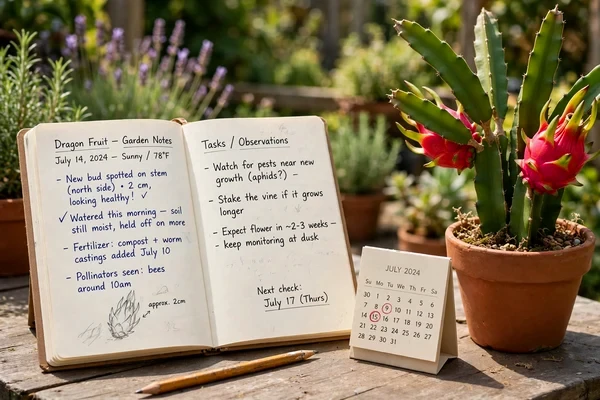
A simple tracking system for dragon fruit days after flowering is all you need, and it takes less than a minute per flower. When a flower opens, tie a small tag to the stem near it, or mark the date on a plant label. A luggage tag, a piece of masking tape on the trellis, or a short note in a garden notebook all work. Write the date the flower opened and the variety, if you know it. Coloured tags are handy if you have several varieties: one colour per variety, so you can tell at a glance which fruit belongs to which count.
Check the plant every few days during flowering season and add tags as new flowers open. Dragon fruit often flowers in flushes, so a plant can carry fruit of different ages at once. Without tags, it is easy to confuse a four-week-old fruit with a two-week-old one — the main reason home growers pick too early.
A notebook or phone note turns tags into a record you can use next year. For each fruit, note the flowering date, the date the skin started to colour, and the picking date, plus a short note on flavour. After one season you will have a personal ripening calendar for your varieties in your climate — worth more than any general figure, because it already includes your weather, soil and plants — and you can predict roughly when the next flush will be ready.
Using the Day Count as an Estimate, Not a Rule
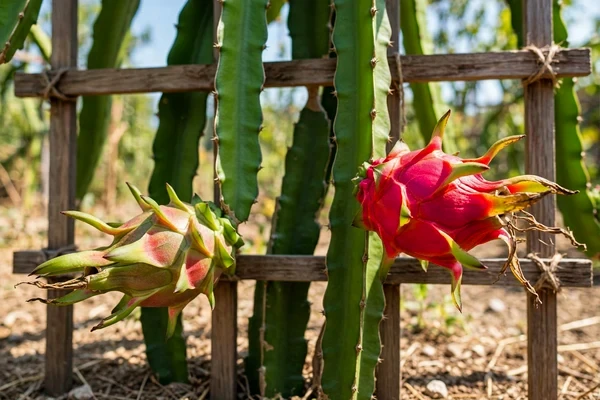
The dragon fruit days after flowering count works best as a prompt to start checking, not as an order to pick. When a fruit reaches the expected range, begin inspecting it every day or two. Look for the signs described in our guide on when to harvest dragon fruit: even skin colour with no large green patches, firm green bracts, and a slight give under gentle palm pressure. If those signs are present, the fruit is ready, whether the count says 30 days or 45. If they are absent, leave the fruit on the plant, whatever the calendar says.
The published figures are minimums and averages, not deadlines. A fruit that reaches 33 days after flowering is not automatically ripe; it has simply reached the earliest point at which ripeness is possible. Many fruits, especially yellow types and late-season fruit, need considerably longer, though a fruit in a hot, sunny spot may be ready a few days early — still, be cautious about picking very early, since dragon fruit does not ripen normally off the plant.
Think of the count as the first of three checks: the calendar tells you when to look, the colour tells you how the fruit is progressing, and the touch test confirms it. No one alone is enough — growers who rely only on the count pick fruit that looks right on paper but tastes bland, while those who ignore the count often leave fruit too long. The detailed hands-on tests are covered in our guide on how to tell if dragon fruit is ripe.
What to Do When the Count and the Colour Disagree
When the dragon fruit days after flowering count and the colour disagree, the colour usually wins. If the count says the fruit should be ready but the skin is still patchy and green, trust the colour and wait. The fruit may have flowered during a cool spell, or the variety may simply be slower than the published figure. Check again in two or three days; the colour often catches up quickly once it starts.
If the colour says ready but the count is well short — for example, a fruit that is fully red only three weeks after flowering — be cautious. Strong sun can colour the skin early while the flesh is still developing. In that case, use the squeeze test: if the fruit is still rock hard, leave it, and check again in a few days. If it gives slightly and the bracts are fresh and green, it may genuinely be an early fruit, and you can pick it and taste it to learn from it.
If the count is long past the expected range and the fruit still shows no colour, look for a cause: poor pollination, heavy shade, drought or a very young plant can all stall development. A fruit that has sat green far longer than expected may never ripen well, and is better picked and composted than left taking energy from the plant. In most cases, though, the answer is patience: wait, keep the plant watered, and let the fruit finish. Once you pick, handle the fruit gently and move it into the shade; our guide on how to store dragon fruit after harvest covers what to do next.
Frequently Asked Questions
What is a typical dragon fruit days after flowering count?
There is no single typical figure. UC Davis gives a minimum of 27 to 33 days depending on cultivar and area, while the University of Guam factsheet reports harvest around 30 days after fruit set, with a delay to about 50 days recommended for sugar development. Start checking from about four weeks after flowering, and judge ripeness by colour, bracts and firmness, not by the calendar alone.
Should I count from flowering or from fruit set?
Count from the night the flower opened, because that date is easy to record. Remember that fruit set follows a few days later, so a figure given in days after fruit set will look shorter than the same period counted from flowering. Note which starting point any guide uses before comparing figures.
Why did my fruit take longer than the published range?
Cool or cloudy weather, a slow variety such as a yellow-skinned type, a young plant, heavy shade or irregular watering can all stretch the count. The published dragon fruit days after flowering range is a minimum and an average, not a promise for every fruit. If the fruit is still colouring and the bracts are fresh, it is still developing; give it more time.
Can I pick dragon fruit early and let it ripen inside?
No. Dragon fruit is non-climacteric and does not continue ripening normally after harvest. A fruit picked too early will stay bland and starchy, and may soften only as it begins to decay. Wait until the fruit is close to full ripeness on the plant, using the day count as a prompt to check, not as a picking order.
Disclaimer: DragonFruitGrow.online is an independent gardening information resource. Growing results vary with cultivar, climate, soil and plant care, so use this guide as general information and adapt it to your local conditions.