
A dragon fruit that was picked at the perfect moment can still disappoint if it is stored badly. The skin is thin, the flesh is soft, and the fruit loses moisture fast in warm, dry air. A few simple choices, made in the first hour after picking, decide whether the fruit stays firm and sweet for two weeks or turns soft and dull in three days. Learning how to store dragon fruit properly is mostly about temperature, humidity, and handling. This guide explains how to store dragon fruit from the moment the fruit leaves the plant, how to keep whole fruit and cut fruit, and which mistakes quietly ruin a good harvest.
Table of Contents
- Why Dragon Fruit Storage Starts at Harvest
- How to Store Dragon Fruit at Room Temperature
- How to Store Dragon Fruit in the Refrigerator
- How to Store Dragon Fruit at the Right Temperature and Humidity
- Storing Cut Dragon Fruit
- Can You Freeze Dragon Fruit?
- Mistakes That Shorten Shelf Life
- How to Tell Stored Fruit Has Gone Bad
- Frequently Asked Questions
- Related Guides
Why Dragon Fruit Storage Starts at Harvest
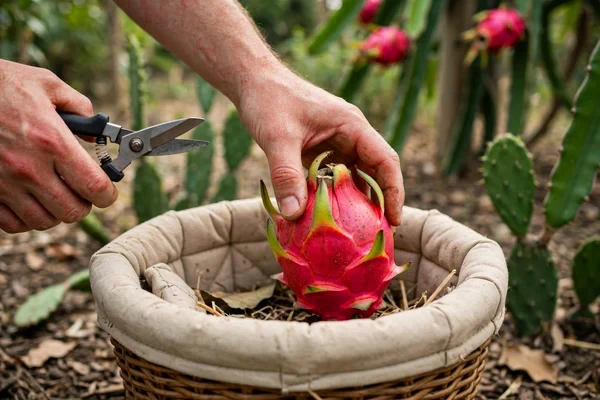
Storage does not begin in the kitchen. It begins on the trellis, in the way the fruit is cut and carried. Dragon fruit does not continue to ripen normally after harvest, according to UF IFAS and UC Davis postharvest research, so a fruit picked under-ripe will not improve in storage, and a fruit picked over-ripe will decline quickly whatever you do. The best storage fruit is picked at full colour with firm flesh and fresh green bracts, cut cleanly with secateurs, and carried in a shallow padded basket. Any bruise made during picking becomes a soft spot in storage, and any tear in the skin becomes an entry point for decay.
Heat is the second factor. Fruit left in the sun after picking warms up fast, and warm fruit loses moisture much faster than cool fruit. UC Davis data shows that pitaya loses about 0.1 percent of its weight per day at 5°C, about 0.3 percent at 10°C, but about 2.6 percent per day at 20°C.
That is why the first rule of storage is simple: get the fruit into shade immediately, and get it cool as soon as you can. If you understand how to store dragon fruit, you will see that the harvest basket, the shade, and the first hour matter as much as the refrigerator. Handle the fruit gently, keep it cool, and do not stack it deep, and you have already won half the battle.
How to Store Dragon Fruit at Room Temperature
Whole, uncut dragon fruit keeps well at cool room temperature for a few days. Choose a spot that is shaded, cool, and well ventilated, such as a pantry shelf or a kitchen counter away from the stove and away from direct sunlight. Do not pile the fruit in a heap. Lay the fruit in a single layer in a shallow basket or on a tray, with a little space between each fruit so air can move around them. If the room is warm, above about 25°C, expect the fruit to soften faster, and plan to eat it within two or three days.
A light covering helps in dry air. A loose cloth over the basket slows moisture loss without trapping heat, and a perforated plastic bag around the fruit can reduce water loss further, as long as the bag has holes for air. Never seal uncut fruit in a closed plastic bag at room temperature, because condensation builds up inside and the skin can start to decay. Check the fruit daily, and eat the softest ones first. Room temperature storage is best for fruit you plan to eat within a few days. If you need it to last longer, the refrigerator is the better choice, and the next section explains how to use it without damaging the fruit.
How to Store Dragon Fruit in the Refrigerator
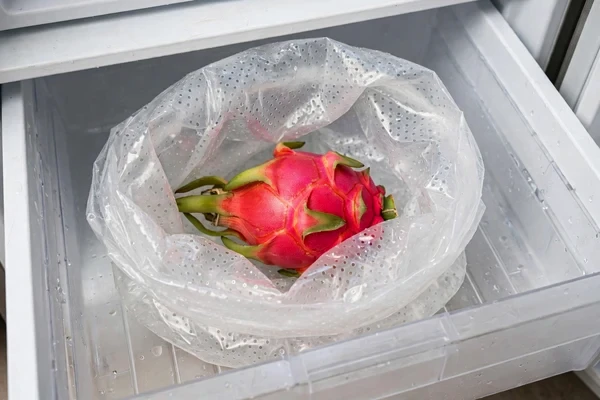
The refrigerator is the best place for whole dragon fruit that you want to keep for a week or more. Place the fruit in the vegetable drawer, ideally inside a perforated plastic bag or a loosely closed bag with a few holes punched in it. The bag holds humidity around the fruit and slows the moisture loss that causes shrivelling, while the holes let enough air through to prevent condensation. Do not wash the fruit before you store it. Water left on the skin encourages decay, so wash it only just before you eat it.
Keep the fruit away from foods with strong smells, because the thin skin can pick up odours. Do not stack heavy items on top of the fruit, and do not pack the drawer so tightly that air cannot circulate. If your refrigerator has a humidity control on the drawer, set it to high humidity, because dragon fruit stores best at about 85 to 90 percent relative humidity. When you take the fruit out, let it sit at room temperature for twenty or thirty minutes before cutting it, because cold fruit can taste flat.
A fruit stored this way commonly keeps for one to two weeks, and sometimes longer if it was picked at the right maturity and handled gently. That is the practical answer to how to store dragon fruit for the longest life: cool, humid, and undisturbed.
How to Store Dragon Fruit at the Right Temperature and Humidity
Temperature is the factor that most growers get wrong, because colder is not always better for this fruit. UC Davis gives the optimum storage temperature for red pitaya as 10°C (50°F), and for yellow pitaya as 6°C (43°F). Chilling injury can develop at 5 or 6°C depending on the type, the harvest maturity, and where the fruit was grown, and early-harvested fruit is more sensitive. The signs of chilling injury are flesh that turns translucent and soft, scales that darken, and poor flavour.
A household refrigerator usually runs at about 3 to 5°C, which is slightly colder than ideal for red dragon fruit, so the vegetable drawer, which is usually a little warmer than the rest of the fridge, is the best spot. Avoid storing dragon fruit at the back of the fridge where it is coldest, and never store it against the cooling element.
Humidity matters almost as much as temperature. Dragon fruit stores best at 85 to 90 percent relative humidity, which is much more humid than an open refrigerator shelf. That is why the perforated bag helps: it holds moist air around the fruit without sealing it in. If you do not have a bag, a damp cloth laid loosely over the fruit in the drawer can help, but check it daily and replace it if it starts to smell.
In a dry climate, or in a frost-free refrigerator that dries the air, the bag makes a visible difference: fruit stored without one shrivels and loses weight within days, while fruit in a bag stays plump and bright. Getting temperature and humidity right is the core skill of learning how to store dragon fruit well.
Storing Cut Dragon Fruit
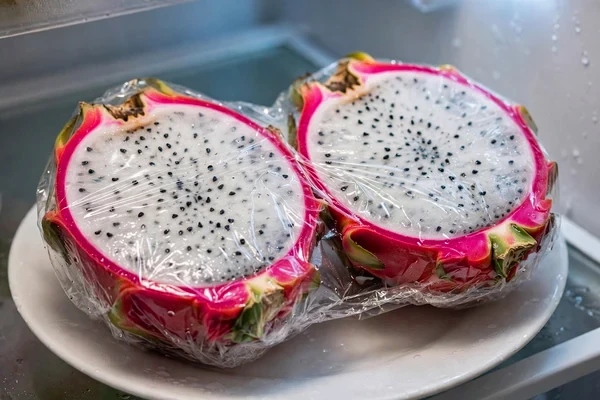
Once a dragon fruit is cut, the rules change. The exposed flesh dries out quickly and picks up smells from the refrigerator, so it needs to be covered. Place the cut halves cut-side down on a plate, or wrap them tightly in cling film, and store them in the refrigerator. Eat cut fruit within one or two days for the best flavour and texture. The flesh may weep a little juice and the surface can dry out, which is normal, but if the flesh turns translucent, brown, or soft and sour-smelling, it is past its best.
Cut fruit also freezes poorly in texture, although it is fine for smoothies, so do not expect a thawed half to eat like a fresh one. If you cut more fruit than you can eat, scoop the flesh into cubes and freeze those instead, as described in the next section. For serving, cut the fruit just before you eat it whenever you can. A whole fruit that has been stored well will always taste better than a half that has sat in the fridge for two days, so plan your cutting around your meals rather than cutting everything at harvest time.
Can You Freeze Dragon Fruit?
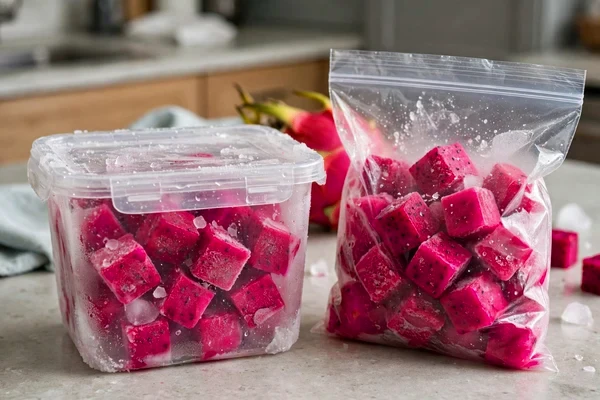
Yes, dragon fruit freezes well for cooking and blending, though not for eating fresh. Scoop the flesh into cubes, spread them in a single layer on a tray, and freeze them until solid. Then move the frozen cubes into a sealed bag or container and return them to the freezer. Frozen cubes keep for several months and are excellent in smoothies, sorbets, and juices, where their bright colour and mild sweetness shine. Thawed cubes will be soft and watery, so do not expect them to slice or serve like fresh fruit.
Do not freeze whole dragon fruit. The skin splits, the flesh becomes mushy on thawing, and the texture is unpleasant. Freezing is a way to save fruit that would otherwise go to waste, not a way to extend fresh eating quality. If you have a large harvest, freeze the extra fruit as cubes on the day you pick it, while it is still firm and fresh, rather than waiting until it is soft. Label the bag with the date so you use the oldest fruit first. Frozen dragon fruit is a practical backup, and it means none of a good harvest has to be thrown away.
Mistakes That Shorten Shelf Life
The most common storage mistake is washing the fruit before storing it. Water on the skin encourages decay, so wash only before eating. The second mistake is storing the fruit in a sealed plastic bag without holes, which traps condensation and speeds up rotting. The third is storing fruit in the warmest part of the kitchen, on top of the refrigerator or beside the stove, where the temperature swings and the fruit softens in a day or two. The fourth is stacking fruit in a deep pile, which bruises the fruit at the bottom and hides the soft ones until they leak and spoil the rest.
Another mistake is storing damaged fruit with good fruit. A fruit with a cut, a split, or a soft spot should be eaten first or used for cooking, not stored alongside sound fruit, because decay spreads from one fruit to another. The same goes for fruit with broken or missing bracts, which dries out faster. Finally, do not store dragon fruit next to apples, bananas, or other fruit that produces a lot of ethylene. Dragon fruit is non-climacteric and its ripening is largely independent of ethylene, but the warmth and moisture from a pile of ripening fruit still shortens its life. Keep it cool, dry on the outside, and separate, and it will last as long as it can.
How to Tell Stored Fruit Has Gone Bad
Stored dragon fruit tells you when it is finished. The skin loses its shine and the colour dulls. The bracts dry out, turn brown, and break off at a touch. The fruit feels soft all over rather than firm with a slight give, and it may feel lighter than it should because it has lost moisture. When you cut it open, the flesh may be translucent, brown at the edges, or sour-smelling. Any of these signs means the fruit is past its best, and if the flesh smells fermented or the skin has dark sunken patches, it should be thrown away.
A small soft spot does not always mean the whole fruit is bad. Cut the fruit open and look: if the flesh is still firm and white or pink with a fresh smell, you can cut away the soft part and eat the rest the same day. If the flesh is brown, watery, or sour, compost the fruit. Trust your nose and your eyes more than any calendar date, because storage life depends on how the fruit was picked, how it was handled, and how cold your refrigerator runs. A fruit that was stored well can still be good after two weeks, while a bruised fruit can spoil in three days.
Frequently Asked Questions
How to store dragon fruit in the refrigerator, and how long does it last?
A whole, undamaged fruit picked at the right maturity commonly keeps for one to two weeks in the refrigerator, stored in a perforated bag in the vegetable drawer. Fruit that was bruised or picked under-ripe will last much less time. Check the fruit every few days and eat the softest ones first.
Should I wash dragon fruit before storing it?
No. Wash dragon fruit only just before you eat it. Water left on the skin encourages decay in storage, so store the fruit dry and wash it at serving time.
Can I store dragon fruit at room temperature?
Yes, for a few days. Keep whole fruit in a single layer in a cool, shaded, ventilated spot and eat it within two or three days in warm weather. For longer storage, use the refrigerator, because the fruit loses moisture quickly at room temperature.
Why did my stored dragon fruit go soft and translucent?
The most likely causes are chilling injury from storage that was too cold, or decay starting from a bruise or skin break. Store red dragon fruit near 10°C rather than at the coldest part of the fridge, keep it in a perforated bag, and do not store damaged fruit with sound fruit.
Related Guides
- When To Harvest Dragon Fruit
- How To Tell If Dragon Fruit Is Ripe
- How To Harvest Dragon Fruit
- How Long Dragon Fruit Lasts
- Dragon Fruit Splitting
- What To Do After Harvesting Dragon Fruit
DragonFruitGrow.online is an independent gardening information website and is not affiliated with any nursery, fruit brand, or agricultural supplier. Growing conditions vary by cultivar, climate, soil, and plant age, so treat this guide as general information and adjust the advice to your own garden.
1 thought on “How to Store Fresh Dragon Fruit After Harvesting”