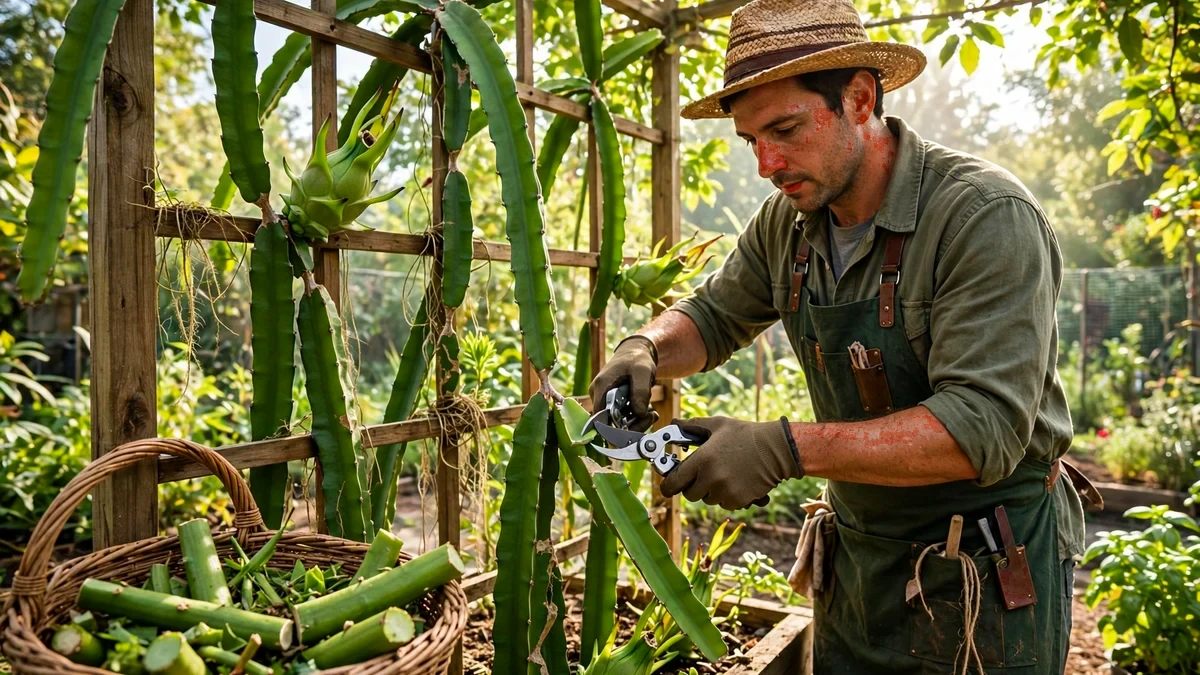
Dragon fruit grows fast. Left alone, a single plant turns into a dense tangle of stems that blocks light, holds moisture, and makes harvesting a struggle. Pruning is the job that keeps the plant open, healthy, and productive, and it is also the job that most new growers put off, because cutting a healthy-looking plant feels wrong.
In fact, a dragon fruit plant that is never pruned produces less fruit, not more, and the fruit it does produce is harder to reach and more likely to rot. Knowing when to prune dragon fruit, and which stems to remove, is one of the most useful skills a grower can learn. This guide explains when to prune dragon fruit, the two kinds of pruning, the best times of year, and how to make clean cuts that heal quickly.
Table of Contents
- Why Pruning Matters for Dragon Fruit
- When to Prune Dragon Fruit: The Best Times of Year
- Training Pruning: Shaping a Young Plant
- Production Pruning: The Annual Post-Harvest Cut
- How to Prune Dragon Fruit Step by Step
- Tools and Cuts: Getting a Clean Result
- What to Do With Pruned Stems
- Mistakes That Weaken the Plant
- Frequently Asked Questions
- Related Guides
Why Pruning Matters for Dragon Fruit
Pruning matters for four reasons. The first is light. Dragon fruit flowers and fruits on stems that receive good light, and a dense canopy shades its own inner stems, so the centre of the plant stops producing. Opening the canopy lets light reach the inner stems, and those stems start to flower. The second reason is air. A crowded canopy stays damp after rain or watering, and damp stems are the ideal home for the fungi and bacteria that cause stem rot and other diseases. Air moving through an open canopy dries the stems quickly and keeps disease down.
The third reason is harvesting. A plant that has been pruned with harvesting in mind has its fruiting stems where you can reach them, and the fruit is easy to see, check, and pick. A plant that has never been pruned hides its fruit behind layers of stems, and much of it is missed, damaged, or left to rot.
The fourth reason is strength. Heavy, crowded stems pull on the trellis and on each other, and they break in wind or under their own weight. A pruned plant carries its weight on strong, well-placed stems tied to a sound trellis. UF IFAS notes that pitaya plants are vigorous and may require pruning one to three times per year, which tells you how seriously the professionals take this job.
That is why knowing when to prune dragon fruit matters as much as knowing how. Pruning is not a punishment for the plant. It is the routine care that keeps it productive for twenty years or more.
When to Prune Dragon Fruit: The Best Times of Year
The main pruning of the year comes soon after the harvest, when the fruit is off the plant and the stems are easy to see and reach. This is the production prune, and it is the one that shapes the plant for the next season. Pruning after harvest gives the plant time to grow new stems before winter, and those new stems are the ones that will flower next year. Pruning also induces flowering and branching, so a good post-harvest prune is the first step towards the next crop rather than the last job of the old one.
Lighter pruning can be done at other times. In spring, remove any stems that were damaged by cold or wind over winter, and tidy up stems that are crossing or rubbing. During the growing season, remove small unwanted shoots as soon as you see them, because a shoot removed while it is small leaves a tiny wound and takes seconds, while the same shoot left for two months needs a saw and leaves a large cut.
Avoid heavy pruning in the middle of flowering or fruiting, because you risk cutting off the stems that carry the current crop, and the plant is using its energy on fruit rather than on healing. Avoid heavy pruning just before a cold snap, because fresh cuts are more vulnerable to cold damage. The simple rule for when to prune dragon fruit is this: the big prune comes after harvest, and small tidying happens whenever you notice a problem.
Training Pruning: Shaping a Young Plant
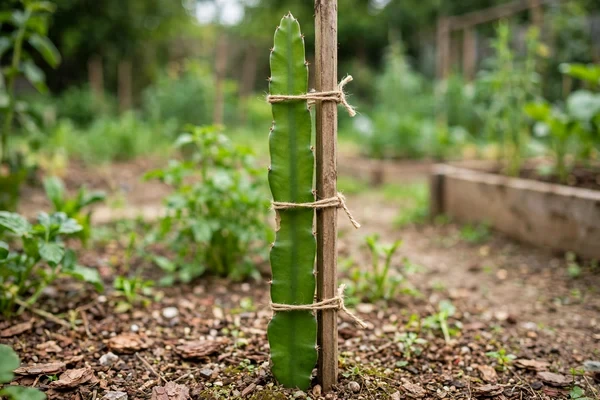
Training pruning is the first kind of pruning, and it applies to young plants. The goal is a single strong main stem that climbs the trellis post, with a spreading canopy at the top. Until the plant reaches the top of the trellis, remove any lateral stems that sprout along the main stem, and tie the main stem to the post with soft ties as it grows. This focuses all the plant’s energy into one stem, so it reaches the trellis faster.
UF IFAS describes this clearly: eliminate lateral stems along the main stem until it reaches the trellis, and tie the main stem to the trellis post.
As soon as the plant reaches the top of the trellis, cut the tip of the main stem. This stops it growing upward and forces it to branch, and the new branches are trained outward and tied to the top frame so they hang down in a curtain. That curtain is where the fruit will form.
If you do not cut the tip, the plant keeps climbing past the trellis and becomes a tangled mass with no clear structure. Training takes patience, because you are removing growth that looks healthy, but a plant that is trained well in its first year is easy to manage for the rest of its life, while a plant that is never trained becomes a problem that is hard to fix later.
Production Pruning: The Annual Post-Harvest Cut
Production pruning is the second kind, and it applies to mature plants. Once the harvest is over, walk around the plant and look at it as a whole. Remove any stem that is dead, diseased, or badly damaged. Then remove stems that reach the soil, because they root where they touch the ground and create a tangle.
Then remove stems that interfere with harvesting or with other stems, and stems that crowd the centre so light cannot reach the inner canopy. Selectively remove some stems and train and tie the remaining stems to the trellis to prevent breakage and crowding, keeping the healthy, strong stems in the best positions.
The aim, once you know when to prune dragon fruit, is an open canopy that you can see through in places, with light reaching the inner stems and air moving freely. A good test is to stand back after pruning and look at the plant: you should be able to see daylight through parts of the canopy, and you should be able to reach into the centre without forcing stems apart.
Do not remove more than about a third of the plant in one session, because a heavy prune shocks the plant and delays recovery. If the plant is very overgrown, spread the work over two seasons rather than cutting half of it away at once. A plant pruned this way after every harvest stays productive, healthy, and easy to pick from year after year.

How to Prune Dragon Fruit Step by Step
Start with a clean, sharp pair of bypass secateurs for most stems, and a pruning saw for any stem thicker than your thumb. Walk around the plant first and mark the stems you plan to remove, either in your head or with a short piece of string, so you do not cut a good stem by mistake.
Work from the top down and from the outside in, so the cut stems fall clear and you can see what you are doing. Hold the stem you are about to cut with one hand so it does not tear as the cut goes through, and cut cleanly in one motion.
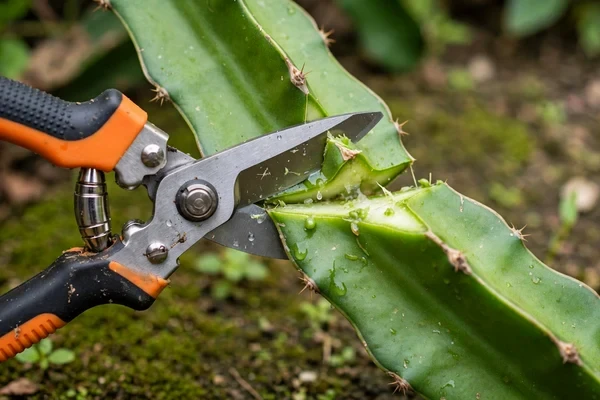
Make each cut just above a joint or a branching point, leaving a short stub that can heal, and angle the cut slightly so water runs off rather than sitting on the cut surface. For larger stems, use the saw and support the stem so it does not split as it falls.
After each cut, step back and look at the plant before you make the next one. Pruning is easier to do in stages than to undo, and a stem that is still on the plant can be cut later, while a stem that is on the ground cannot be put back.
A careful, staged approach is the practical side of knowing when to prune dragon fruit and how to do it well. When you finish, tie any loose stems to the trellis with soft ties, and stand back to check the shape. The plant should look open and balanced, with no heavy section pulling to one side.
Tools and Cuts: Getting a Clean Result
The tool matters as much as the technique. Bypass secateurs, whose two blades slide past each other like scissors, make the cleanest cuts on stems up to about two centimetres thick. Anvil secateurs crush the stem and leave a ragged wound, so they are a poor choice for dragon fruit.
A pruning saw handles thicker stems, and a sharp knife can be used for small shoots, though secateurs are safer. Whatever you use, keep it sharp: a blunt blade crushes the stem, leaves a ragged edge, and heals slowly. Test the edge on paper before you start. A sharp blade cuts cleanly, a blunt one tears.
Clean the blades before you start and between plants, because a dirty blade can carry disease from one plant to another. Wash with soapy water, dry the blades, and wipe them with a little oil after use so they do not rust.
UF IFAS recommends treating larger cuts with a fungicide to reduce the incidence of stem rot, which is worth doing on thick cuts in humid weather.
Wear gloves and long sleeves, because the stems have spines that catch on skin, and wear eye protection when you are cutting overhead, because a falling stem piece can scratch your face. Good tools, kept sharp and clean, make pruning faster, safer, and kinder to the plant when you know when to prune dragon fruit.
What to Do With Pruned Stems
Do not leave pruned stems under the plant. They harbour pests and fungal spores, and they make the area damp and untidy. Carry them away from the trellis and compost them away from the plant, or dispose of them if they are diseased.
UF IFAS advises removing all pruned stems from the field and composting them at a location away from the planting. Diseased stems should not go into a home compost heap that will be used on the same plants, because some fungal spores survive cool composting. Bag diseased stems and dispose of them with household waste.
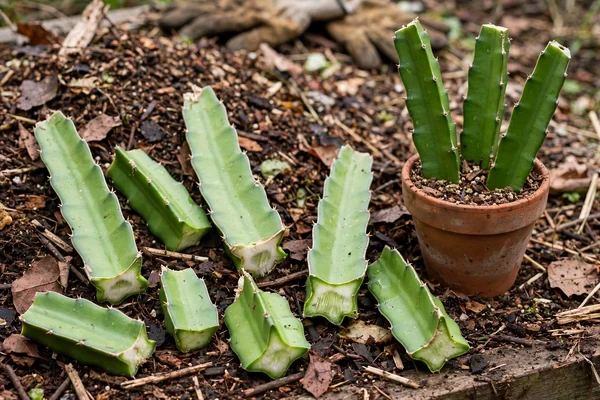
Healthy pruned stems are useful. A stem segment of fifteen to thirty centimetres, cured for a week in a dry, shady place, can be planted as a cutting to grow a new plant, and many growers use their prunings to expand the planting or to share with friends. Keep the best cuttings, label them with the variety if you know it, and cure them before planting. The rest can be chopped and composted. A pruning session that ends with a tidy area, a compost heap, and a few labelled cuttings is a pruning session well done.
Mistakes That Weaken the Plant
The most common mistake about when to prune dragon fruit is not pruning at all. A plant left for three or four years becomes a dense mass that stops fruiting well, and by then the job is large and intimidating. Prune a little every year and the job stays small. The second mistake is pruning too hard at once. Removing more than a third of the plant shocks it, delays recovery, and can reduce flowering the following year. Spread heavy work over two seasons.
The third mistake is using blunt tools, which crush stems and leave ragged wounds that invite rot. Sharpen before you start.
The fourth mistake is pruning at the wrong time, such as during flowering, when you risk cutting off the crop, or just before a cold snap, when fresh cuts are vulnerable. The fifth mistake is leaving pruned stems under the plant, which spreads disease.
The final mistake is tying stems too tightly to the trellis with wire or thin string, which cuts into the stem as it grows. Use wide, soft ties and check them every season, loosening any that have become tight. Pruning done well is gentle, regular, and clean, and it starts with knowing when to prune dragon fruit in the first place. Pruning done badly is the opposite, and the plant shows it for a year afterwards.
Frequently Asked Questions
When to prune dragon fruit for the best harvest?
When to prune dragon fruit for the main prune is soon after harvest, when the fruit is off and the plant can be seen clearly. Light tidying can be done in spring and during the growing season. Avoid heavy pruning during flowering or fruiting, and avoid it just before a cold snap.
How much of the plant can I prune at once?
When you know when to prune dragon fruit, do not remove more than about a third of the plant in one session. If the plant is very overgrown, spread the work over two seasons. A heavy prune shocks the plant and delays recovery and flowering.
Should I treat the cuts after pruning?
For small cuts, the plant usually heals on its own. For larger cuts, especially in humid weather, treating the cut surface with a fungicide helps prevent stem rot. Keep the cut dry and let it heal in the open air.
Can I plant the stems I prune off?
Yes. Healthy stem segments of fifteen to thirty centimetres can be cured for about a week in a dry, shady place and then planted as cuttings. Label them with the variety if you know it, and do not plant diseased stems.
Related Guides
- Train Dragon Fruit On Trellis
- Dragon Fruit Trellis
- Support Dragon Fruit Stems
- Dragon Fruit Stem Rot
- Dragon Fruit Plant Diseases
- What To Do After Harvesting Dragon Fruit
- Dragon Fruit Plant Care
DragonFruitGrow.online is an independent gardening information website and is not affiliated with any nursery, fruit brand, or agricultural supplier. Growing conditions vary by cultivar, climate, soil, and plant age, so treat this guide as general information and adjust the advice to your own garden.
1 thought on “When and How to Prune Dragon Fruit Plants”