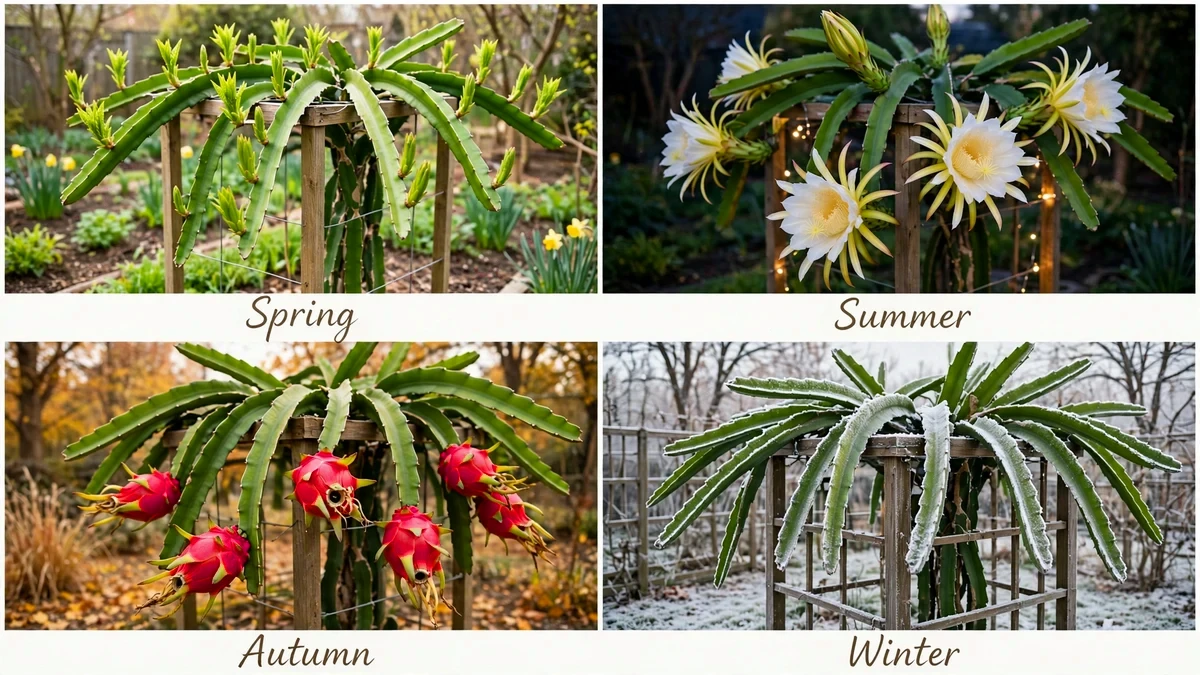
Dragon fruit plant care does not stay the same all year. In spring it grows fast, in summer it flowers and fruits, in autumn it recovers after harvest, and in winter it rests. This dragon fruit plant care calendar sets out what to do in each season, so you can plan watering, feeding, pruning, training and inspections at the right time. It is a guide, not a rigid schedule: exact months shift with climate, variety and whether the plant grows in the ground or in a pot.
Use this dragon fruit plant care calendar as a checklist, adjusted to your local seasons. In a warm, frost-free climate, growth may continue almost all year. In a climate with a cold winter, the year has a clearer shape: growth from spring to autumn, then rest. In the southern hemisphere, seasons are reversed, so read season names, not month names. The UF IFAS pitaya guide includes a month-by-month calendar for Florida — feeding and watering in the warm season, a dry period to encourage flowering, pruning after harvest — a useful model to adapt.
Table of Contents
- How to Use This Calendar
- Spring: Growth, Feeding and First Flowers
- Summer: Flowering, Fruiting and Harvest Support
- Autumn: After Harvest, Pruning and Recovery
- Winter: Rest, Protection and Planning
- Watering and Feeding Through the Year
- Pruning, Training and Inspections Through the Year
- Adjusting the Calendar to Your Climate
How to Use This Calendar
Start by noting your plant’s stage. In dragon fruit plant care, a young cutting in its first year needs different care from a mature plant: it needs steady water, light shade in hot sun, training up its trellis, and time to build roots, but it should not be pushed to flower heavily. A mature plant needs regular pruning to stay open and manageable, feeding through the growing season, and support for heavy stems and fruit. A plant that has just been transplanted needs gentle care for a few weeks, with regular water and no heavy feeding until it shows new growth.
Do the small jobs often rather than the big jobs rarely. A ten-minute weekly inspection — stems, ties, soil moisture and the plant base — catches most problems early. Keep brief notes: when buds appeared, when flowers opened, when fruit ripened, and what the weather did. The calendar also helps you avoid common timing mistakes: feeding heavily in late autumn, when soft growth will freeze; pruning heavily just before a heatwave, when inner stems will burn; and watering heavily in cold, wet winter soil. Each season below is brief, with links to the detailed guides, so this page stays a planning hub rather than repeating those guides.
Spring: Growth, Feeding and First Flowers
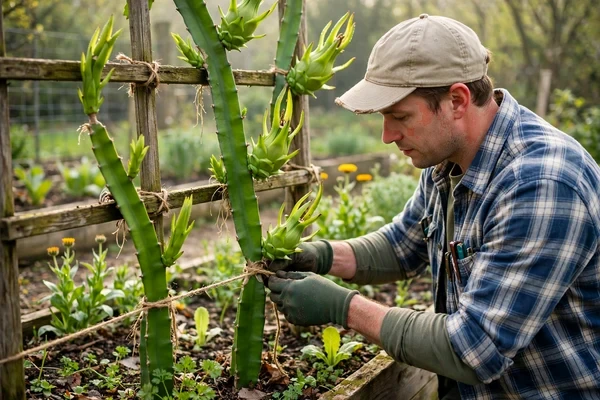
Spring is when dragon fruit plant care starts in earnest. As temperatures rise, the plant wakes from winter and pushes new growth from stem tips and buds. Inspect the whole plant now: remove stems that died back in winter, check ties and the trellis, and clear fallen leaves and old fruit from the base — before growth gets dense and hides the plant’s structure.
Feeding begins in spring, once the plant shows active growth. A light, balanced feed, or compost around the base, supports new shoots without forcing soft, weak growth. UF IFAS suggests starting fertiliser about a month after planting, or when plants begin to grow, and feeding lightly and frequently in the first year. For established plants, small, regular feeds through the warm season are better than one large dose. Detail is in best fertilizer for dragon fruit.
Watering also resumes in spring, steadily rather than heavily: soil should be moist but well drained. As weather warms, increase watering gradually, and watch for the first flower buds on mature stems as days lengthen. Most species are long-day plants, so longer daylight encourages flowering. If your plant is young, let it grow and train its stems; if mature, tie new shoots to the trellis. Guidance is in train dragon fruit on a trellis.
Summer: Flowering, Fruiting and Harvest Support
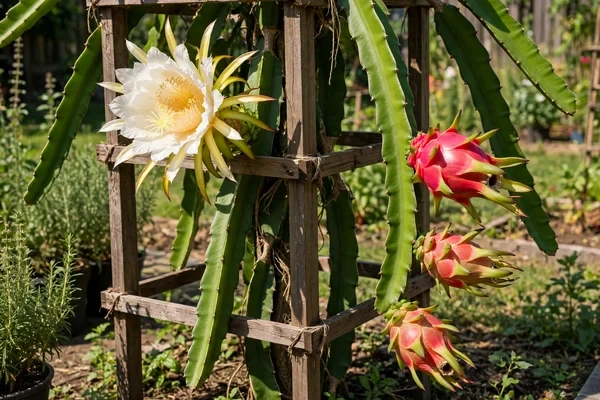
Summer is the busiest season for dragon fruit plant care. Flowers open at night, often in flushes, and fruit follows. Watering is most important now: UF IFAS notes that a dry period in winter and early spring helps flowering, but once plants flower, drought can lead to poor production, so periodic watering is recommended from flowering through harvest. Keep soil moist but drained, water at the base in the morning, and check containers more often, because they dry out faster than ground soil. How to judge moisture is covered in how often to water dragon fruit.
Pollination needs attention in summer too. Some varieties need pollen from a different variety, and night pollinators are not always present, so hand pollination on the night a flower opens can improve fruit set. Also watch for sunburn in hot, dry weather: young and newly exposed stems can scorch, and light shade cloth during a heatwave helps — see protect dragon fruit from sunburn.
As fruit develops, support becomes important. Mature stems are heavy, and fruit adds weight, so check ties and add support where stems sag — see support heavy dragon fruit stems. Harvest when fruit shows the signs for its variety, usually full skin colour and slight softness, rather than by a fixed number of days, because timing differs by cultivar and climate — see when to harvest dragon fruit. After each picking, remove fallen fruit and damaged stems.
Autumn: After Harvest, Pruning and Recovery
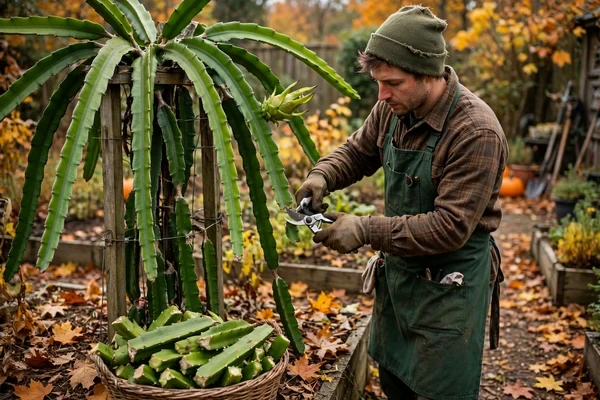
Autumn is the season for recovery and pruning. After the last fruit is picked, the plant recovers before winter. This is the main pruning time: remove damaged, diseased or dead stems, stems that reach the soil, and stems that crowd the canopy or interfere with harvesting. Pruning opens the canopy to light and air, which reduces disease and makes next year’s flowering easier. UF IFAS notes that pitaya may need pruning one to three times a year, and that pruning after harvest is the main production pruning. The timing and cuts are covered in when to prune dragon fruit.
Reduce feeding in autumn: the plant is slowing down, and nitrogen-rich feeding now encourages soft growth that is first to freeze. A light application of compost is usually enough. Reduce watering too as the weather cools, but do not let soil dry out completely in a dry autumn. In a warm climate where flowering continues into autumn, keep watering steady until flowering ends, then taper off.
Autumn is also a good time to inspect for pests and disease while the canopy is open after pruning. Look for scale, mealybug, thrips damage, stem rot and black spot, and remove affected material. Clean tools between cuts if you find disease, and take pruned stems away from the plant. See dragon fruit plant diseases and dragon fruit pests. Finally, check the trellis and ties before winter storms.
Winter: Rest, Protection and Planning
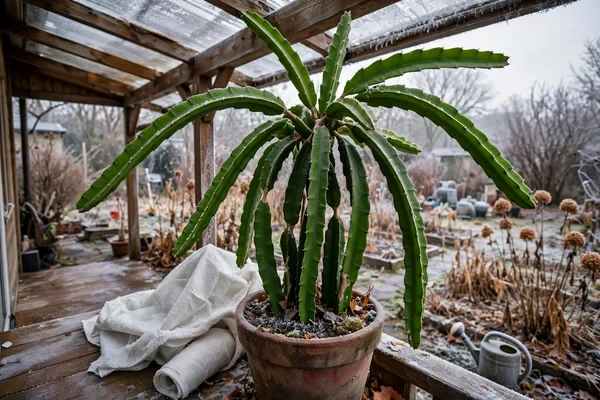
Winter is the rest season, and the main job in dragon fruit plant care is protection, not growth. Below about 10 degrees Celsius, growth largely stops and the plant uses little water, so water lightly and only when soil is dry. Wet, cold soil is the main winter risk, because it invites root and stem rot. Keep soil moist, not soggy, and make sure pots drain freely.
In frost-prone areas, protection is the priority. Choose the warmest spot, keep frost cloth ready, mulch the root zone, and move small pots to shelter before the first frost. The full methods — warm positions, covers, watering before frost, and what to do after a cold night — are in protect dragon fruit from cold. Do not prune in the middle of winter, except to remove a clearly dead or rotting stem, because fresh cuts in cold, wet weather can let in disease, and it is hard to tell what is alive until spring growth appears.
Winter is also the planning season: order a second variety if pollination was a problem, plan a new trellis or better position, review your notes, and check tools. Take cuttings in the warm season, not winter, when rooting is slow. A plant that rests well in winter — dry enough, protected from frost, left alone — starts spring strongly.
Watering and Feeding Through the Year
In dragon fruit plant care, watering and feeding follow the plant’s growth, not the calendar alone. In spring and summer, when the plant is growing, flowering and fruiting, it needs regular water and light, regular feeding. In autumn, both taper off as growth slows. In winter, water is minimal and feeding stops. This pattern matches the UF IFAS guidance: a dry period in winter and early spring helps flowering, regular water from flowering through harvest supports fruit, and fertiliser increases gradually as the plant ages, with small, frequent applications rather than large, infrequent ones.
The soil is the best guide to watering. Check it before you water: the top few centimetres can dry between waterings, but deeper soil should stay moist in the growing season. In a pot, soil dries faster; in sandy soil, water may be needed more often; in heavy soil, water less often and ensure drainage is free. A wet week means no watering, a dry hot week means more. See how often to water dragon fruit and best fertilizer for dragon fruit.
Feeding should be moderate and balanced. Over-feeding, especially with nitrogen, produces soft growth at the expense of flowers and can burn roots on dry soil. Under-feeding over years leaves a plant thin and pale, with few flowers. Compost around the base, kept away from the stem, improves soil and feeds slowly. Follow the product label, water before feeding if soil is dry, and do not feed a stressed or newly transplanted plant until it is growing again.
Pruning, Training and Inspections Through the Year
Pruning, training and inspection are the quiet, regular jobs in dragon fruit plant care that keep a plant productive. Training happens mainly in spring and early summer, when new shoots are soft and easy to tie: guide the main stem up the trellis, remove side shoots until it reaches the top, then tip it to encourage branching. The method is in train dragon fruit on a trellis. Support is checked through summer, when stems and fruit are heaviest, and the options are in support heavy dragon fruit stems.
Pruning has two forms. Training pruning shapes a young plant. Production pruning, done mainly after harvest, removes damaged, diseased or dead stems, stems reaching the soil, and crowded stems that block light and air. A plant that is never pruned becomes a dense tangle, with poor light, more disease and harder harvesting. A plant pruned too hard loses flowering wood and takes a season to recover. The balance is to remove a little, often, rather than a lot at once. Timing and cuts are in when to prune dragon fruit.
Inspections should happen weekly in the growing season and monthly in winter. Look at stem colour and firmness, new growth, ties, the trellis, soil moisture and the plant base, and watch for pests and disease signs such as soft, blackened or spotted stems — see dragon fruit plant diseases and dragon fruit pests. Remove fallen flowers and fruit promptly, clean tools after cutting diseased stems, and keep the area under the plant clear so air can move.
Adjusting the Calendar to Your Climate
No dragon fruit plant care calendar fits every garden. In a frost-free tropical climate, the plant may grow and flower most of the year, with a short slow period in the coolest months — feed and water when it is growing, prune after the main harvest, and rest it during its slowest months. In a subtropical climate with a mild winter, the four-season shape here fits well, with winter as a short rest.
In a climate with a cold winter, start feeding later in spring, after the last frost, and stop earlier in autumn, so growth hardens before cold arrives. In a very hot, dry climate, add shade and water in summer. In a humid climate, focus on airflow, drainage and disease prevention, because wet, still air is the main risk.
Altitude, wind and soil also shift the calendar. A high-altitude garden has stronger sun and colder nights, so sun protection in summer and frost protection in winter both matter more. A windy garden dries soil faster, so watering and ties need more attention. Sandy soil needs more frequent watering; heavy soil needs better drainage and less water. Keep notes for a full year, then adjust the calendar: move a task a month earlier or later, add one your garden needs, and drop one it does not. After a year, this dragon fruit plant care calendar becomes your calendar, and that is when it is most useful — a living plan for dragon fruit plant care in your own garden.
Frequently Asked Questions
How often does dragon fruit plant care need a check?
Check weekly in spring and summer, when the plant is growing, flowering and fruiting, and monthly in winter, when it is resting. A quick look at stems, ties, soil moisture and the base of the plant catches most problems early, when they are easy to fix.
Can I follow this calendar if my seasons are reversed?
Yes. The calendar is written by season, not by month, so in the southern hemisphere, read spring as September to November, summer as December to February, autumn as March to May and winter as June to August. The order of tasks stays the same.
What is the most important task in the calendar?
Steady watering from flowering through harvest, and pruning after harvest, most affect fruiting. Without steady water, flowers and young fruit drop; without pruning, the canopy becomes dense and disease increases.
Should I feed my dragon fruit in winter?
No, in most climates. The plant is barely growing in winter and uses little water or nutrients, so feeding then can encourage soft growth that freezes, or burn roots in cold, wet soil. Resume light feeding in spring once active growth appears.
DragonFruitGrow is an independent gardening information resource. Growing results vary with cultivar, climate, soil and plant age.