How to Propagate Dragon Fruit from Stem Cuttings
To propagate dragon fruit from cuttings, you take a healthy stem segment from a mature plant, let the cut end dry and heal, then plant it in a free-draining mix until roots form. It is the standard way dragon fruit is multiplied around the world, and for good reason: a cutting is an exact clone of its parent, so the fruit, flesh colour and growth habit are already known, and it reaches fruiting far sooner than a seed-grown plant.
If you already have a plant — or a friend with one — a single stem can become several new plants within a season. The process is simple, but the details matter: the cut must heal before it touches soil, the mix must drain freely, and the young plant needs warmth and patience while it roots.
Table of Contents
- Why Growers Propagate Dragon Fruit from Cuttings
- Choosing the Right Stem to Cut
- Tools and Hygiene Before You Cut
- Cutting and Curing: The Step Beginners Skip
- The Rooting Mix: What Cuttings Need Underground
- Planting the Cutting in Its First Pot
- Rooting Conditions: Warmth, Light and Water
- Signs of Success and Common Failures
- From Rooted Cutting to Climbing Plant
- Frequently Asked Questions
- Final Thoughts
Why Growers Propagate Dragon Fruit from Cuttings
Growers propagate dragon fruit from cuttings more than any other way because cuttings are fast, reliable and true to type. UF IFAS Extension notes that entire stem segments of 6 to 15 inches (about 15 to 38 cm) are commonly used, and that cuttings grow fast — around 3 cm a day in warm conditions — with many producing fruit within 6 to 9 months of planting under good conditions. That speed is a huge advantage over seeds, which can take up to 7 years to fruit and produce plants that differ from the parent.
A cutting also removes the guesswork. If the parent plant produces sweet red-fleshed fruit and sets fruit reliably, every cutting from it carries the same genetics. With seeds, each seedling is a genetic mix, so fruit colour, flavour and even the plant’s ability to set fruit on its own pollen can all vary. For a home grower who wants a known result, that certainty is worth a great deal. Our guide on growing dragon fruit from seeds explains the seed route in full, so you can compare the two methods before deciding.
Choosing the Right Stem to Cut

When you propagate dragon fruit from cuttings, the quality of the cutting decides the quality of the new plant, so choose carefully. Take stems from a healthy, mature plant that has already fruited if possible — a plant that has proven it can flower and set fruit is the best possible source. Look for a stem that is thick, firm and deep green, with plump ribs and no soft spots, yellowing, scarring or insect damage. A stem that is at least a year old, fully hardened and about as thick as your thumb is ideal. Young, thin, pale-green growth is too soft: it dries out easily and rots more readily.
Avoid taking cuttings from a plant that is stressed, diseased or covered in pests, and avoid stems that are already flowering or carrying fruit — the plant’s energy is going into the fruit, not into rooting. If the plant has several healthy stems, take one or two and leave the rest; heavy cutting weakens the parent.
A good time to take cuttings is in the warm season, when the plant is actively growing and the cutting will root quickly. In cooler months, rooting slows down and rot becomes more likely, so wait for warmth if you can. Note which end is the top before you cut: the areoles — the small bumps that carry the spines — angle upward toward the growing tip. If you take several cuttings, mark the top of each one so there is no confusion later.
Tools and Hygiene Before You Cut
When you propagate dragon fruit from cuttings, clean tools are not optional. Dragon fruit stems are fleshy and full of moisture, and a dirty blade can introduce bacteria and fungi straight into the cut. Use sharp, clean secateurs or a pruning knife, and wipe the blade with rubbing alcohol or a dilute household disinfectant before you start and between plants. A clean, sharp cut heals far better than a crushed or ragged one, so keep the blade sharp and cut in one confident motion.
Wear gloves: the stems carry small spines along their ribs, sharp enough to be unpleasant when you are handling several cuttings. Have your curing area ready before you cut — a dry, shaded spot with good air circulation, such as a shelf in a garage or under a covered porch. You may also want a fungicide, or a dusting of cinnamon or sulfur powder for the cut end, to discourage rot while it heals. Rooting hormone is optional: UF IFAS notes that some propagators apply it after curing and before planting, but plenty of cuttings root without it.
Cutting and Curing: The Step Beginners Skip

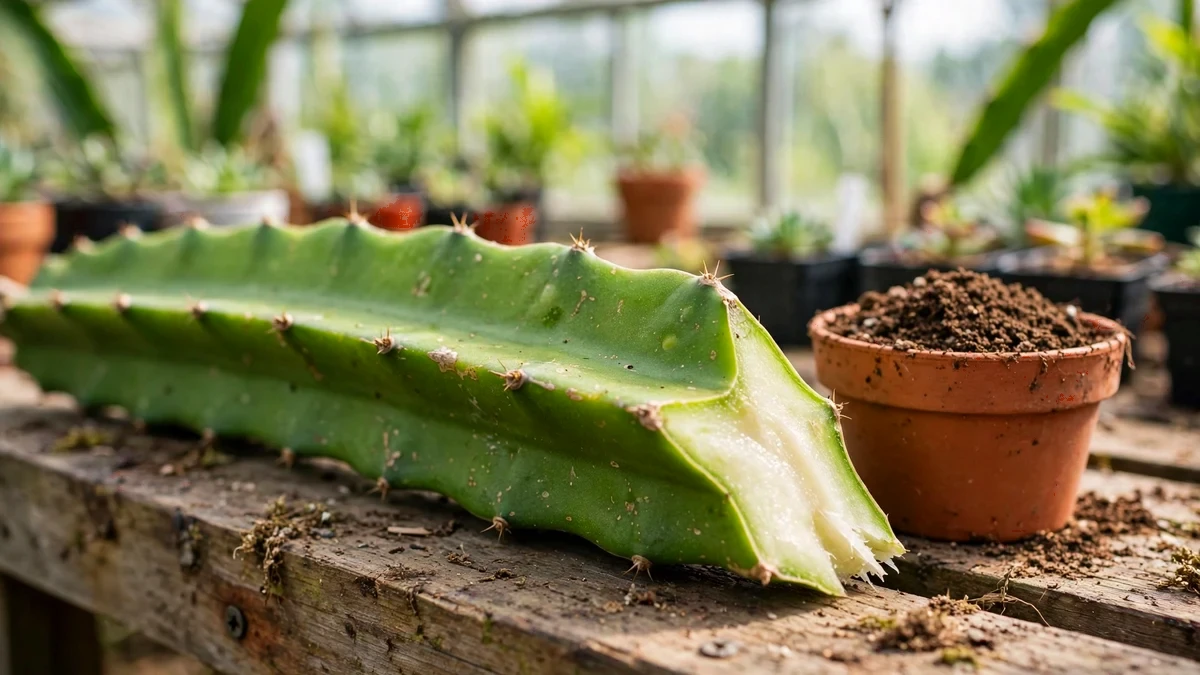
To propagate dragon fruit from cuttings successfully, cut a stem segment 15 to 38 cm long, making a slanted cut at the base. The slant increases the surface area for rooting, helps water run off the cut instead of pooling on it, and makes it obvious which end goes down. Cut straight across the top, or leave the natural growing tip intact if the segment ends in one. Keep each piece at least 15 cm long — shorter pieces have less stored energy and dry out faster.
Now comes the step most beginners skip, and the one that causes most failures: curing. The fresh cut must be left to dry and heal for 7 to 8 days in a dry, shady location, according to UF IFAS, before it is planted. During this time the cut surface forms a dry callus that seals the wound against rot. A cutting planted while the cut is still wet and open is an open door for fungi and bacteria, especially in warm, damp soil.
Stand the cuttings upright or lay them on a shelf in the shade with good airflow, cut end exposed to the air. Do not wrap them in plastic or keep them in a damp bag, and do not rush this step. The cut is ready when the surface feels dry, firm and slightly shrunken, with a pale callus covering it. If any cutting shows soft, dark or foul-smelling tissue at the cut, discard it — it is already rotting.
The Rooting Mix: What Cuttings Need Underground
The mix you use to propagate dragon fruit from cuttings must do two things: hold the stem upright and stay moist without ever staying wet. A heavy garden soil that holds water is the worst choice, because the callused end will soften and rot before roots form. Use a very free-draining mix instead: one part potting mix or compost, one part coarse perlite or pumice, and one part coarse sand or fine bark. Some growers root cuttings in pure perlite or coarse sand, then move them to a richer mix once roots appear — that also works well.
The pot matters too. Use a small pot, roughly 10 to 15 cm across, with large drainage holes. A small pot dries out and warms up faster than a large one, which suits a cutting, and it is easier to judge when the mix needs water. Fill the pot with the mix, firm it lightly, and water it once before planting so it is evenly damp, not soaked. Our soil guide at best soil for dragon fruit explains the same principles in more detail: drainage first, organic matter second.
Planting the Cutting in Its First Pot
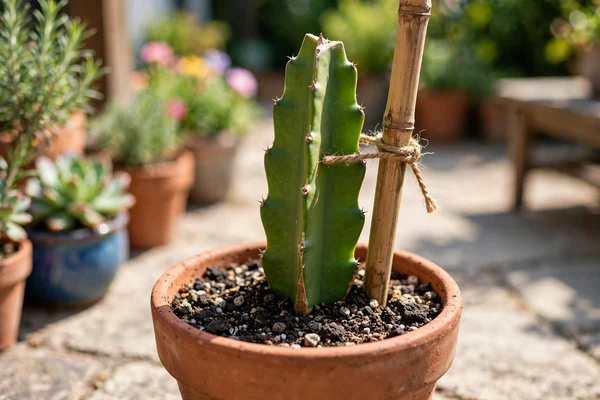
Plant the cured cutting with the callused end down, burying the bottom 3 to 5 cm in the mix. Press the mix gently around the base so the cutting stands upright on its own; if it wobbles, tie it loosely to a short bamboo stake. The cutting should be stable, because any movement at the base can break the fragile new roots as they form. Water lightly — just enough to settle the mix around the base — and then leave it alone. The most common error at this stage is overwatering: the cutting has no roots to use the water, so a soaked mix only invites rot.
Rooting Conditions: Warmth, Light and Water
When you propagate dragon fruit from cuttings, watering is a balancing act. The mix should stay lightly moist, never wet and never bone dry. Check it every few days by pushing a finger into the top 2 cm: if it feels dry, water sparingly around the base, not over the stem. If it still feels damp, wait. In warm weather a small pot may need water every few days; in cooler weather, once a week or less. When in doubt, wait — a slightly dry cutting survives, a rotted one does not.
Place the pot in a warm, bright spot out of direct midday sun — a shaded greenhouse bench, a covered porch or a bright windowsill all work. Warmth matters more than light at this stage: rooting is fastest when the mix stays around 20 to 30°C, and it slows sharply below about 15°C, so move the pot under cover on cold nights. Airflow is the forgotten ingredient: stagnant, humid air encourages fungal problems, so keep the pot where air moves freely and do not crowd pots together. And resist the urge to tug on the cutting to check for roots — pulling it up breaks the new root hairs and sets the plant back weeks.
Signs of Success and Common Failures
The first sign of success is new growth at the tip or from a side areole: a small green shoot, often slightly pink or red at first, pushing out of the stem. That means roots have formed and the plant is feeding itself. A second sign is resistance: if you give the cutting a very gentle nudge and it holds firm instead of wobbling, roots are anchoring it.
Failure usually looks like softness. A cutting that turns yellow, then brown, then soft at the base is rotting, and the usual cause is a wet mix, an uncured cut, or cold conditions. If the rot is only at the very base, you can sometimes rescue it: cut off the rotted part with a clean blade, re-cure the cutting for a week, and try again in fresh, drier mix.
If the rot has spread up the stem, discard it. Shrivelled, thin stems usually mean the opposite problem — too dry, or too much sun — and a move to shade with light watering may save them. The most common failure of all is impatience: a cutting that looks unchanged for a month may still be quietly growing roots underground, so unless the stem is soft, discoloured or foul-smelling, give it time.
From Rooted Cutting to Climbing Plant

Once you propagate dragon fruit from cuttings and the young plant is growing strongly, it is ready for the next stage: a larger pot or a place in the ground beside its trellis. UF IFAS recommends growing cuttings in pots for 4 to 6 months so they develop a good root system before planting out, and that is a sensible timeline to follow. When you move it, handle the root ball gently and plant at the same depth it was growing in the pot.
The trellis should be ready before the plant is — a strong post with a support structure at the top, because a mature dragon fruit plant is heavy and a weak trellis will buckle under it. Tie the main stem to the post and remove side shoots until the stem reaches the top, then let it branch.
Our guide on training dragon fruit vines on a trellis covers this stage step by step, and planting dragon fruit in the ground covers site selection, spacing and planting depth. If you are keeping the plant in a container long term, our guide to growing dragon fruit in pots explains pot size and support. And if you want to know how long the whole journey takes, see how long dragon fruit takes to fruit — the answer depends on variety, climate and care, and cuttings are the fastest route there.
Frequently Asked Questions
How long does it take to propagate dragon fruit from cuttings?
When you propagate dragon fruit from cuttings in warm weather, most show new growth within 3 to 6 weeks, which means roots have formed. Full establishment — a strong root system ready for planting out — takes about 4 to 6 months in a pot. Cooler weather slows everything down, so take cuttings in the warm season when you can.
Can I plant a dragon fruit cutting directly in the ground?
Yes, a cured cutting can be planted directly into well-drained soil, and this is common in warm climates. But starting in a pot gives you more control over moisture and lets you check progress, so it is the safer choice for beginners and for cooler or wetter conditions. Either way, the cut must be cured first and the soil must drain freely.
Do I need rooting hormone for dragon fruit cuttings?
No, it is optional. Many cuttings root perfectly well without it, provided the cut is cured and the mix drains. Rooting hormone can speed things up slightly and is cheap insurance if your conditions are less than ideal, but it does not replace curing or good drainage.
Why did my dragon fruit cutting rot?
The usual causes are planting an uncured cutting, a mix that stays wet, or cold conditions. Cut off the rotted tissue, let the cutting cure again for a week in dry shade, and replant in fresh, drier mix. If rot has spread well up the stem, discard the cutting and start again.
Final Thoughts
To propagate dragon fruit from cuttings, remember three things: choose a healthy stem, cure the cut for a week, and root it in a mix that drains freely. Those three steps decide almost every outcome. Cuttings are the fastest, most reliable way to multiply dragon fruit, and they give you a plant that is a true copy of its parent — fruit, flavour and all.
Take your cuttings in the warm season, be patient while they root, and move them onto a strong trellis when they are ready. If you want the full picture from the start, read our complete beginner’s guide to growing dragon fruit, and if you are curious about the slower road, compare this method with growing dragon fruit from seeds.