
How to Grow Dragon Fruit from Seeds
To grow dragon fruit from seeds, you scoop the tiny black seeds from a ripe fruit, clean and dry them, sow them on the surface of a moist, free-draining mix, and keep them warm and humid until they sprout. It is the cheapest way to start dragon fruit — a single fruit holds hundreds of seeds — and it is genuinely fun to watch a tray of seedlings appear from something you ate for breakfast. But it is also the slowest road to fruit, and the plants you get will not be copies of the parent.
Seeds suit growers who enjoy the process itself: experimenting, breeding, or starting many plants at almost no cost. They do not suit anyone who wants a known variety and fruit soon, and understanding that trade-off before you sow saves years of disappointment.
Table of Contents
-
- Why Grow Dragon Fruit from Seeds?
- What Seed-Grown Plants Really Are
- Getting Seeds: From Fruit to Seed Tray
- Germination Step by Step
- Seedling Care: The First Few Months
- Transplanting: Moving Seedlings On
- The Long Wait: From Seedling to Fruit
- When Seeds Make Sense — and When Cuttings Win
- Frequently Asked Questions
- Final Thoughts
Why Grow Dragon Fruit from Seeds?
The obvious reason to grow dragon fruit from seeds is cost and availability. A single fruit from a shop or market can yield hundreds of viable seeds, and you do not need a mature plant, a cutting, or a nursery nearby. For growers in places where dragon fruit plants are hard to buy, seeds may be the only practical starting point.
The second reason to grow dragon fruit from seeds is curiosity. Growing from seed is how new varieties are created: every seedling is a genetic mix of its parents, so each one is slightly different. Most will be ordinary, but a few may be interesting — a different flesh colour, a sweeter fruit, a stronger plant. Breeders and keen hobbyists grow hundreds of seedlings precisely to find those rare ones. If you enjoy that kind of slow experiment, seeds are the way in. But go in with your eyes open: seeds are a project, not a shortcut, and the rest of this guide explains why.
What Seed-Grown Plants Really Are
Every seed is a genetic gamble. A dragon fruit seed carries genes from both its parents — the mother plant that bore the fruit and whichever plant supplied the pollen. The seedling that grows from it will resemble its parents in general, but it will not be identical to either of them. Fruit colour, flesh colour, flavour, sweetness, fruit size and even the plant’s ability to set fruit with its own pollen can all differ from the parent fruit you ate. UF IFAS Extension states this plainly: pitaya may be propagated from seed, but fruit and stem characteristics are variable.
That variability also affects pollination: some cultivars are self-incompatible, and a seedling may inherit that trait — or not. Because you cannot know until the plant flowers years later, seed-grown plants are a poor choice if you want a guaranteed self-fertile plant. If a known variety matters to you, cuttings are the reliable route, as explained in our guide on how to propagate dragon fruit from cuttings.
Seedlings also vary in vigour. Some grow fast and strong; others stay weak or develop unusual stem shapes. This is normal, and part of the reason growers start many seeds and keep only the strongest plants. Do not judge a seedling too early — a slow starter in the first months can still become a strong plant — but do not be afraid to thin out the weakest ones either. Space, pots and time are limited, and the best plants deserve them.
Getting Seeds: From Fruit to Seed Tray
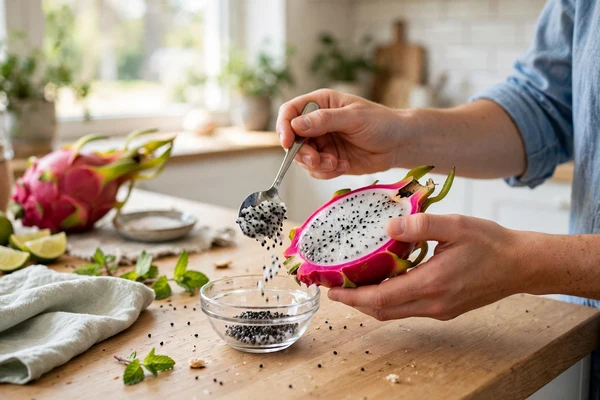
Start with a fully ripe fruit. The seeds inside are mature and ready, while seeds from an unripe fruit may be pale and unlikely to germinate. Cut the fruit open and scoop the flesh into a bowl. The seeds are the tiny black dots scattered through the pulp. To separate them, mash the flesh gently in water: the pulp floats and breaks apart, and the heavier seeds sink. Pour off the cloudy water, add fresh water, and repeat until the seeds are mostly clean.
Spread the seeds on a paper towel or a fine cloth and let them dry for a day or two in a shaded, airy spot. They should feel dry and separate easily, not clump together. Do not dry them in direct sun or in an oven — heat kills them. Once dry, the seeds can be sown straight away, which gives the best germination, or stored in a labelled paper envelope in a cool, dry place for a few months. Fresh seed germinates best, so do not store them longer than you need to.
You can also buy seeds, but buy carefully. Choose a seller who names the variety, and be wary of listings promising an unusual variety at a suspiciously low price — mislabelled seed is common, and you will only discover the truth years later when the plant fruits. A fruit bought from a market, where you can see and taste exactly what you are getting, is often the most reliable source of all.
Germination Step by Step
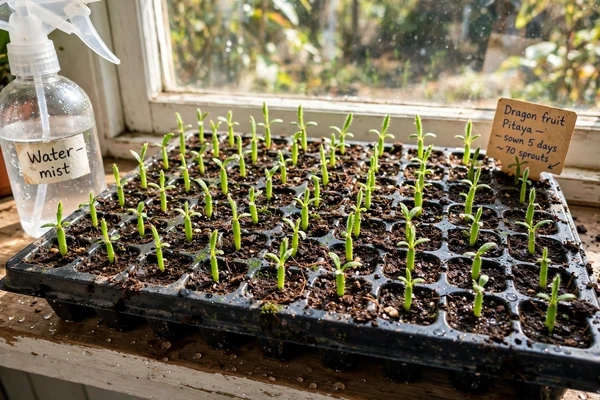
To grow dragon fruit from seeds successfully, germination conditions matter more than anything else. The seeds need warmth, moisture and light, all at once. Fill a shallow tray or small pots with a fine, free-draining seed mix — one part compost, one part perlite and one part fine sand works well. Water it until evenly damp, then let excess drain away. The mix should feel like a wrung-out sponge, not a wet cloth.
Sprinkle the seeds thinly over the surface and press them down very gently, but do not bury them. Dragon fruit seeds are tiny and need light to germinate, so a covering of more than a millimetre or two of mix can stop them sprouting. Mist the surface lightly with a spray bottle.
Cover the tray with a clear lid or a sheet of cling film with a few small holes, and place it somewhere warm and bright — 20 to 30°C is ideal, such as a sunny windowsill or a heated propagator. The cover holds humidity, which the seeds need, but open it daily for a few minutes so fresh air gets in and mould does not build up.
Keep the surface moist with a light mist whenever it looks dry; never let it dry out completely, and never flood it. In good conditions, the first tiny green sprouts usually appear within 1 to 3 weeks. If nothing appears after a month, the seed may have been old or the conditions too cool — try again with fresh seed and more warmth.
Seedling Care: The First Few Months
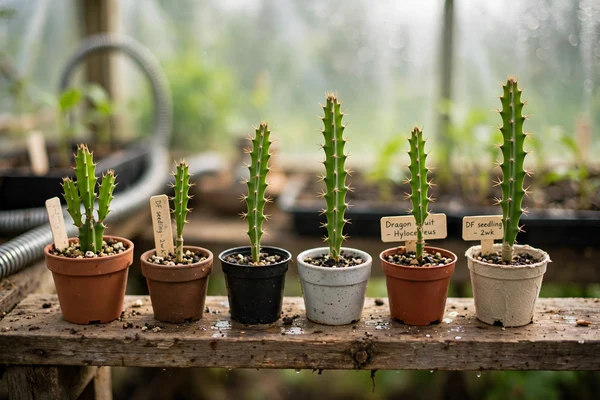
The first seedlings are tiny and fragile: thin green stems, often with a reddish tinge, and a pair of small seed leaves. Keep them warm, bright and lightly moist, and protect them from direct midday sun, which can scorch them in a small tray. Morning sun and bright shade for the rest of the day is a good balance.
Ventilation matters as soon as the seedlings appear. Remove the cover gradually over a few days rather than all at once, so the seedlings adjust to drier air without wilting. If white, fuzzy mould appears on the surface, increase airflow and let the top of the mix dry slightly between mistings. Water from below where possible, by standing the tray in a shallow dish of water for a few minutes, so the delicate stems stay dry.
Do not feed seedlings in their first weeks: the seed itself carries enough food to get the plant started, and fertiliser at this stage can burn the tiny roots. Once the seedlings are a few centimetres tall and showing their first true spines, a very dilute liquid feed — at quarter strength, once every two to three weeks — is enough. Slow, steady growth makes stronger plants than a forced flush of soft growth.
Transplanting: Moving Seedlings On
When you grow dragon fruit from seeds and the seedlings reach about 5 to 8 cm tall with their first proper stems, they are ready to move into individual pots — usually a few months after sowing. Handle them by their leaves or by a small clump of mix around the roots, never by squeezing the stem. Use a small pot, about 7 to 9 cm across, filled with the same free-draining mix used for germination, with a little more compost mixed in.
Water the seedlings an hour before transplanting so the mix holds together, then lift each one with a small fork or spoon and set it in its new pot at the same depth it was growing. Firm the mix gently around it and water lightly. Keep the transplanted seedlings in bright shade for a week while they settle, then move them gradually into more sun. Some wilting in the first day or two is normal.
As the plants grow, pot them on into larger containers before they become root-bound. When a seedling reaches 30 to 40 cm tall and has a firm, thick stem, give it a stake or a small trellis and start training it upward. Our guide on how to grow dragon fruit from a cutting follows the same growth stages from this point on, so it is a useful next read.
The Long Wait: From Seedling to Fruit
This is the part of the story that surprises most beginners. UF IFAS Extension notes that the time from planting a seed to fruit production may be up to 7 years. Not every seedling takes that long — some fruit sooner, especially in warm climates with good care — but years, not months, is the honest expectation.
Why does it take so long? A seedling must first grow into a mature plant: build a strong stem, climb to the top of its support, branch into a canopy, and reach the size and age at which flowering is triggered. That process cannot be rushed with fertiliser or extra water; pushing a young plant too hard with nitrogen usually produces soft growth and delays flowering. The plant fruits when it is ready, and readiness depends on variety, climate, sunlight, support and care together.
There are two ways to shorten the wait. The first is grafting: a seedling stem grafted onto a mature, rooted cutting gets an established root system and can fruit sooner. The second is to grow several seedlings at once and keep the strongest: a vigorous plant reaches maturity faster than a weak one. Either way, patience is part of the method — if you want fruit soon, start with a cutting as well, and let the seedlings be a long-term project alongside it.
When Seeds Make Sense — and When Cuttings Win
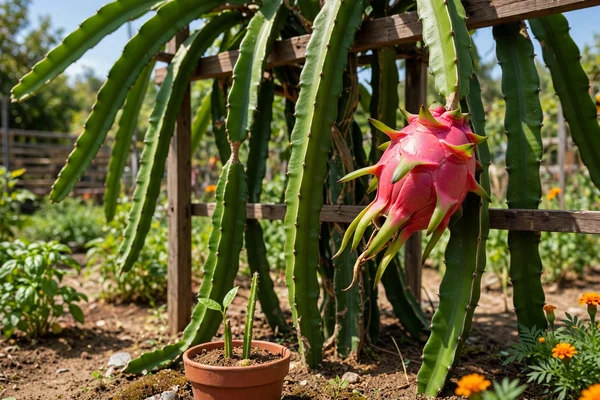
Seeds make sense when you want many plants cheaply, when you enjoy experimenting, when you are breeding for new traits, or when cuttings are simply not available. They are also a good way to learn the plant from the very beginning. If you have space, time and curiosity, grow dragon fruit from seeds — and grow a lot of them, so you can select the best.
Cuttings win in almost every other situation. If you want a known variety, known fruit quality, a self-fertile plant, or fruit within a year or two, a cutting is the right choice. They are exact clones of the parent, they root quickly, and they skip the long juvenile phase that seedlings must pass through. Most home growers are best served by starting with one or two cuttings of a proven variety, and using seeds as a side project rather than the main plan.
The two methods are not rivals. Many experienced growers do both: cuttings for reliable fruit, and a tray of seedlings for fun, breeding and backup plants.
If you take that approach, keep the seedlings labelled — especially if you sow seeds from more than one fruit — because in two or three years you will not remember which plant came from which fruit, and that information matters if one of them turns out to be special. For the cutting route, see our guide on propagating dragon fruit from cuttings, and for the timeline question in full, see how long dragon fruit takes to fruit.
Frequently Asked Questions
How long does it take to grow dragon fruit from seeds?
In warm, moist conditions at 20 to 30°C, most seeds sprout within 1 to 3 weeks. Cooler conditions slow germination considerably, and old or poorly stored seed may not germinate at all. If nothing appears after a month, try again with fresh seed and more warmth.
Can I grow dragon fruit from seeds from a shop-bought fruit?
Yes, and it is one of the most reliable sources of seed, because you can see and taste the fruit you are taking seeds from. Scoop out the seeds, wash off the pulp, dry them for a day or two, and sow them fresh. The plant that grows will not be an exact copy of the parent fruit, but it will be closely related.
Will a seed-grown dragon fruit plant produce the same fruit as the parent?
No — not exactly. Each seedling is a genetic mix, so fruit colour, flesh colour, flavour and size can all differ from the parent. Some seedlings produce fruit very like the parent, others quite different. If you want the same fruit, grow a cutting from the parent plant instead.
How can I speed up fruiting from a seed-grown plant?
Give the plant full sun, a strong trellis, free-draining soil and steady care, and keep only the most vigorous seedlings. Grafting a seedling onto a mature rooted cutting can also bring it into fruit sooner. But no shortcut turns a seedling into a fruiting plant in months — expect years, and treat the wait as part of the project.
Final Thoughts
To grow dragon fruit from seeds is to choose the slow, cheap and fascinating road. A single fruit gives you hundreds of plants for almost nothing, and each one is a small genetic surprise. The price is time — years, not months, before the first fruit — and uncertainty about what that fruit will be like. Go in knowing that, sow plenty, keep the strongest, and enjoy the process as you grow dragon fruit from seeds.
And if you want fruit soon as well, start a cutting alongside your seedlings: the cutting will feed you while the seedlings grow up. For the full picture, read our complete beginner’s guide to growing dragon fruit and our soil guide at best soil for dragon fruit before you pot your seedlings on.
DragonFruitGrow is an independent gardening information resource. This article is for general gardening guidance only.