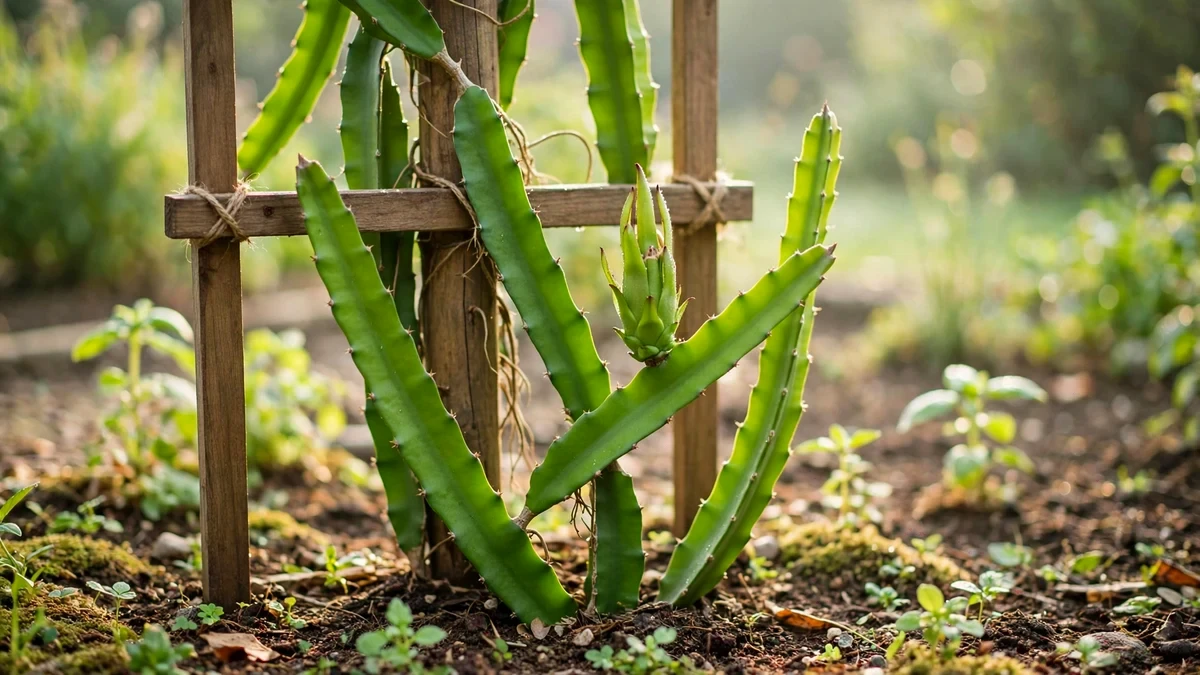
How to Plant Dragon Fruit in the Ground
To plant dragon fruit in ground well, plan before you dig. Dragon fruit, also called pitaya, is a climbing, vine-like cactus. Its stems grow fast, spread wide, and become heavy as the plant matures. A small nursery plant can, over a few seasons, cover a trellis and test the strength of its support. The choices you make on planting day — site, drainage, distance from walls and trees, and support — shape the plant for years. When you plant dragon fruit in ground with those choices made well, it has room to root, climb, and fruit in its own time.
This guide covers the in-ground method for gardeners with space and a warm climate. If space is limited, see how to grow dragon fruit in pots. For the wider first year, see how to grow dragon fruit.
Table of Contents
- Choosing the Right Spot and Checking Drainage
- Preparing the Soil and Planting Hole
- Installing the Support First
- Rooted Plants or Fresh Cuttings
- Setting the Plant at the Right Depth
- Plant Dragon Fruit in Ground: Spacing, Watering and the First Month
- Common Mistakes
- Frequently Asked Questions
Choosing the Right Spot and Checking Drainage

Choose a site in full or almost full sun, because dragon fruit is a full-sun crop in its native range and plants in heavy shade grow weakly and fruit poorly. Look for direct sun for most of the day, and watch the spot through the day first: a place sunny at noon may fall into house or tree shadow by mid-afternoon. Warmth matters too. UF IFAS gives optimum growth temperatures of roughly 18°C to 25°C, notes damage above about 38°C, and warns that long exposure below freezing can injure plants, while the Hong Kong AFCD gives an optimal range of 25°C to 32°C and warns that temperatures below 5°C cause serious damage.
Choose the warmest part of your garden, sheltered from cold winds, and avoid frost pockets at the bottom of a slope. See the best climate for dragon fruit for more detail. Keep the plant well away from buildings, fences, trees, and power lines: UF IFAS recommends 15 to 25 feet (about 4.5 to 6.1 metres) or more from trees, structures, and electrical lines, and advises against planting beside homes or utility poles.
That sounds generous for a young plant, but mature stems can reach about 6 metres long and weigh several hundred pounds on a trellis, so a plant against a wall will press stems against gutters and make pruning and harvesting awkward. Leave a clear path around it for a wheelbarrow and a step ladder, and match a variety to your space with the best dragon fruit varieties.
Drainage is the most important soil factor when you plant dragon fruit in ground. Its roots are shallow, spreading in the top 5 to 15 centimetres of topsoil, and they need air as well as moisture. Soil that stays wet after rain starves roots of oxygen and encourages stem rot, and the AFCD notes that roots may be damaged if immersed in water for 24 hours. Test the site first: dig a hole about 30 centimetres deep, fill it with water, let it drain, fill it again, and time the second filling.
If water is still sitting after several hours, drainage is poor. If drainage is only slightly poor, plant on a raised mound 0.6 to 0.9 metres high, as UF IFAS describes, so the root zone sits above the water table. Compost improves soil structure over time, but it will not rescue a site that floods regularly. See the best soil for dragon fruit for suitable mixes.
Preparing the Soil and Planting Hole
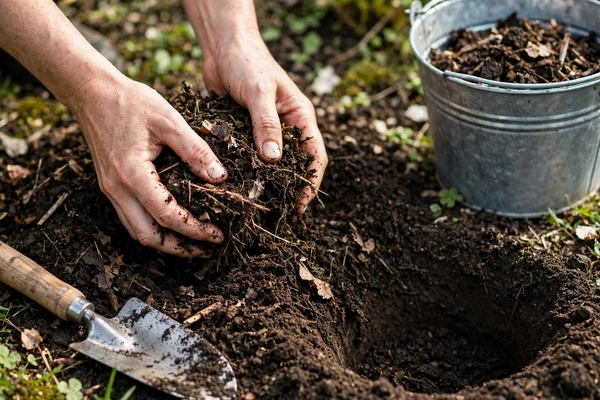
Prepare the soil a few days before planting so it can settle. Clear a ring of grass and weeds about 1 to 3 metres across around the planting spot, because grass competes for water and nutrients and a clear ring makes watering, mulching, and inspection easier. Remove stones and old roots from where the hole will go.
Dig a hole three to four times the diameter of the container your plant came in, and about three times as deep. That large hole loosens the soil around the young roots so they can expand easily instead of hitting a hard wall of compacted soil. Mix the removed soil with well-decomposed compost or aged manure, breaking up large clods as you go. Do not use fresh, uncomposted manure, which can burn young roots.
In sandy soil, compost helps hold moisture and nutrients; in heavy soil, it improves structure. Do not replace the native soil entirely with imported mix: roots eventually have to grow into the surrounding ground, and a sharp boundary between two soil types can trap water. Check the pH if you can: the AFCD recommends sandy loam with a pH between 5.5 and 7.5, rich in organic matter and well aerated. Good soil preparation helps you plant dragon fruit in ground successfully, so amend the whole planting area rather than only the hole if the pH is far outside that range.
Installing the Support First
Install the trellis or post before you put the plant in the ground, not after. Driving a post beside an established plant risks cutting through its shallow roots, and lifting a heavy stem onto a support that was not there when it started climbing often snaps stems. A support installed first lets you guide the young stem straight up from day one. For a single home-garden plant, the classic design is a sturdy vertical post with a strong frame or ring at the top. UF IFAS describes a four- to six-inch diameter pressure-treated pole with a strong metal grid at the top, set 10 to 15 feet away from other plants and structures.
Set the post at least 60 centimetres into firm ground, deeper in loose or sandy soil, and pack the soil firmly around its base, or set it in concrete, so it does not lean as the plant gains weight. A mature plant may weigh several hundred pounds, and a weak trellis can buckle under it, so choose materials that last outdoors for years: treated timber, galvanised steel, or concrete. Avoid untreated softwood that rots at ground level within a season or two. For a full comparison of designs, see dragon fruit trellis ideas.
Rooted Plants or Fresh Cuttings
You can plant dragon fruit in ground as a rooted plant grown in a pot, or as a fresh stem cutting planted directly into the soil. The rooted-plant route is more reliable for most home gardeners, and UF IFAS recommends it. A cutting is first rooted in a pot, allowed to develop a good root system over four to six months, and then planted out. That head start matters: the plant already has roots to take up water, establishes faster, and is less vulnerable to a dry spell or a cold night in its first weeks outdoors. A cutting planted directly can also succeed, but it needs more care.
It must first be cured — the cut end left to dry and heal for several days in a dry, shady place — before planting, otherwise the fresh wound can rot in moist soil. UF IFAS describes curing for seven to eight days, with a slanted cut at the base and, in some practice, a fungicide treatment and rooting hormone after curing.
The cured cutting is then planted shallowly and kept in warm, well-drained soil. The guide on how to propagate dragon fruit from cuttings explains curing and rooting in detail. It roots slowly at first and is more exposed to rot, pests, and drying out than a potted plant with an established root ball.
Setting the Plant at the Right Depth

When you plant dragon fruit in ground, depth matters more than it looks. Set the plant at the same level it was growing in its pot. The top of the root ball should sit level with the surrounding soil surface, not buried below it and not perched above it. Planting too deep buries the base of the stem, where moisture collects and rot can start; planting too shallow leaves roots exposed, dries them out, and makes the plant unstable in wind. Water the pot an hour or two before you start so the root ball holds together.
Tip the pot gently and slide the plant out, keeping the root ball intact, and do not pull the plant by its stem. Place it in the centre of the hole at the same depth it sat in the pot, and check the level with a straight stick laid across the hole if you are unsure. The stem should sit a few centimetres from the support post, close enough to tie to it but not pressed hard against it. Fill the hole with the soil and compost mix, pressing it down lightly halfway through and again when the hole is full.
Plant Dragon Fruit in Ground: Spacing, Watering and the First Month

Spacing is where many first-time growers underestimate dragon fruit. In a home garden, one plant per trellis is the usual pattern, and each trellis needs its own clear space. UF IFAS advises keeping individual plants 15 to 25 feet from trees, structures, and electrical lines, and the post itself 10 to 15 feet from other plants and structures.
In a smaller garden you can work tighter if you prune firmly, but still leave at least 2 to 3 metres between posts in a row, and 3 metres or more between rows, so you can walk, prune, and harvest without fighting through a tangle. The AFCD gives commercial spacings of 2.5 by 2.5 metres for the trellis-climbing method and 3.2 by 2.8 metres for the post-climbing method, with three to four seedlings per post. Fewer plants, well spaced, will usually outperform many plants crowded together: crowded plants shade each other, trap humidity, and make it hard to see disease or pests early, and they compete for water and nutrients.
Think about the canopy too. Once the main stem reaches the top of the post, it branches and the branches hang down, forming a wide umbrella that can easily reach 1.5 to 2 metres across. If two canopies overlap, inner stems get little light and produce little fruit, and the weight can pull a post sideways. If space is tight, choose a single plant and a compact trellis, and prune it to stay within its space.
Water the plant well immediately after planting, filling the low berm slowly so water soaks down to the roots instead of running off. In the first weeks, keep the soil consistently moist but never waterlogged; check by pushing a finger a few centimetres into the soil and watering only when it feels dry at that depth. The guide on how often to water dragon fruit explains how to adjust for weather, soil, and season.
Spread organic mulch about 5 to 8 centimetres thick around the plant, a few centimetres away from the stem, to keep shallow roots cool and slow evaporation. Do not fertilise immediately: wait about a month, or until new growth appears, then apply light, frequent fertiliser in the first year. Tie the main stem loosely to the post and check the tie every week or two. Note the planting date and variety to plan the seasonal tasks in the dragon fruit plant care calendar.
Common Mistakes
Most failures when you plant dragon fruit in ground come from a small set of avoidable mistakes. The first is planting in a spot that floods or drains slowly: if water sits around the base after rain, roots will suffer no matter how good the rest of your care is, so fix the drainage, choose a mound, or pick a different spot before you plant.
The second is planting too deep, because burying the stem base invites rot where the plant meets the soil; set the root ball level with the surrounding ground. The third is installing the support after planting, or using a weak support: a thin cane may hold a young plant, but it will not hold a mature one, so build the real trellis first, and build it strong. The fourth is overwatering a newly planted cutting or plant: daily soaking keeps soil airless and encourages rot, so water when the soil needs it and let the surface dry slightly between waterings.
The fifth is planting too close to a wall, tree, or another plant, which leads to shade, competition, and difficult pruning. The sixth is expecting fruit on a fixed timetable: a cutting-grown plant may fruit within its first year or two under good conditions, while a seed-grown plant can take several years longer, so variety, climate, sunlight, and care all affect timing.
Frequently Asked Questions
How deep should I plant dragon fruit in ground?
Set a potted plant at the same depth it grew in its pot, with the top of the root ball level with the surrounding soil. A fresh cutting should be buried only about 5 centimetres deep.
When is the best time to plant dragon fruit in ground?
In warm, frost-free regions, planting can be done at any time if you can water reliably, but the warm, rainy season is often easiest. In cooler regions, wait until frost risk has passed and night temperatures are reliably warm.
How far apart should dragon fruit plants go in the ground?
Allow at least 2 to 3 metres between posts, and more if you have space. UF IFAS recommends keeping plants 15 to 25 feet from trees, structures, and power lines.
Can I plant dragon fruit directly in ground from a cutting?
Yes, a cured cutting can be planted directly into well-drained soil, but a rooted plant grown in a pot for four to six months establishes more reliably. Cure the cut end for about a week in a dry, shady place first, plant it shallowly, and keep the soil moist but not wet.
To plant dragon fruit in ground successfully is a long-term decision, and the care you take on planting day pays off for years. Choose a sunny, warm, well-drained site with room to grow, prepare the soil with compost, install a strong support before the plant goes in, and set the plant at the right depth. Water steadily, mulch well, and give the young plant a month to settle before you feed it.