
A dragon fruit plant in full flower is one of the most beautiful sights in a garden: huge white blooms, as wide as a dinner plate, opening in the dark and filling the night air with scent. Then morning comes, the flowers close, and a week later most of them have fallen off without setting a single fruit. Learning how to hand pollinate dragon fruit flowers with a paintbrush at night is the skill that turns those beautiful flowers into fruit, and it takes about five minutes per flower.
This guide explains how to hand pollinate dragon fruit flowers with a paintbrush at night step by step, from why the flowers need help, to when they open, what you need, and exactly how to move the pollen. You do not need special equipment or experience, just a soft brush, a torch, and the habit of going out after dark on flowering nights.
In This Guide
- Why dragon fruit flowers need help
- When the flowers open
- What you need
- How to hand pollinate dragon fruit flowers with a paintbrush at night: step by step
- Self-fertile or cross-pollination
- How to tell it worked
- After the flower closes
- Common mistakes
- Frequently asked questions about how to hand pollinate dragon fruit flowers with a paintbrush at night
Why Dragon Fruit Flowers Need Help
In the wild, dragon fruit flowers are pollinated at night by bats and large moths, which fly from flower to flower carrying pollen on their fur and wings. In a home garden, those animals are often absent: there may be no bats in the area, the garden may be walled in, or the moths may simply not find the flowers. Without them, the pollen sits on the flower untouched, and the flower falls off unpollinated.
That is why knowing how to hand pollinate dragon fruit flowers with a paintbrush at night matters so much for home growers. You are doing the bat’s job, moving pollen from the male parts of the flower to the female part, and it is a simple, reliable way to turn a flowering plant into a fruiting one. Growers who hand pollinate routinely report far more fruit set than those who leave it to chance, and on some plants the difference is between no fruit at all and a full harvest.
The flowers themselves are built for night visitors. They are large, white, and strongly scented, which is how they attract bats and moths in the dark. A flower that opens at 9 pm and closes at 8 am is advertising to night animals, not to daytime bees, and when those animals are missing, the gardener has to step in.
When the Flowers Open
Timing is the heart of how to hand pollinate dragon fruit flowers with a paintbrush at night, because the window is short. Dragon fruit flowers open in the evening, usually between 8 and 9 pm, and close in the morning, usually between 8 and 10 am. They open fully for only one night, and once they close, the chance is gone. A flower that was not pollinated on its one night will not open again.
The best time to pollinate is between 9 pm and midnight, when the flower is fully open and the pollen is fresh. Go out with a torch and look at the flower: the petals should be spread wide, and you should be able to see the ring of yellow-tipped anthers around the centre and the single pale stigma standing up in the middle. If the flower is still half closed, wait an hour and come back.
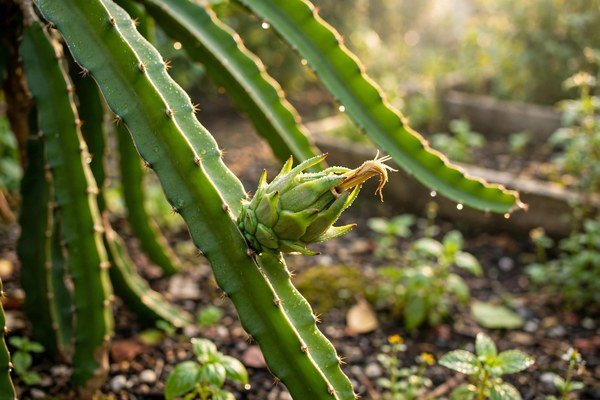
Watch the plant in the late afternoon for buds that are about to open. A bud ready to flower looks swollen, with the white petal tips starting to show through the green outer scales. For the basics of growing a plant to flowering size, see our guide on how to grow dragon fruit, which covers planting, support, and care from a cutting to a mature plant.
What You Need
You need very little to learn how to hand pollinate dragon fruit flowers with a paintbrush at night, and most of it is already in the house. A small, soft paintbrush is the main tool: a watercolour brush about a centimetre wide is ideal, with soft bristles that hold pollen without damaging the flower. Keep one brush just for pollination, and do not use a brush that has been in paint.
You also need a torch or a headlamp, so you can see the flower clearly in the dark. A small jar or cup is useful if you want to collect pollen first and apply it later, and a step ladder helps if the flowers are high on the trellis. That is the whole kit: brush, light, and something to stand on.
Use a clean brush every time, and never use the same brush for two different varieties if you are trying to cross-pollinate, because mixed pollen can give confusing results. Wash the brush in warm water and let it dry after each use, and store it somewhere clean. The UF IFAS growing guide describes dragon fruit flowering and fruit set in detail, and you can read the full guide through UF IFAS.
How to Hand Pollinate Dragon Fruit Flowers With a Paintbrush at Night: Step by Step
Here is how to hand pollinate dragon fruit flowers with a paintbrush at night, in order. First, go out after 9 pm with your brush and your light, and find a fully open flower. Look inside: you will see a ring of thin stalks, the stamens, each tipped with yellow pollen, surrounding one thicker central stalk, the stigma, which is the part that receives the pollen.
Second, touch the brush gently to the yellow anthers, and twist it a little so the bristles pick up a visible dusting of pollen. The pollen is fine and yellow, and you should be able to see it on the brush. If the anthers look dry and there is no pollen, the flower may be too young or too old, so try another flower.
Third, brush the pollen onto the stigma, the pale, slightly sticky tip in the centre of the flower. Dab it on gently, covering the whole tip, and repeat from two or three different anthers to make sure enough pollen lands. The stigma is delicate, so do not press hard or bend it; a light touch is enough.
Fourth, repeat the process on every open flower on the plant, working from flower to flower. Use fresh pollen from each flower’s own anthers first, and if you are cross-pollinating, carry pollen from another variety’s flower on the brush. The whole job takes about five minutes per flower, and a plant with six flowers takes half an hour.

Self-Fertile or Cross-Pollination
Some varieties set fruit with their own pollen, but many do not, and cross-pollination is the advanced version of how to hand pollinate dragon fruit flowers with a paintbrush at night that every serious grower learns. A self-fertile variety, such as most white-flesh types, will set fruit when you move its own pollen to its own stigma. A self-sterile variety, which includes many red-flesh types, will drop its flowers no matter how carefully you pollinate it with its own pollen, because it needs pollen from a different variety.
The solution is to grow two different varieties side by side, so that when both flower on the same night, you can carry pollen from one to the other. On a pollination night, start at the first variety’s flower, collect pollen on the brush, then walk to the second variety’s flower and brush it onto the stigma. Then go back and do the reverse, so both flowers get cross-pollen. Growers who do this see far better fruit set, larger fruit, and fewer dropped flowers.
If you only have one plant and it keeps dropping flowers, the variety is probably self-sterile, and the fix is a second cutting of a different variety, planted beside the first. Ask the seller which varieties cross-pollinate well together, and plant them close enough that you can reach both flowers on the same night.

How to Tell It Worked
Knowing how to hand pollinate dragon fruit flowers with a paintbrush at night is only half the job; the other half is knowing whether it worked. The first sign comes the morning after: a pollinated flower wilts and closes, but the base of the flower, where it joins the stem, stays firm and starts to swell slightly. An unpollinated flower also wilts, but its base turns yellow and soft, and the whole flower drops off within a few days.
A week after learning how to hand pollinate dragon fruit flowers with a paintbrush at night, the difference is clear. A pollinated flower leaves behind a small green fruit, about the size of a marble, growing from the stem where the flower was. An unpollinated flower leaves nothing but a dry scar. Count the young fruits after a week, and you will know exactly how many of your flowers set.
If none of your flowers set, the variety may need cross-pollen, or the night may have been too cold or too wet for the pollen to work. Try again on the next flowering night, use pollen from another variety if you can, and pollinate earlier in the evening when the flower is freshest. Flowers also need enough light and warmth to set fruit, so if the plant is in a shady spot, see our guide to dragon fruit sunlight requirements, which explains how much sun the plant needs to flower and fruit well.

After the Flower Closes
The work is not over when the flower closes: after you learn how to hand pollinate dragon fruit flowers with a paintbrush at night, the next days decide whether the fruit holds. For the first week, do not touch the young fruit or the stem around it, because the tiny fruit is fragile and knocks off easily. Water the plant normally, and do not feed it heavily right after pollination, because a flush of soft growth can push the plant to drop its young fruit.
Once you have learned how to hand pollinate dragon fruit flowers with a paintbrush at night, the fruit grows slowly for the first two weeks, then swells fast, and it takes about 30 to 50 days from flowering to ripe fruit, depending on the variety and the weather. As the fruit grows, the flower remains fall away on their own, and the skin starts to colour. Thin the fruit if the plant sets too many: a stem carrying five small fruits will give you five small fruits, while the same stem carrying two will give you two large ones, so remove the smallest ones early.
When the fruit is ripe, pick it and enjoy it, and keep notes on which flowers you pollinated and which set fruit. A simple notebook entry, the date, the variety, and whether you used self or cross pollen, tells you more about your plant each year than any book. For what happens next, see our guide on what to do after harvesting dragon fruit, which covers storage, eating, and looking after the plant after the harvest.
Common Mistakes
The most common mistake in how to hand pollinate dragon fruit flowers with a paintbrush at night is doing it too late. A flower pollinated at 6 am, when it is already closing and the pollen is damp with dew, sets far less often than one pollinated at 10 pm when it is fresh and fully open. Set an alarm, go out after dark, and do it on the flower’s one night, not the next morning.
The second mistake is using a brush that is too stiff or too dirty. A stiff brush tears the stigma and the anthers, and a dirty brush carries old pollen from another plant or from paint, which can spoil the result. Use a soft, clean watercolour brush, kept just for this job, and wash it after each use.
The third mistake is pollinating only one flower and giving up when it drops. Some flowers drop even when pollinated well, especially on a young plant or in bad weather, so pollinate every open flower on every flowering night, and judge the result after a week, not after a day. Patience and repetition are what turn a flowering plant into a fruiting one.
Frequently Asked Questions About How to Hand Pollinate Dragon Fruit Flowers With a Paintbrush at Night
How to hand pollinate dragon fruit flowers with a paintbrush at night?
Go out between 9 pm and midnight with a soft paintbrush and a torch. Pick up yellow pollen from the anthers with the brush, then dab it gently onto the pale central stigma. That is how to hand pollinate dragon fruit flowers with a paintbrush at night in one sentence: collect pollen on the brush, and brush it onto the stigma.
What time of night is best?
Between 9 pm and midnight, when the flower is fully open and the pollen is fresh. Flowers open around 8 or 9 pm and close by 8 or 10 am, and they only open for one night. Pollinating early in the evening works far better than waiting until morning.
Do I need two plants to get fruit?
It depends on the variety. Self-fertile varieties set fruit with their own pollen, but many red-flesh varieties are self-sterile and need pollen from a different variety. If your plant keeps dropping flowers despite careful hand pollination, plant a second variety beside it and cross-pollinate.
Can I use my finger instead of a paintbrush?
You can, but a brush works better. A finger picks up less pollen, spreads it unevenly, and can damage the delicate stigma. A soft watercolour brush holds more pollen, reaches into the flower easily, and gives a much better fruit set.
How long after pollination does the fruit ripen?
About 30 to 50 days from flowering to ripe fruit, depending on the variety and the weather. The fruit grows slowly for two weeks, then swells fast, and the skin colours as it ripens. Pick it when the skin is fully coloured and the fruit gives slightly under your thumb.
Conclusion
Once you know how to hand pollinate dragon fruit flowers with a paintbrush at night, a flowering dragon fruit stops being a beautiful disappointment and becomes a harvest in the making. The routine is simple: watch for buds in the evening, go out after dark with a soft brush and a light, move the pollen from the anthers to the stigma, and repeat on every flower. Do it on the flower’s one night, use cross-pollen when the variety needs it, and check after a week for the small green fruits that mean it worked. Five minutes a flower, a few nights a season, and the plant does the rest.