
A box of dragon fruit can look perfect when it is packed and disappointing by the time it reaches the market stall. The fruit softens, the skins sweat, and a faint sour smell creeps in, all because the box trapped heat and moisture instead of letting it out. The fruit was fine, the grading was fine, and the box was the problem.
Choosing dragon fruit packing boxes for market sale ventilation is the part of market day most home growers overlook, and it decides whether the fruit arrives looking as good as it left the garden.
This guide explains dragon fruit packing boxes for market sale ventilation from the box itself: which materials breathe, how many vent holes a box needs and where they should go, how to cushion the fruit without blocking the airflow, and how to stack and carry the boxes so the air keeps moving. It focuses on the box and the air inside it, which is a different job from sorting and wrapping the fruit.
In This Guide
- Why ventilation matters in a box
- Box materials that breathe
- Vent holes: size, number and placement
- Cushioning without blocking airflow
- Stacking and transport
- Keeping fruit cool on the stall
- Common mistakes to avoid
- Frequently asked questions
Why Ventilation Matters in a Box
Freshly picked dragon fruit is still alive, and it keeps breathing after picking. It gives off heat and moisture as it respires, and in a sealed box that heat and moisture have nowhere to go. The temperature inside a closed box on a warm morning can rise several degrees above the air outside, and the humidity climbs until water condenses on the skins.
Damp skins invite mould, warm fruit softens faster, and a box that felt cool at packing time can arrive with fruit that is already turning.
That is why dragon fruit packing boxes for market sale ventilation need air moving through them, not just around them. A ventilated box lets warm, damp air escape from the top and draws cooler, drier air in from the sides, which keeps the fruit near room temperature instead of warmer than it. The difference is easy to feel: open a sealed box after an hour in the sun and the air inside feels warm and stuffy, while dragon fruit packing boxes for market sale ventilation feel close to the air outside.
The fruit notices the same difference, and it shows in how it looks and how long it lasts on the stall.
The UF IFAS growing guide recommends picking promptly and handling fruit gently, since bruising shortens storage life, and you can read the full guide through UF IFAS. For the full routine from picking to storage, see our guide on how to store dragon fruit after harvest, which covers whole fruit storage times and conditions.

Box Materials That Breathe
Cardboard is the best material for a home grower’s market box, because it breathes a little on its own and it is easy to cut vents into. Use sturdy single-wall or double-wall corrugated cardboard, dry and clean, with no damp patches or chemical smells. A box that has already been used for onions, chemicals or anything strong-smelling will pass the smell to the fruit through the skin, so keep a stock of fresh boxes for fruit only.
Shallow boxes with low sides work best, since the fruit is easy to see and lift out, and a shallow box holds one layer of fruit, which is far safer than a deep box where the upper layers crush the lower ones.
Plastic crates are the main alternative: a rigid crate with built-in slots is strong, reusable and easy to wash, and the slots give good airflow without any cutting. The drawback is the hard surface, since fruit resting directly on hard plastic bruises more easily, so a crate always needs a paper lining. Plastic crates also cost more and need storage space, while cardboard boxes fold flat.
For most home growers, cardboard is the simpler choice, and the ventilation in dragon fruit packing boxes for market sale ventilation is easier to control when you cut the holes yourself.
Avoid sealed plastic bags, foam boxes with tight lids, and any container that closes airtight: they keep the fruit warm and damp, and they are the fastest way to turn a good harvest into soft, spoiled fruit. If you must use a lidded box, leave the lid ajar or cut vents in it before you load the fruit.

Vent Holes: Size, Number and Placement
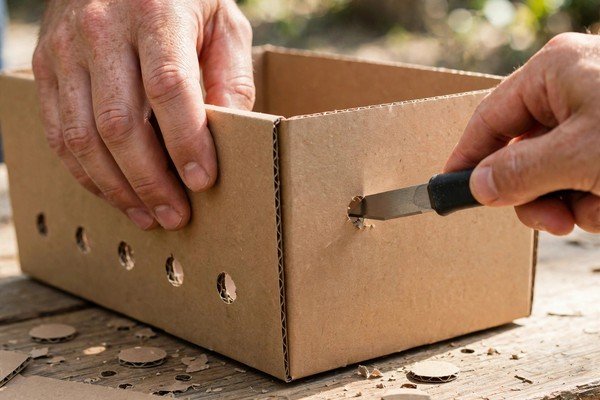
Vent holes are the working part of dragon fruit packing boxes for market sale ventilation, and a few details decide whether they help or hurt. Cut round holes about 2 to 3 centimetres across, which is large enough for air to move but small enough that the box stays strong and no fruit can slip through. Use a sharp craft knife or a hole punch on a cutting board, and cut from the outside in, so the rough edge faces outward and cannot scratch the fruit inside.
Place the holes on the long sides of the box, not on the bottom or the top. Two or three holes on each long side, spaced evenly, give a cross-draft that carries warm air out as cooler air comes in. Add one or two holes on each short side as well if the box is large. Do not cut holes in the bottom, since they weaken the base and let dirt in, and do not cut a large opening in the lid, since the lid is what keeps the sun off the fruit.
The total vent area should be small, roughly five percent of the side area, because the goal is gentle airflow, not an open basket. Too many holes weaken the box and let dust and insects in, while too few leave the air still.
Check the holes after cutting by holding the box up to the light: you should see daylight through each one, and the edges should be smooth. If the cardboard tears while you cut, the knife is blunt or the box is damp, so use a fresh blade and a dry box. A box with clean, even vents lasts for several market days, while a torn box should be used once and then recycled.
Cushioning Without Blocking Airflow
Cushioning and ventilation can work against each other if the cushioning blocks the vents, so in dragon fruit packing boxes for market sale ventilation the order of packing matters. Line the bottom of the box with crumpled paper or clean straw, then place the first layer of fruit with the stem ends facing the same way, leaving a finger-width gap between each fruit. Fill the gaps loosely with crumpled paper, which stops the fruit rolling without sealing the gaps shut.
The paper should be loose and airy, not packed tight, because tight paper stops the air moving just as surely as a sealed lid does.
Wrap each fruit in a sheet of soft paper or a paper towel, tucking it loosely around the fruit so the scales are covered and the skin cannot rub against its neighbour. The wrap absorbs a little moisture, which keeps the skin dry, and it adds a thin cushion between the fruit.
Keep the wrapping loose rather than tight, since tight wrapping presses the scales flat and marks the skin. Do not use plastic wrap or plastic bags as cushioning: they trap moisture against the skin and undo the work of the vents entirely.
If you pack two layers, lay a flat sheet of cardboard between them, with a few small holes punched in it, so the upper fruit never rests directly on the lower fruit and the air can still pass between the layers. Never pack more than two layers, and never fill a box so full that the flaps press down on the top fruit. A box packed tight looks generous and sells badly, because the fruit at the bottom arrives crushed and the air inside never moves.

Stacking and Transport
Stacking is where dragon fruit packing boxes for market sale ventilation often fail, because a stack of boxes can block the very vents that were cut with care. Stack boxes so that the vent holes on the sides stay open: line the boxes up with their long sides facing outward, and leave a small gap between stacks so air can move around them. Never stack a box directly on top of another box’s lid vents, and never push boxes tight against the wall of a vehicle, since the wall blocks the airflow on that side completely.
Keep the stack low, no more than three or four boxes high, because the weight of a tall stack crushes the fruit at the bottom and squeezes the boxes so the vents close up. Use a flat board between layers if the boxes are soft, so the weight spreads evenly.
During transport, keep the boxes out of direct sun: a stack in the back of a vehicle in full sun heats up fast, and even good vents cannot keep up. Cover the stack with a light cloth for shade, but do not wrap it in a tarpaulin, which seals the air in and turns the load into an oven. Drive gently on rough roads, since every bump knocks the fruit against the box.
Keeping Fruit Cool on the Stall
The stall is the last part of the journey, and dragon fruit packing boxes for market sale ventilation need the same care there as they did on the road. Keep the boxes in the shade from the moment they arrive, and sell the oldest boxes first. A box left in the sun softens within an hour, and soft fruit bruises at the slightest knock, so shade is worth more than any vent.
If the market has no shade, bring a light cloth or a small umbrella and drape it over the boxes, leaving the sides open so the air can still move.
Open one box at a time for display, and keep the rest closed but ventilated. A display box with the fruit laid out neatly on a cloth sells the fruit, while the closed boxes behind it stay cool.
Check the fruit in the display box through the morning, and move any fruit that starts to soften into a separate pile for quick sale. Pick the fruit at the right ripeness before packing, and check the colour stages in our guide to dragon fruit skin colour when ripe. For what happens after the market, see our guide on what to do after harvesting dragon fruit.
Common Mistakes to Avoid
The most common mistake with dragon fruit packing boxes for market sale ventilation is cutting vents and then blocking them. A box with good holes, packed tight with paper, stacked against a wall and covered with a tarpaulin has no airflow at all. Check the airflow at every step: holes open, paper loose, stack spaced, cover shaded but not sealed.
The second mistake is cutting the holes too big or too many, which weakens the box until it collapses under the fruit above it. Small, even holes are enough.
A third mistake is packing warm fruit straight into boxes. Fruit picked in the heat of the day carries that heat into the box, and the vents cannot cool it down. Pick in the morning, let the fruit cool in the shade, and pack only when it is cool to the touch.
A fourth mistake is reusing a damp or damaged box: wet cardboard is weak, it tears at the vents, and it holds mould that spreads to the fruit. Use dry boxes, check them before packing, and recycle any box that is soft, torn or smelly.
Frequently Asked Questions
How many vent holes do dragon fruit packing boxes for market sale ventilation need?
Dragon fruit packing boxes for market sale ventilation need two or three round holes, about 2 to 3 centimetres across, on each long side, plus one or two on each short side for a large box. That gives a gentle cross-draft without weakening the box. Do not cut holes in the bottom, and keep the total vent area small, around five percent of the side area.
Is cardboard or plastic better for ventilated fruit boxes?
Cardboard is usually better for a home grower, because it breathes a little on its own, it is easy to cut vents into, and it folds flat for storage. Plastic crates with built-in slots give good airflow too, but they need a paper lining to stop bruising, they cost more, and they need storage space. Whichever you use, never use a sealed lid or a plastic bag, since both trap heat and moisture.
Should the vents be on the sides or the top of the box?
Put the vents on the long sides of the box, so air flows across the fruit from one side to the other. Holes in the bottom weaken the base and let dirt in, and a large opening in the lid lets the sun in. The lid should shade the fruit, while the side vents do the breathing.
Can I reuse ventilated cardboard boxes?
Yes, if they are dry, clean and undamaged. Check the vents after each market day: if the edges are torn or the cardboard is soft, recycle the box and use a fresh one. A good box with clean vents lasts for several market days, but a damp or torn box should never be reused.
How do I keep fruit cool if there is no shade at the market?
Bring your own shade, a light cloth or a small umbrella, and drape it over the boxes while leaving the sides open so air can still move through the vents. Keep the boxes off hot ground on a table or a board, sell the oldest boxes first, and take unsold fruit home to cool storage rather than leaving it packed in the heat.
Conclusion
A market box is more than a container: it is the fruit’s shelter for the hours between the garden and the buyer, and the air inside it decides how the fruit arrives. Shallow cardboard, a few small holes on the long sides, loose paper cushioning that does not block the vents, a low stack with space around it, and shade on the stall are all it takes.
Once dragon fruit packing boxes for market sale ventilation are set up this way, the fruit stays cool and dry, the skins stay bright, and the boxes you open at the market look as good as the ones you packed at home. It costs almost nothing, it takes a few minutes per box, and buyers notice the difference before they even taste the fruit.