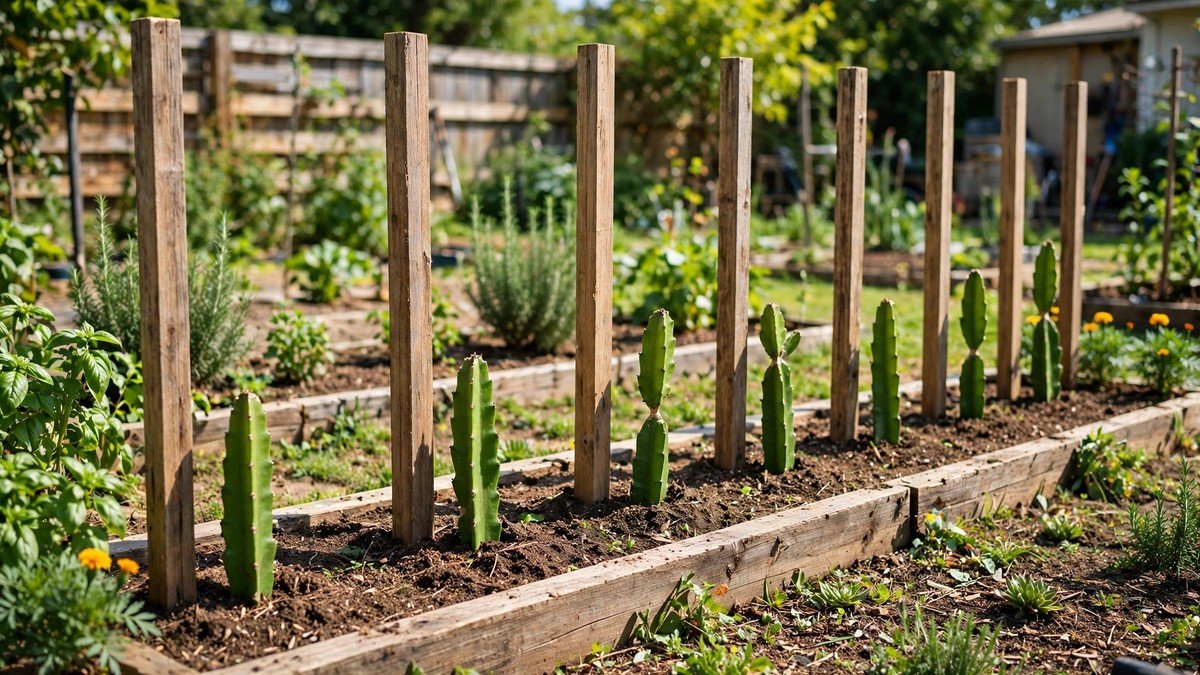
A dragon fruit cutting looks small and lonely in its pot, and the temptation is to plant several close together so the garden looks full from the start. A year later those cuttings have grown into a tangled mass, shading each other, competing for water, and trapping damp air where disease spreads.
Getting the spacing right on planting day is one of the few decisions you cannot easily fix later, because moving a mature dragon fruit means cutting it back hard and losing a season of growth. Knowing how far apart to plant dragon fruit cuttings is really about giving each plant the room it will need when it is full grown, not the room it needs today.
This guide gives practical spacing ranges for pots, garden beds and rows, explains why the gaps matter, and shows what goes wrong when plants are too close or too far apart.
In This Guide
- Why spacing matters
- How far apart to plant dragon fruit cuttings in pots
- How far apart to plant dragon fruit cuttings in garden beds
- Spacing in rows and on trellises
- Spacing for different varieties and climates
- What happens when cuttings are too close
- What happens when cuttings are too far apart
- Getting the layout right before you plant
- Frequently asked questions
Why Spacing Matters
Spacing decides three things at once: light, air and roots. A dragon fruit needs full sun on its stems to flower well, and a plant crowded by its neighbours gets shade on its lower stems, where the flowers should form. Air matters just as much: stems that stay damp after rain or watering invite rot and fungal disease, and a gap between plants lets the breeze dry them. When you are deciding how far apart to plant dragon fruit cuttings, you are really deciding how much light, air and root room each plant gets for its whole life.
The second reason spacing matters is access. A mature dragon fruit is a climbing cactus with stems that drape over a trellis, and you need to reach every part of it: to prune, to check for pests, to hand pollinate the night flowers, and to pick the fruit. Plants packed shoulder to shoulder turn into a wall you cannot get behind, and the fruit on the far side rots unpicked.
The third reason is the trellis itself. Dragon fruit is usually grown up a post with a frame at the top, and each post needs its own space.
How Far Apart to Plant Dragon Fruit Cuttings in Pots
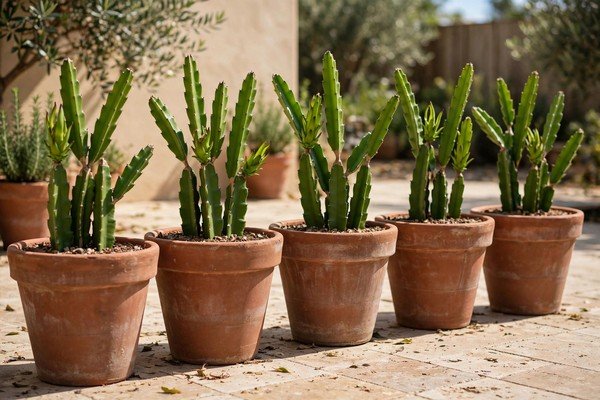
Pots are the simplest case, because each cutting usually gets its own container. One cutting per pot is the rule for home growers: two cuttings in one pot will compete from the first month, and the stronger one will shade out the weaker one. Use a pot of at least 50 litres for a single cutting, wide rather than tall, with drainage holes and a trellis post set in the middle. A large pot gives the roots room for two or three years before repotting becomes necessary.
The gap between pots matters too, and it is part of how far apart to plant dragon fruit cuttings on a patio or balcony. Place pots about 60 to 90 centimetres apart, measured from the centre of one pot to the centre of the next, so that the vines on their trellises do not grow into each other. On a small balcony, that may mean only two or three pots, and that is fine: three well-spaced plants will fruit better than six crowded ones. Leave a clear path behind the pots as well, so you can reach the back of each trellis to prune and pick.
For the wider routine of container growing, see our guide on how to grow dragon fruit, which covers planting, support and care from a cutting to a mature plant.
Potted plants dry out faster than plants in the ground, and spacing helps here too: pots that touch each other shade their own sides and dry unevenly, while pots with a gap between them dry evenly and are easier to water properly.
How Far Apart to Plant Dragon Fruit Cuttings in Garden Beds
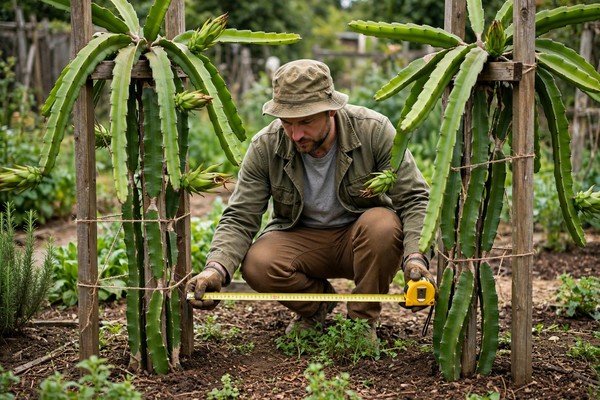
In a garden bed, the cutting goes straight into the ground, and the spacing is measured between planting holes. A practical range for home gardens is 2 to 3 metres between plants in the same bed, measured from the centre of one plant to the centre of the next. The UF IFAS growing guide recommends giving dragon fruit plenty of room to climb and spread, and you can read the full guide through UF IFAS.
The bed itself needs to be wide enough for the roots. Dragon fruit roots are shallow and spread outwards, so a bed 60 to 90 centimetres wide gives them room without crowding. If you plant in a narrow bed against a wall, leave at least 45 centimetres between the plant and the wall, so the stems do not press against it and trap damp air.
Soil matters as much as spacing in a bed. The soil must drain freely, since a cactus in wet soil rots faster than one in dry soil, and a crowded bed stays wet longer after rain. Use the free-draining mix from our guide to the best soil for dragon fruit, and raise the bed slightly above the surrounding ground so water runs off rather than pooling around the roots.
When you are working out how far apart to plant dragon fruit cuttings in a bed, the soil and the gap are one decision, not two.
Spacing in Rows and on Trellises
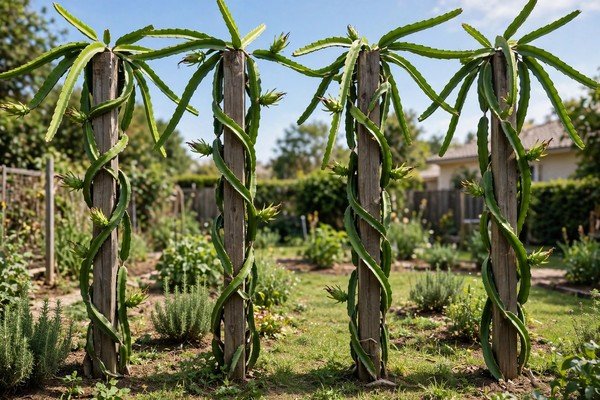
Rows are how larger plantings are laid out, and the two gaps that matter are the gap between plants in a row and the gap between rows. A practical range is 2 to 3 metres between plants along a row, and 3 to 4 metres between rows, so that you can walk between the rows with a wheelbarrow, reach the fruit from both sides, and let the sun reach the lower stems. In a small home garden, one row is usually enough, and the row gap is simply the path around it.
Getting the row gap right is part of how far apart to plant dragon fruit cuttings, because the trellis frames decide how close the posts can stand.
The trellis decides the minimum gap. A single-post trellis with a frame about 60 centimetres across needs at least 2 metres between posts, so the frames do not touch when the vines drape over them. A larger frame, or a trellis where two plants share one post, needs more room: if two cuttings share a post, plant them on opposite sides of it and count that post as one planting position, with the next post 2 to 3 metres away.
Sun direction shapes the rows. In most gardens, rows running north to south let the morning and afternoon sun reach both sides of the plants, while rows running east to west shade one side all day. For the plant’s light needs, see our guide to dragon fruit sunlight requirements, which explains how much sun the plant wants and how shade affects flowering.
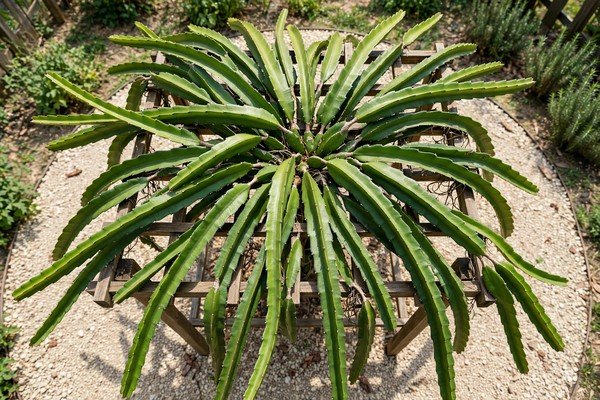
Spacing for Different Varieties and Climates
Not all varieties grow at the same speed. Vigorous white-flesh types can grow several metres in a season and will fill a 2-metre gap quickly, while slower red-flesh types may take an extra year to reach their neighbours.
If you grow a vigorous variety, use the wider end of the range: 3 metres between plants rather than 2. When you are deciding how far apart to plant dragon fruit cuttings of a variety you have not grown before, ask the seller how fast it grows, and give it the wider gap if you are unsure.
Climate changes the answer too. In a hot, humid climate, plants grow fast and disease spreads easily in still air, so wider spacing pays for itself: the extra air movement dries the stems and slows fungal problems. In a cooler climate, plants grow slower and the risk is frost rather than disease, so you can plant a little closer and use the shelter of neighbouring plants, though you should still leave room to cover each plant with frost cloth on cold nights.
Mixed plantings need extra thought. If you grow two varieties side by side for cross-pollination, plant them close enough that you can carry pollen from one to the other on the same night, but far enough apart that their vines do not tangle: 2 to 3 metres is the practical compromise.
What Happens When Cuttings Are Too Close
Cuttings planted too close show the same problems in the same order. First, the stems stretch toward the light and grow thin and pale, because each plant shades the next. Flowering drops, because the shaded lower stems never get enough sun to set buds.
Then the damp air between the crowded stems invites disease: stem rot starts at the base, fungal spots appear on the shaded stems, and pests like mealybugs spread quickly from plant to plant in the still air. That chain of problems is the clearest warning about how far apart to plant dragon fruit cuttings, because every one of them comes back to the same missing gap.
The roots suffer too. Two plants sharing the same small patch of soil use up the water and nutrients faster, so both grow slower and fruit smaller. The fruit is the last thing to suffer, but it suffers most visibly: small fruit, uneven ripening, and fruit that rots before it is picked because you cannot reach it through the tangle.
Fixing overcrowding means cutting back hard. You can remove whole stems, thin the vines, and open up the middle of the planting so light and air get in, but you cannot move a mature plant without cutting it back to the base and losing a season.
What Happens When Cuttings Are Too Far Apart
Too much space has its own costs, though they are smaller. A garden with plants 5 metres apart wastes sun and water on bare ground, and weeds fill the gaps faster than the dragon fruit can. The loss is in the harvest per square metre, which matters if your garden is small or you want a lot of fruit from a small area. Even so, knowing how far apart to plant dragon fruit cuttings is about avoiding crowding first, and a little extra space is a far smaller problem than too little.
Wide spacing can also make pollination harder. If two varieties are planted far apart for cross-pollination, you have to carry pollen a long way on a dark night, and the flowers may be on opposite sides of the garden. The fix is simple: keep cross-pollination partners within 2 to 3 metres of each other, and use the extra space elsewhere in the garden for other plants.
Getting the Layout Right Before You Plant
The best time to plan spacing is before you dig a single hole. Mark the planting positions with stakes or pots placed where the plants will go, then step back and look at the garden. Walk between the stakes: can you reach every position from a path?
Stand at each stake and imagine the trellis at full height: will the frames touch? Will the vines shade the vegetable bed or the path? That dry run is the practical side of how far apart to plant dragon fruit cuttings, because it lets you see the finished garden before you commit to it.
Check the sun before you commit. Watch the planting area through a day, morning to evening, and note where the shadows fall. A spot that looks sunny at noon may be shaded by a fence at 4 pm, and a plant that gets less than six hours of direct sun will flower poorly.
Think about water as well. Plants spaced for easy access are easier to water properly, and a hose or watering can that can reach every plant without dragging across the others saves the stems from damage. If you use drip irrigation, lay the lines before you plant, with a dripper at each planting position, so the water goes to the roots and not to the weeds between the plants.
Frequently Asked Questions
How far apart to plant dragon fruit cuttings in a garden bed?
Plant cuttings 2 to 3 metres apart in a garden bed, measured from the centre of one plant to the centre of the next. That is how far apart to plant dragon fruit cuttings for home gardens: 2 metres if you prune regularly or grow a compact variety, and 3 metres for vigorous varieties or if you prune less often. Leave 3 to 4 metres between rows so you can walk between them and reach the fruit.
Can I plant two dragon fruit cuttings in one pot?
It is better not to. One cutting per pot is the rule, in a pot of at least 50 litres with its own trellis post. Two cuttings in one pot compete for water, light and root room from the first month, and the stronger one shades out the weaker one. Place pots 60 to 90 centimetres apart so the vines do not grow into each other.
How far apart should dragon fruit rows be?
Leave 3 to 4 metres between rows, so you can walk between them with a wheelbarrow, reach the fruit from both sides, and let the sun reach the lower stems. Rows running north to south usually give the most even sun on both sides of the plants.
Does spacing affect how much fruit I get?
Yes. Plants spaced too close shade each other, get less sun on their lower stems, and set fewer flowers, so they fruit less. Plants with the right spacing get full sun, good air and room for their roots, and they fruit better and more reliably.
When should I decide the spacing?
Before you dig. Mark the planting positions with stakes, check the sun through the day, and make sure you can walk between the plants and reach every trellis. Spacing is a planting-day decision, because moving a mature dragon fruit means cutting it back hard and losing a season of growth.
Conclusion
Spacing is a small decision with a long life, and knowing how far apart to plant dragon fruit cuttings is what keeps that decision from turning into a rescue job later. A cutting planted with room to grow gets full sun, fresh air, space for its roots and a trellis of its own, and it repays the room with steady flowering and fruit you can actually reach. Mark the positions, check the sun, leave 2 to 3 metres between plants and 3 to 4 metres between rows, and let each plant grow into the space you gave it.