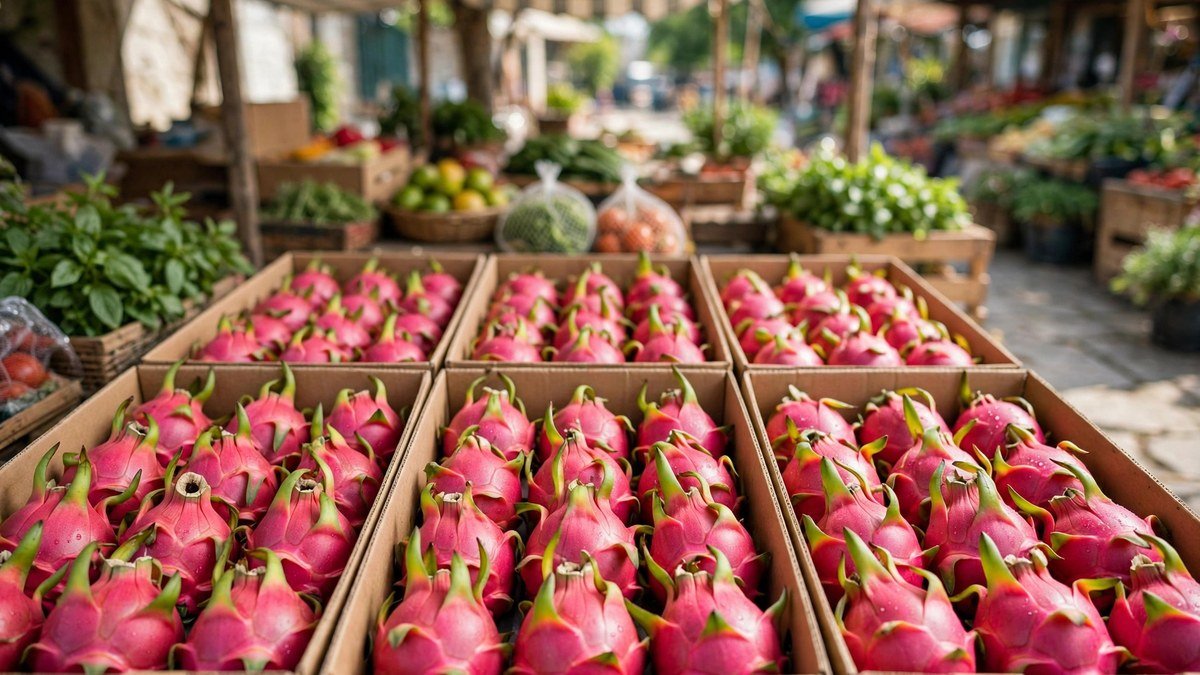
A good harvest can still earn little if the fruit reaches the market bruised, mixed and poorly presented. Buyers at a local market choose with their eyes first: they pick the box with even, bright, unmarked fruit and leave the box where large and small fruit are jumbled together with damaged skins.
The difference between those two boxes is not the variety or the growing. It is grading and packing, done carefully at home before the fruit ever leaves the garden. Learning how to grade and pack dragon fruit for selling turns a good harvest into fruit that arrives looking as good as it left the garden, and buyers notice.
This guide walks through how to grade and pack dragon fruit for selling step by step, from picking at the right ripeness to sorting by size and skin, cushioning each fruit, choosing the right box, and labelling it for the buyer. It uses simple materials you already have at home, and it avoids any claims about market prices or profits, since those change from place to place and season to season.
In This Guide
- Why grading matters at a local market
- Picking at the right ripeness for selling
- How to Grade and Pack Dragon Fruit for Selling: Sorting by Size
- How to Grade and Pack Dragon Fruit for Selling: Checking Skin Quality
- Cushioning and wrapping each fruit
- Choosing the right box
- Packing the box step by step
- Labelling and keeping fruit cool
- Mistakes to avoid
- Frequently asked questions
Why Grading Matters at a Local Market
Grading is simply sorting fruit into groups that look alike, so that every box you sell contains fruit of the same size and quality. A buyer who opens a box and finds three large, bright fruit and one small, dull one feels cheated, even if the average quality is fine. A buyer who opens a box of evenly matched fruit trusts the seller and comes back next week. That trust is the real product at a local market, where the same buyers return week after week.
Grading is the first step in how to grade and pack dragon fruit for selling, and it costs nothing but a little time at the packing table. It also protects your price: mixed boxes sell at the price of their worst fruit, while graded boxes sell at the price of their best.
Picking at the Right Ripeness for Selling
Grading starts before picking, because fruit picked too early or too late cannot be graded well. Pick dragon fruit when the skin is fully coloured and the scales at the edges are just starting to dry, with a slight give under gentle pressure. Fruit picked at this stage holds up well in a box and ripens evenly on the stall. Fruit picked too early stays pale and bland, and no amount of careful packing will fix it. Fruit picked too soft bruises in the box before it reaches the buyer.
Check the colour stages in our guide to dragon fruit skin colour when ripe before your first picking for market, so you know what full colour looks like for your variety. Pick in the cool of the morning, handle each fruit gently by the body rather than the scales, and place it straight into a shallow picking tray, never a deep bucket where the weight of the fruit above crushes the fruit below. Cut the stem with clean secateurs, leaving a short stub, rather than twisting the fruit off, since a torn stem end rots quickly and stains the fruit beside it.
The UF IFAS growing guide recommends picking promptly and handling fruit gently, since bruising shortens storage life, and you can read the full guide through UF IFAS.
How to Grade and Pack Dragon Fruit for Selling: Sorting by Size
Size is the simplest part of how to grade and pack dragon fruit for selling, and it is the one buyers notice first. Set up three groups on a clean table: large, medium and small. Weigh a few fruit from each group on a kitchen scale to learn what each group feels like, so you can sort by hand afterwards without weighing every fruit. Large fruit goes in its own boxes, medium in theirs, and small fruit in theirs. Do not mix sizes in one box, even if you are short of fruit: a half-empty box of even fruit sells better than a full box of mixed sizes.
Size grading also tells you what to do with each group. Large, even fruit is your best selling grade and goes to the market first. Medium fruit sells well too, at its own price. Small fruit is still saleable, but pack it separately and be honest about it: small fruit suits buyers who want fruit for smoothies or for children, and it sells fine when it is not hidden among large fruit. Fruit that is very small, misshapen or badly marked should not go to market at all.

How to Grade and Pack Dragon Fruit for Selling: Checking Skin Quality
Skin quality decides the grade, and in how to grade and pack dragon fruit for selling the skin is checked before size, because a large fruit with a damaged skin is worth less than a medium fruit with a perfect one. Hold each fruit up to the light and turn it slowly, looking for scratches, sunburn patches, insect marks, soft spots and cracks. A small healed mark is acceptable on a lower grade, but any soft, wet or mouldy spot means the fruit should not be sold.
Check the stem end too: a dry, clean cut is good, while a wet or rotting stem end will spread rot to the fruit beside it in the box.
Colour matters as well. Even, deep colour across the whole skin marks a top-grade fruit, while patchy or pale colour drops it a grade. For the full picture on colour and ripeness, see our guide on dragon fruit skin colour when ripe. Never slip a damaged fruit into a box of good fruit: at a local market, buyers always notice, and they remember.
Cushioning and Wrapping Each Fruit
Cushioning is where how to grade and pack dragon fruit for selling saves the most fruit, because most market damage happens in the box, not in the garden. Dragon fruit bruises easily: a hard box, a bumpy road and a heavy stack are enough to mark every fruit in a box that was packed without cushioning. Wrap each fruit in a sheet of soft paper, old newspaper, or a paper towel, tucking the paper loosely around the fruit so the scales are covered and the skin cannot rub against its neighbour. The wrap also absorbs a little moisture, which keeps the skin dry in the box.
Wrap each fruit in soft paper before it goes in the box, because how to grade and pack dragon fruit for selling depends on keeping the skin unmarked from the table to the stall. For top-grade fruit, add a second layer of protection at the bottom of the box: a sheet of crumpled paper or a layer of clean straw or shredded paper, so the bottom row never sits on hard cardboard. Keep the wrapping loose rather than tight, since tight wrapping presses the scales flat and marks the skin.

Choosing the Right Box
The box matters as much as the wrap when you are learning how to grade and pack dragon fruit for selling. Use sturdy cardboard boxes with low sides, so the fruit is easy to see and easy to lift out without digging. A shallow box that holds one layer of fruit is better than a deep box that holds three layers, because the weight of the upper layers crushes the lower ones. If you must pack two layers, put a flat sheet of cardboard between them, so the upper fruit never rests directly on the lower fruit.
Ventilation matters too. A box with a few small air holes, or a box that is not sealed shut, keeps the fruit cool and dry, while a sealed box traps heat and moisture and speeds up rotting. Choose boxes that are clean and dry, and never reuse a box that held chemicals, onions or anything strong-smelling, since the fruit picks up odours through the skin. For a regular market stall, keep a stock of two or three standard box sizes, so every grade has a box that fits it without wasted space.
Packing the Box Step by Step
Packing is the heart of how to grade and pack dragon fruit for selling, and the order matters. Line the bottom of the box with cushioning paper, then place the first layer of fruit with the stem end facing the same way, leaving a finger-width gap between each fruit so they cannot knock together. Fill the gaps loosely with crumpled paper, which stops the fruit rolling when the box is carried. Lay a flat sheet of cardboard over the first layer before starting a second, and never pack more than two layers in one box.
Finish the box by folding the top flaps loosely over the fruit, not pressing them down, and check the weight: a box that is too heavy to lift with one hand will be dropped, so keep boxes light enough to carry comfortably.
Count the fruit as you pack and write the count on the box, so you know what you sold and the buyer knows what they bought. If you are packing several boxes, pack one grade at a time and keep the grades apart, so a medium fruit never slips into a large box by accident. Good packing takes a few minutes per box, and those minutes are what turn a harvest into a sale.

Labelling and Keeping Fruit Cool
A clear label is the finishing touch of how to grade and pack dragon fruit for selling, and it takes seconds. Write the variety if you know it, the grade, the number of fruit, and the picking date on the outside of the box with a marker. A buyer who can read the label trusts the box, and a seller who can read their own labels knows which boxes to sell first.
Keep the packed boxes cool and shaded from the moment they are packed until they are sold. Heat is the enemy of packed fruit: a box left in the sun softens within an hour, and soft fruit bruises at the slightest knock.
Store boxes in the coolest room of the house, out of direct sun, and cover them with a light cloth if they must wait outdoors. At the market, keep boxes in the shade and sell the oldest boxes first. For the full routine from picking to storage, see our guide on how to store dragon fruit after harvest, which covers whole fruit storage times and conditions.

Mistakes to Avoid
The most common mistake in how to grade and pack dragon fruit for selling is packing fruit that is already soft or damaged and hoping the buyer will not notice. They will, and the cost is your reputation, which is worth far more than one box. The second mistake is overfilling boxes: a box packed tight looks generous and sells badly, because the fruit at the bottom arrives crushed. The third is mixing grades in one box, which drags the whole box down to the price of its worst fruit.
Another error in how to grade and pack dragon fruit for selling is picking in the heat of the day and packing warm fruit straight into boxes, which traps heat and speeds up softening. Pick in the morning and pack only when the fruit is cool to the touch. Finally, do not forget the label: an unlabelled box looks careless, and careless packing makes buyers doubt the fruit inside.
Frequently Asked Questions
What do I need to start learning how to grade and pack dragon fruit for selling?
You need very little to begin how to grade and pack dragon fruit for selling: a clean table, soft paper or newspaper for wrapping, sturdy shallow cardboard boxes, a marker for labels, and a kitchen scale to learn the size groups. That is enough for a first market day, and you can add better boxes and cushioning as you sell more.
How many grades should I sort my fruit into?
Three grades are enough for most home growers: large, medium and small. Sort by size first, then check the skin and move any damaged fruit down a grade or out of the sale pile entirely. More than three grades slows the packing down without earning more, since local buyers choose mainly between large and medium.
Should I wash dragon fruit before packing it?
No. Do not wash fruit before packing, since extra water speeds up rotting in the box. Wipe off loose dirt with a dry cloth if needed, and leave the skin dry. Wash fruit only just before eating, not before selling.
How long can packed dragon fruit wait before selling?
Packed fruit keeps best if sold within a day or two, kept cool and shaded. Whole fruit stores for up to two weeks in a fridge, but a packed box at market temperature should not wait: sell the oldest boxes first, keep them out of the sun, and take unsold fruit home to cool storage rather than leaving it packed overnight in the heat.
Can I sell small or slightly marked fruit?
Yes, honestly. Pack small or lightly marked fruit separately, label it clearly, and sell it at its own price. Many buyers are happy with smaller fruit for smoothies or for children. What damages your name is hiding poor fruit among good fruit, not selling it openly at a fair price.
Conclusion
Good grading and careful packing take a little time, but how to grade and pack dragon fruit for selling is a skill that pays for itself at every market day. Pick at the right ripeness, sort by size and skin, wrap each fruit, pack shallow boxes with cushioning, label them clearly, and keep them cool until they are sold.
Leave damaged fruit out of the sale pile, be honest about the smaller grades, and let the even, bright boxes speak for themselves. Do that week after week, and buyers will come back to your stall first, because they know what they are getting before they open the box. For the next season’s crop, our guide on how to grow dragon fruit covers soil, watering, feeding and flowering.