
Ask how long dragon fruit takes to fruit and you will hear many different answers — six months, one year, three years, seven years — and they can all be correct, because the answer depends on how the plant was started, which variety it is, and where and how it is grown. There is no single universal figure, and any source that promises fruit in a fixed number of days for every plant is oversimplifying.
This guide explains the real range, the factors that move a plant toward the fast end or the slow end of it, and how to tell whether your plant is simply young or actually held back by a fixable problem. The goal is a realistic expectation for your own plant, not a countdown.
Table of Contents
- The Short Answer: It Depends
- Cuttings vs Seeds: The Biggest Difference in How Long Dragon Fruit Takes to Fruit
- How Variety Affects the Timeline
- Climate, Sunlight and Temperature
- Soil, Water and Feeding: Growth Speed Factors
- Plant Age and Maturity Signs
- When Fruiting Is Delayed: Common Reasons
- What to Expect in the First Few Fruiting Seasons
- Frequently Asked Questions
The Short Answer: It Depends
The most useful short answer is a range. A dragon fruit plant started from a healthy cutting in a warm climate with good care often produces its first fruit within six to twelve months of planting, and UF IFAS reports that many cuttings fruit in six to nine months. A plant started from seed, by contrast, may take five to seven years to fruit, and its fruit may differ from the parent plant.
Between those two extremes sit most real-world cases. A cutting planted late in the season, in a cooler climate, in poor soil, or in shade will usually take longer than a cutting planted at the start of the warm season in full sun and rich, well-drained soil. A cutting taken from a young stem may take longer than one taken from a mature, fruiting stem. And a variety that needs cross-pollination may flower on schedule yet set no fruit until a compatible variety flowers nearby or the grower hand-pollinates.
So when someone asks how long dragon fruit takes to fruit, the honest answer is: usually under a year from a good cutting in warm conditions, longer — sometimes much longer — when any of the key factors works against the plant. The rest of this article explains each factor so you can place your own plant on that spectrum. Keep that range in mind whenever you read a claim about how long dragon fruit takes to fruit.
Cuttings vs Seeds: The Biggest Difference in How Long Dragon Fruit Takes to Fruit
Propagation method is the single largest influence on how long dragon fruit takes to fruit. A cutting is a piece of an already mature plant. It carries mature tissue, and once it roots, it can move quickly through growth and into flowering, because it does not need to pass through a juvenile phase. That is why cuttings are the standard propagation method for fruit production, and why extension guides recommend them over seed for anyone who wants fruit in a reasonable time.
A seed, by contrast, starts a new plant from scratch. The seedling must pass through a juvenile phase in which it grows stems and roots but cannot flower, and that phase lasts years. Seeds germinate within about three weeks, and the seedlings grow, but fruit may be five to seven years away. Seed-grown plants are also genetically variable: each seedling is a new combination, so its fruit colour, flavour, size, and pollination needs may differ from the parent.
If you already have a seed-grown plant and are wondering how long dragon fruit takes to fruit from seed, do not assume it is broken. It may simply still be juvenile. Check its size and stem maturity instead: a seedling with thin, small stems is still a young plant whatever its age in years. If you want fruit sooner, starting a cutting from a known fruiting variety alongside it is usually the faster path. For a full comparison, see our guides to grow dragon fruit from a cutting and grow dragon fruit from seeds.

How Variety Affects the Timeline
Not all dragon fruit varieties fruit at the same speed. Vigorous varieties with strong growth habits can fill a trellis and flower in their first year, while slower or less vigorous types may need a second season even from cuttings. Fruit type also plays a role: common red-skinned varieties with white flesh, such as Hylocereus undatus types, are widely grown and generally reliable, while yellow-skinned varieties are often slower growing and can take longer to reach fruiting.
Pollination behaviour matters as much as vigour. Some varieties are self-fertile and can set fruit with their own pollen. Others are self-incompatible, meaning their own pollen will not fertilise their flowers, and they need pollen from a different variety to set fruit. A self-incompatible plant can flower on time every year and still produce nothing if no compatible pollen reaches its flowers. UF IFAS advises planting two or three different genetic types so cross-pollination can take place, and notes that information on the self-incompatibility of many named cultivars is poorly documented.
When buying a plant, ask the nursery whether the variety is self-fertile or needs a pollination partner, and how long dragon fruit takes to fruit for that variety in local conditions. If you already own a plant of unknown variety, assume it may need cross-pollination and plan accordingly rather than waiting years to find out.

Climate, Sunlight and Temperature
Climate sets the speed limit for growth. Dragon fruit grows best in tropical and subtropical conditions, with optimum growth temperatures around 18 to 25°C and tolerance up to about 38°C. In regions where warm weather lasts most of the year, a cutting can grow almost continuously — and that shortens how long dragon fruit takes to fruit considerably. In regions with a short warm season and a cool winter, the same cutting grows only during the warm months and may need two seasons to reach flowering size.
Sunlight is part of the same equation. Dragon fruit is a full-sun crop and a long-day plant, meaning longer daylight periods encourage flowering. A plant in full sun for six to eight hours a day grows faster and flowers more readily than a plant in partial shade. A shaded plant may take an extra year or more to reach the size and energy reserves needed for flowering, and some shaded plants never flower at all.
Cold is the main brake. Dragon fruit can be damaged by long exposure below freezing, around -2°C, and growth slows sharply in cool weather even without frost. A plant that spends winter cold and still will not grow during those months, and the fruiting clock effectively pauses. In marginal climates, protecting plants from cold and choosing the warmest microclimate in the garden — a sunny wall, a sheltered courtyard — can add weeks of growing season and bring fruiting forward by a season.
Soil, Water and Feeding: Growth Speed Factors
A plant can only grow as fast as its roots allow, and roots depend on soil. Dragon fruit tolerates a wide range of soils provided they drain well, and it thrives in soils high in organic matter. Waterlogged soil damages roots, invites rot, and slows growth dramatically — a plant sitting in wet soil may survive but will not race to fruiting. Conversely, a plant in very poor, sandy soil with no organic matter grows slowly for lack of nutrients. The practical middle ground is a loose, free-draining mix enriched with well-decomposed compost or manure.
Water needs are higher than many people expect for a cactus. Dragon fruit tolerates dry periods but has a fairly high water requirement, and drought during flowering and fruiting reduces production. Regular watering during the warm growing season supports fast growth; a dry period in winter and early spring is associated with abundant bloom induction.
Feeding supports speed, but only in balance. Light, regular applications of a balanced fertiliser during the first years, increasing gradually as the plant grows, support steady growth. Heavy nitrogen pushes soft, leafy growth that is slow to flower and vulnerable to disease. A plant that is overfed may look lush yet fruit late, while a plant that is starved grows slowly and fruits late for the opposite reason.
Plant Age and Maturity Signs
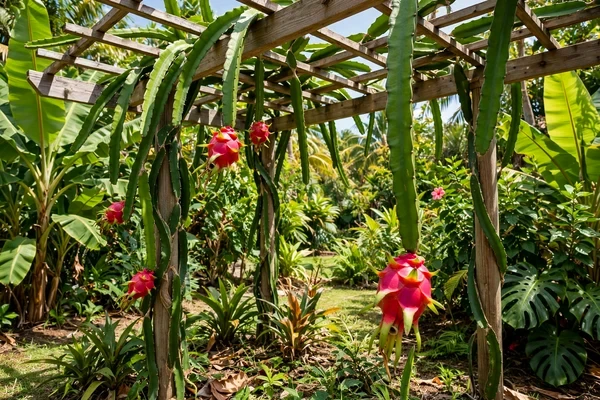
Age in months is less informative than the plant’s physical maturity. A dragon fruit plant is ready to flower when it has a well-developed root system, a main stem that has reached the top of its trellis, and a canopy of mature branches hanging from the frame. Flowers form on mature stems, usually on the hanging branches rather than on young upright growth. A plant that has not yet built this structure is not late — it is still growing.
Useful maturity signs include thick, firm, deep-green stems; a canopy that has filled the top of the trellis; and new growth that is strong rather than thin and stretched. If your plant shows these signs and the season is right, flowering is likely near — and that is the best local answer to how long dragon fruit takes to fruit. If the stems are still thin and the plant has not reached the trellis top, the timeline is simply still running, and the best action is good care rather than intervention.
When Fruiting Is Delayed: Common Reasons
If a plant is old enough, large enough, and in a warm season yet still not fruiting, work through the likely causes in order. The most common is immaturity: the plant looks big but has not built a mature canopy, or it is a seedling still in its juvenile phase. The second is insufficient light, especially plants in partial shade or under trees. The third is pollination failure, where flowers open but no fruit sets because the variety is self-incompatible and no compatible pollen is available. The fourth is nutrition imbalance, particularly excess nitrogen, which favours stem growth over flowering. The fifth is water stress or waterlogging at flowering time, which can cause flower drop.
Each cause has a different fix, so diagnosis matters. A plant with no flowers at all points to age, light, pruning, or nutrition. A plant with flowers but no fruit points to pollination. A plant with flowers that fall off points to water, weather, or pollination problems. Our article on why a dragon fruit plant is not flowering walks through this diagnosis step by step.

What to Expect in the First Few Fruiting Seasons
First harvests are usually small. A young plant may set only a few fruit in its first season, and that is normal and healthy. Production builds with age and canopy size: UF IFAS reports that three- to four-year-old plants may produce around 100 kg of fruit per year, and the life of a planting is estimated at about 20 years.
Expect the flowering season to stretch over months, with several waves of flowers rather than a single event. Each flower lasts one night, and fruit develops over the following weeks. Fruit from different waves ripens at different times, so harvest is spread out rather than a single day. Once you have fruit, timing the harvest matters as much as timing the first flower: see our guide on when to harvest dragon fruit for ripeness signs.
The most useful mindset is to treat the first year as establishment and the second and third years as production building. A plant that fruits lightly in year one and heavily by year three is following the normal pattern. Patience in the first year is not wasted time; it is the foundation of the next twenty.
Frequently Asked Questions
How long dragon fruit takes to fruit after planting a cutting six months ago?
Probably not. Six months is within the normal range for establishment, and many cuttings fruit between six and twelve months only when planted at the start of the warm season in full sun — so six months tells you little about how long dragon fruit takes to fruit for your plant yet. Check the plant’s maturity signs: has it reached the trellis top, built a canopy, and grown thick stems? If it is still climbing, it is on track. If it is mature, in full sun, and the season is warm, review light, feeding, and pruning before assuming a deeper problem.
Will a bigger pot make my dragon fruit fruit faster?
A larger pot can help by giving roots room and buffering water and temperature, but pot size alone does not trigger flowering. A plant fruits when it is mature, well-lit, and in season, not simply when its pot is big. A cutting in a small pot with full sun will usually outpace a cutting in a huge pot in shade.
Does cutting the tip of the main stem speed up fruiting?
Topping the main stem when it reaches the trellis top does speed up fruiting, because it redirects energy into side branches, and flowers form on mature branches rather than on a single upright stem. But topping too early — before the plant reaches the trellis — does not help; it creates low branches that waste energy and delay the climb. Top once at the trellis top, then let the canopy develop.
Can weather in one bad year delay fruiting permanently?
No. A cold winter, a heatwave, or a storm may delay flowering by a season, but dragon fruit is a long-lived perennial that recovers and resumes its normal cycle. Protect the plant from the immediate damage, prune out dead stems after the event, and let the next warm season restart growth.
Disclaimer: DragonFruitGrow.online is an independent gardening information resource. Growing conditions vary by climate, cultivar, and site, so observe your own plants and adapt this general guidance to local conditions.