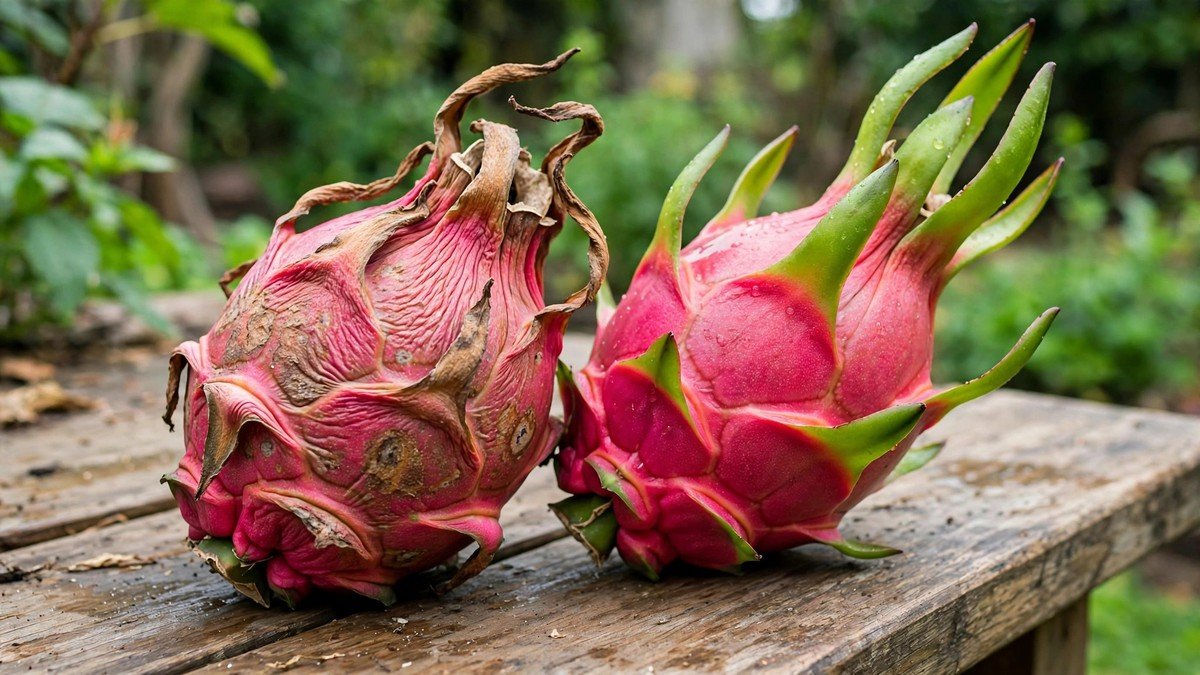
A dragon fruit left on the plant too long does not get sweeter. It gets soft, dull and tired, and by the time you cut it open the flesh is watery, sour or already starting to rot. The difference between a fruit at its peak and one that is past it can be a matter of two or three days, and the signs are all on the outside if you know where to look. Learning how to tell dragon fruit is overripe before picking saves the harvest from itself: you pick the fruit that is ready, leave the ones that still need time, and never bring home a fruit that was already spoiling on the vine.
This guide covers the five clear signs of an overripe fruit — soft spots, dull skin, wrinkles, smell and the stem end — plus what to do with fruit that has gone too far and how to time your picking better next season. It is the companion to knowing when a fruit is ripe: ripeness is about full colour and a slight give, while overripeness is about the fruit starting to break down.
In This Guide
- What overripe really means
- Soft spots: how to tell dragon fruit is overripe before picking by touch
- Dull skin and fading colour: how to tell dragon fruit is overripe before picking
- Wrinkles, shrivel and the scales
- The smell test
- Checking the stem end
- What to do with overripe fruit
- Picking at the right time next season
- Mistakes to avoid
- Frequently asked questions
What Overripe Really Means
An overripe dragon fruit is a fruit whose flesh has started to break down while still attached to the plant. The sugars that made it sweet begin to ferment, the cell walls weaken, and the skin loses its tight, bright finish. The process is slow at first and then quick: a fruit that was perfect on Monday can be soft and sour by Thursday in warm weather, and even faster after rain. Knowing how to tell dragon fruit is overripe before picking starts with this idea, because overripeness is not one single sign but a fruit that is past its peak in several small ways at once.
The timing depends on the weather. In a hot spell, fruit ripens and then overripens quickly, sometimes within two days of reaching full colour. In cooler weather the window is wider, and a fruit can hold at its peak for four or five days. Rain speeds everything up: water on the skin encourages soft spots and cracking, and a fruit that was fine before a storm can be spoiled after it.

Soft Spots: How to Tell Dragon Fruit Is Overripe Before Picking by Touch
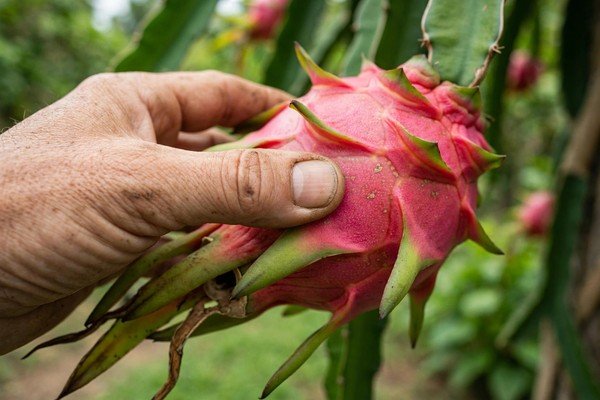
Soft spots are the most reliable sign of overripeness, and they are also the easiest to check. Hold the fruit in your palm and press it gently all over with your thumb, working around the whole surface. A fruit at its peak gives slightly and springs back everywhere, with the same firmness from end to end. An overripe fruit has patches that stay dented, or spots that feel much softer than the rest of the skin. Those soft patches are where the flesh underneath has started to break down, and they will only get worse.
Pay attention to where the soft spots sit. One soft patch near the stem end is often the first sign, since that end ripens first and ages first. Soft spots on the underside, where the fruit rested against the trellis or another stem, can be bruising rather than overripeness, so check whether the soft area matches a point of contact. Several soft spots spread across the fruit mean it is well past its peak, and it should be picked and used the same day or composted.
The press test is a matter of pressure. Use your thumb, not your fingers, and press gently: a hard squeeze will bruise even a good fruit. Press, release, and watch whether the skin springs back. A dent that stays is the warning. When you are learning how to tell dragon fruit is overripe before picking, the thumb test is the skill to practise first, because it works on every variety and in every season.
Dull Skin and Fading Colour: How to Tell Dragon Fruit Is Overripe Before Picking
A ripe dragon fruit glows. Its skin is bright pink or red, tight and glossy, with a shine that catches the light. An overripe fruit loses that shine: the colour turns dull and flat, the pink fades toward a muddy red, and the skin looks tired rather than vivid. The change is gradual, which is why it is easy to miss if you only look at the plant once a week. Learning how to tell dragon fruit is overripe before picking means catching this slow fade, so compare the fruit with a younger one on the same plant and the difference is usually obvious.
Colour alone is not proof, because varieties differ and a fruit in shade colours less brightly than one in full sun. The useful comparison is against the same fruit a few days earlier, or against its neighbours at the same stage. A fruit that was bright pink on Monday and looks dull and greyish-pink on Thursday is past its peak, even if it still feels firm. For the full colour stages of a fruit at its best, see our guide to dragon fruit skin colour when ripe, which shows what full colour looks like before the fading starts.
Wrinkles, Shrivel and the Scales
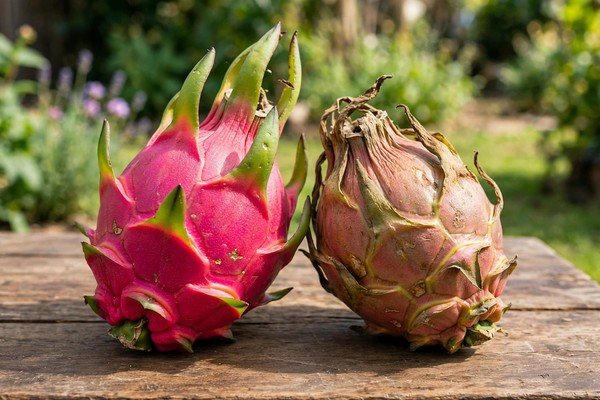
Wrinkles are the skin’s way of saying the fruit is losing moisture from the inside. As the flesh breaks down, it loses water, and the skin, which was stretched tight at ripeness, starts to loosen and fold. Fine wrinkles around the stem end are the first sign, and they spread across the fruit as it ages further. Spotting those early wrinkles is part of how to tell dragon fruit is overripe before picking, because they show up days before the flesh turns.
The scales tell the same story in a different way. On a fruit at its peak, the little green-tipped scales around the skin are fresh, flexible and slightly glossy. On an overripe fruit they dry out, turn brown, and become brittle, snapping off at a touch. Dry, brown, curling scales are one of the clearest visual signs of overripeness, and they are easy to check from a distance: if the scales look like dry leaves, the fruit is old. The UF IFAS growing guide describes the fruit’s appearance at harvest and the signs of a fruit past its best, and you can read the full guide through UF IFAS.
Shrivel is different from wrinkling, though they often appear together. A shrivelled fruit has lost so much moisture that it feels light for its size and looks deflated, with the skin loose around the flesh. Pick it up and compare its weight with a fruit of the same size: an overripe, shrivelled fruit feels noticeably lighter.

The Smell Test
Smell is the sense most growers forget, and it is often the most honest. A ripe dragon fruit smells faintly sweet, or of nothing at all, when you hold it to your nose. An overripe fruit smells different: sweet in a heavy, wine-like way, or sour and fermented, like fruit juice left out overnight. That fermented smell comes from the sugars in the flesh starting to turn, and it is a clear sign the fruit is past eating fresh.
Smell the stem end, where the scent is strongest, and smell the skin near any soft spot. A faint sweet smell on a firm fruit is fine. A strong sour smell, or a smell you can notice from a step away, means the fruit is overripe and should be used at once or composted.
Use smell together with the other signs, not on its own. A fruit can smell slightly sweet and still be perfectly good, and a fruit with no smell at all can still be soft inside. But when the smell test agrees with the thumb test and the colour test, you can be confident. When you are learning how to tell dragon fruit is overripe before picking, the smell test is the fastest check of all, because it takes two seconds and needs no tools.
Checking the Stem End
The stem end is where the fruit joined the plant, and it ages first. On a fruit at its peak, the stem end is dry, clean and slightly shrivelled, with a short stub of stem still attached. On an overripe fruit, the stem end turns dark, soft and wet, and it may leak a little juice or smell sour. A stem end that is black and mushy means the rot has started at the attachment point and is working into the flesh.
When you are learning how to tell dragon fruit is overripe before picking, the ring where the stem meets the fruit is one of the most telling places to look. On a good fruit it is tight and dry. On an overripe fruit it loosens, and the fruit may wobble on its stem or come away with a gentle twist. A fruit that falls off at a touch is overripe, and it should be used the same day if the flesh is still sound.
What to Do With Overripe Fruit
An overripe fruit is not always a wasted fruit, and knowing how to tell dragon fruit is overripe before picking also means knowing what to do with the ones that slip past their best. If the flesh is soft but still bright, with no mould and no sour smell, it is perfect for smoothies, sorbet and juice, where texture does not matter and the extra sweetness is welcome. Cut it open, scoop the flesh, and blend it with banana and yoghurt, or freeze it in cubes for later.
If the flesh is watery, translucent or sour, the fruit has gone too far for eating. Compost it, and do not leave it on the ground under the plant, where it attracts fruit flies and spreads rot to the stems. For the wider routine of handling fruit once it is off the plant, see our guide on how to store dragon fruit after harvest, which covers how long ripe fruit keeps and when it is too late.
Picking at the Right Time Next Season
The best cure for overripe fruit, once you know how to tell dragon fruit is overripe before picking, is picking on time. Once fruit starts colouring, check the plant every day, and pick each fruit when the skin is fully coloured, the scales are just starting to dry, and the fruit gives slightly under your thumb. Do not wait for the whole plant to ripen at once: dragon fruit ripens fruit by fruit, and the first fruit can be overripe while the last is still green. Picking fruit by fruit takes more trips, but it gives you more good fruit.
Keep a simple note of when each fruit was picked and how it looked, because knowing how to tell dragon fruit is overripe before picking gets easier when you can compare this year’s dates with last year’s. Over a season, the notes show you how many days your variety takes from full colour to overripe in your climate, and next year you will know exactly when to start checking. For what happens after a good picking, see our guide on what to do after harvesting dragon fruit, which covers handling, storage and looking after the plant after the harvest.
Mistakes to Avoid
The most common mistake when judging overripeness is trusting colour alone. A fruit can look fully pink and still be overripe inside, or look dull because it grew in shade while the flesh is still perfect. Always check with your thumb and your nose as well as your eyes, and judge from three signs together rather than one. When you are learning how to tell dragon fruit is overripe before picking, the habit of checking all three — touch, colour and smell — is what turns guessing into knowing.
The second mistake is waiting for a picking day instead of picking when the fruit is ready. A fruit does not wait for the weekend, and two days of delay in hot weather is enough to push a good fruit past its peak. The third mistake is squeezing too hard: a firm press bruises the fruit and makes it spoil faster, so use a gentle thumb and let the fruit tell you.
Frequently Asked Questions
How to tell dragon fruit is overripe before picking?
Check three signs together: press the fruit gently and look for soft spots that stay dented, look for dull faded skin and dry brown scales, and smell the stem end for a sour or fermented smell. That is how to tell dragon fruit is overripe before picking in one sentence: soft spots, dull skin, dry scales and a sour smell together mean the fruit is past its peak.
Can I still eat an overripe dragon fruit?
If the flesh is soft but bright, with no mould and no sour smell, yes, but use it the same day in a smoothie, sorbet or juice rather than eating it fresh. If the flesh is watery, translucent, mouldy or smells of vinegar, compost it instead.
How many days after full colour does dragon fruit go overripe?
It depends on the weather: in hot weather, sometimes within two days of reaching full colour, and in cooler weather within four or five days. Rain speeds it up. Check the plant daily once fruit starts colouring, and pick each fruit as it reaches its peak.
Why does my dragon fruit go soft on the plant?
Softness on the plant usually means the fruit is past its peak and the flesh is breaking down, especially after hot weather or rain. It can also be bruising where the fruit pressed against the trellis, so check whether the soft area matches a point of contact before deciding.
Should I pick overripe fruit off the plant or leave it?
Pick it off. An overripe fruit left on the plant attracts fruit flies, can spread rot to the stem, and wastes the plant’s energy. Pick it, check the flesh, use it at once if it is sound, and compost it if it is spoiled.
Conclusion
Overripe fruit is easy to miss and easy to learn to spot. The signs are all on the outside: soft spots that stay dented, dull fading skin, dry brown scales, a sour smell and a dark stem end. When you are learning how to tell dragon fruit is overripe before picking, check the plant daily once fruit starts colouring, pick each fruit at its peak, and use the ones that slip past their best in smoothies and cooking rather than wasting them.