
Dragon fruit is a sun-loving tropical cactus, so growing it inside a house sounds like a contradiction. A sunny windowsill is rarely enough, winter days are too short, and the plant stretches toward the glass, grows pale, and never flowers. Learning to grow dragon fruit indoors under grow lights solves the light problem directly: a good LED panel gives the plant the bright, long days it needs, in any room, in any season.
This guide shows how to grow dragon fruit indoors under grow lights step by step, from choosing the right LED panel and setting the hours and distance, to the pot, soil, watering and training that keep an indoor plant healthy. An indoor plant under proper lights can grow strong stems, flower, and set fruit on a balcony or in a spare room.
In This Guide
- Can dragon fruit really fruit indoors?
- Choosing the right grow light
- How many hours of light
- How far above the plant
- The right pot and soil
- Training stems indoors
- Watering indoors
- Getting flowers and fruit
- Common problems indoors
- Frequently asked questions
Can Dragon Fruit Really Fruit Indoors?
The short answer is yes, you can grow dragon fruit indoors under grow lights and get fruit, but it is not quick and it is not automatic. Outdoors, a mature plant in full sun flowers in its second or third year. Indoors, the same plant needs the same amount of light, delivered by a panel, for the same number of years. A small cutting under a weak desk lamp will grow thin, pale stems and never flower, because the light is simply not enough.
The plant needs strong light for most of the day, warmth, and room to climb. A single plant in a large pot with a proper LED panel above it is a realistic indoor project. A whole collection of plants under one small light is not. Start with one plant, give it the brightest spot you can plus the panel, and judge by the stems: thick, deep green, firm stems mean the light is working, while thin, pale, stretched stems mean it is not.
Be honest about the space too. A mature dragon fruit is a climbing cactus that wants to grow upward and then drape over a frame. Indoors, that means a pot on the floor, a trellis of about 1.5 metres, and clear space around it.
Choosing the Right Grow Light
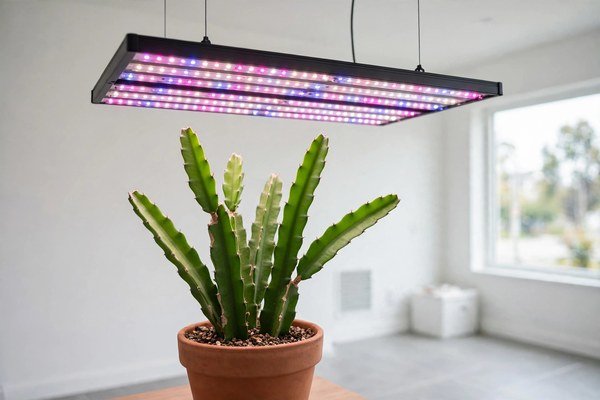
The light is the most important purchase when you grow dragon fruit indoors under grow lights, and it is worth spending a little more on the right one. A full-spectrum LED panel is the best choice for home growers: it is efficient, runs cool, and covers the blue light the plant uses for growth and the red light it uses for flowering. Look for a panel rated at least 100 watts for a single plant, and 200 watts if the plant is large or the room is dark.
Avoid purple-only grow bulbs and small clip-on lights. Purple lights make it hard to see the true colour of the stems, so you cannot tell whether the plant is healthy, and clip-on lights are too weak to cover a whole plant. The UF IFAS growing guide notes that dragon fruit needs full sun and a bright, open site, and an indoor panel is simply a way of recreating that sun. You can read the full guide through UF IFAS.
Buy a panel with a built-in dimmer if you can. Young cuttings need gentler light than a mature plant, and a dimmer lets you start low and raise the brightness as the plant grows.
How Many Hours of Light
Light hours are the second decision when you grow dragon fruit indoors under grow lights, and the answer is longer than most people expect. Give the plant 12 to 14 hours of light a day during the growing season, from spring through autumn. That matches the long tropical days the plant evolved for, and it keeps growth steady and stems thick.
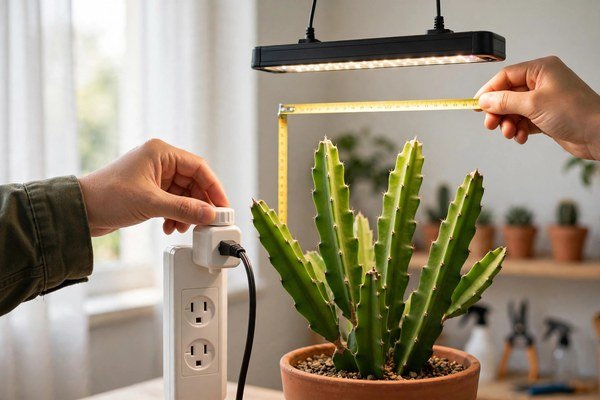
In winter, you can drop to 10 to 12 hours, which matches the shorter days and lets the plant rest a little. Do not run the lights 24 hours a day: plants need a dark period to rest. Use a simple plug-in timer so the hours stay the same every day; the plant responds to a steady routine far better than to random on-and-off hours.
If the plant also gets some window light, count that toward the total: a plant in a bright south-facing window may need only 8 to 10 hours of panel light on top. For the plant’s outdoor light needs, see our guide to dragon fruit sunlight requirements, which explains how much sun the plant wants in a garden.

How Far Above the Plant
Distance matters as much as brightness when you grow dragon fruit indoors under grow lights, because a panel hung too close burns the stems and a panel hung too far away is wasted. Start with the panel 30 to 45 centimetres above the top of the plant, and watch the stems for a week.
Healthy stems stay deep green and firm. Stems that turn yellow or pale at the top are getting too much light, so raise the panel by 10 centimetres. Stems that stretch upward, growing long and thin between the joints, are not getting enough, so lower the panel by 10 centimetres.
Raise the panel as the plant grows. A dragon fruit grows fast in summer, and a panel that was perfect in spring can be touching the top stems by midsummer. Check the distance every two weeks and adjust the hanging height. Most panels come with adjustable ropes or chains; use them, and never rest the panel directly on the plant. Hold your hand at the level of the top stems for a minute: if your hand feels uncomfortably hot, the panel is too close.
The Right Pot and Soil
An indoor dragon fruit needs a large, heavy pot, because the plant plus its trellis is top-heavy and a light pot tips over. Use a container of at least 50 litres, wide rather than tall, with drainage holes in the bottom and a saucer underneath to catch water.
The soil must drain freely, since a cactus in wet soil indoors rots faster than one outside, where sun and wind dry the pot. Use the free-draining mix from our guide to the best soil for dragon fruit, which is a blend of coarse sand, perlite or small bark with compost.
Never use heavy garden soil in a pot: it stays wet for days indoors, and wet roots are the fastest way to lose an indoor plant. When roots fill the pot and water runs straight through, repot into fresh mix and check the roots: healthy roots are pale and firm, while dark, soft roots mean rot, and the plant needs drier soil and less water. For container growing outdoors, see our guide on how to grow dragon fruit in a container on a balcony, which covers pot size and placement in detail.
Training Stems Indoors
Training is how you grow dragon fruit indoors under grow lights without the plant taking over the room. Give the plant a trellis from the start: a post of about 1.2 to 1.5 metres in the pot, with a small top frame for the stems to drape over. Tie the main stem loosely to the post with soft ties, adding a new tie every 30 centimetres as it grows, and pinch out side shoots that sprout low down.
Let one strong stem grow to the top of the post, then let it grow over the frame and hang down. The hanging stems are the ones that flower, so train two or three of them over the frame in different directions, spacing them evenly. Prune away stems that grow toward the wall or across the room, and cut back any stem that reaches the ceiling before it flops over and breaks. A plant trained neatly on its trellis catches the panel light evenly, dries quickly after watering, and is easy to inspect for pests.

Watering Indoors
Watering changes when you grow dragon fruit indoors under grow lights, because an indoor pot dries far more slowly than one outside. Water only when the top few centimetres of soil feel dry to the touch, and water deeply when you do, until a little runs out of the drainage holes. Then empty the saucer, so the pot never stands in water, and wait until the soil dries again before the next watering.
The calendar is not the guide; your finger in the soil is. Overwatering is the most common killer of indoor dragon fruit, and it shows as yellow, soft stems starting at the base, which is stem rot.
Water in the morning, so the soil surface dries during the day under the lights. Use room-temperature water, not cold water from the tap, which can shock the roots. If the room is very dry, a shallow tray of pebbles and water beside the pot raises the humidity a little without wetting the stems, which the plant prefers.
Getting Flowers and Fruit
Flowers are the goal when you grow dragon fruit indoors under grow lights, and they need three things: a mature plant, enough light, and a little stress at the right time. A plant grown from a cutting usually needs two to three years under good light before it flowers. A plant grown from seed takes far longer, often five years or more, so start with a cutting from a fruiting plant if you can.
In spring, when growth restarts, the plant needs its longest light hours, 14 hours a day, and a balanced feed. Too much nitrogen pushes soft, leafy growth with no flowers, so feed lightly and let the plant feel the season change. A slight drop in night temperature in autumn, down to around 15 degrees for a few weeks, can also trigger flowering in some varieties, since it mimics the seasonal shift the plant expects.
Common Problems Indoors
The most common indoor problem when you grow dragon fruit indoors under grow lights is stretched, pale growth, which means too little light. The stems grow long and thin, with wide gaps between the joints, and lean toward the window. Fix it by lowering the panel, adding light hours, or moving the plant closer to the brightest window. The stretched stems will not thicken again, so prune them back once new, compact growth appears.
The second problem is root and stem rot from overwatering, which shows as yellow, soft stems at the base and a sour smell from the soil. Stop watering at once, let the soil dry completely, and cut away any soft stem back to firm, healthy tissue. Repot into fresh, dry mix if the rot is advanced, and water far less from then on.
Pests are the third problem. Indoors, the usual visitors are mealybugs, which look like tiny white cotton clumps in the stem joints, and spider mites, which leave fine webbing and pale speckles. Check the plant weekly, because indoor pests spread fast in warm, still air. A small fan running on a low setting for a few hours a day keeps air moving around the stems, which helps the plant dry and makes life harder for pests.
Frequently Asked Questions
What do I need to start to grow dragon fruit indoors under grow lights?
To grow dragon fruit indoors under grow lights you need a large pot of at least 50 litres with drainage holes, a free-draining soil mix, a small trellis, a full-spectrum LED panel of at least 100 watts, a plug-in timer, and a cutting from a fruiting plant. Set the panel 30 to 45 centimetres above the plant, run it 12 to 14 hours a day, and water only when the top soil is dry.
How long until an indoor dragon fruit flowers?
A plant grown from a cutting usually flowers in its second or third year under good light. Strong light, a mature plant, and hand pollination at night are the three things that bring flowers sooner.
Can I use a normal household LED bulb?
A normal household bulb is too weak and too narrow in spectrum for a whole plant. It may keep a small cutting alive on a windowsill, but it will not grow thick stems or flowers. Use a proper full-spectrum grow panel rated at least 100 watts for one plant.
Why are my indoor stems thin and pale?
Thin, pale, stretched stems mean too little light. Lower the panel by 10 centimetres, add light hours up to 14 a day, or move the plant to a brighter spot. Prune the stretched stems back once new, compact growth appears, since stretched stems do not thicken again.
Does an indoor dragon fruit need a fan?
Yes, a small fan helps a lot. It moves air around the stems, dries the plant after watering, and discourages pests. Run it on a low setting for a few hours a day, not blowing directly at the plant, but moving air through the room.
Conclusion
Growing dragon fruit indoors is a longer game than growing it outside, but the rules are the same: strong light, free-draining soil, careful watering, and a trellis to climb. Once you know how to grow dragon fruit indoors under grow lights, the setup is simple: a good LED panel, 12 to 14 hours of light, the panel at the right distance, and a large pot with dry feet. Give the plant two or three years, pollinate its night flowers by hand, and the first fruit from your own living room is worth every watt.