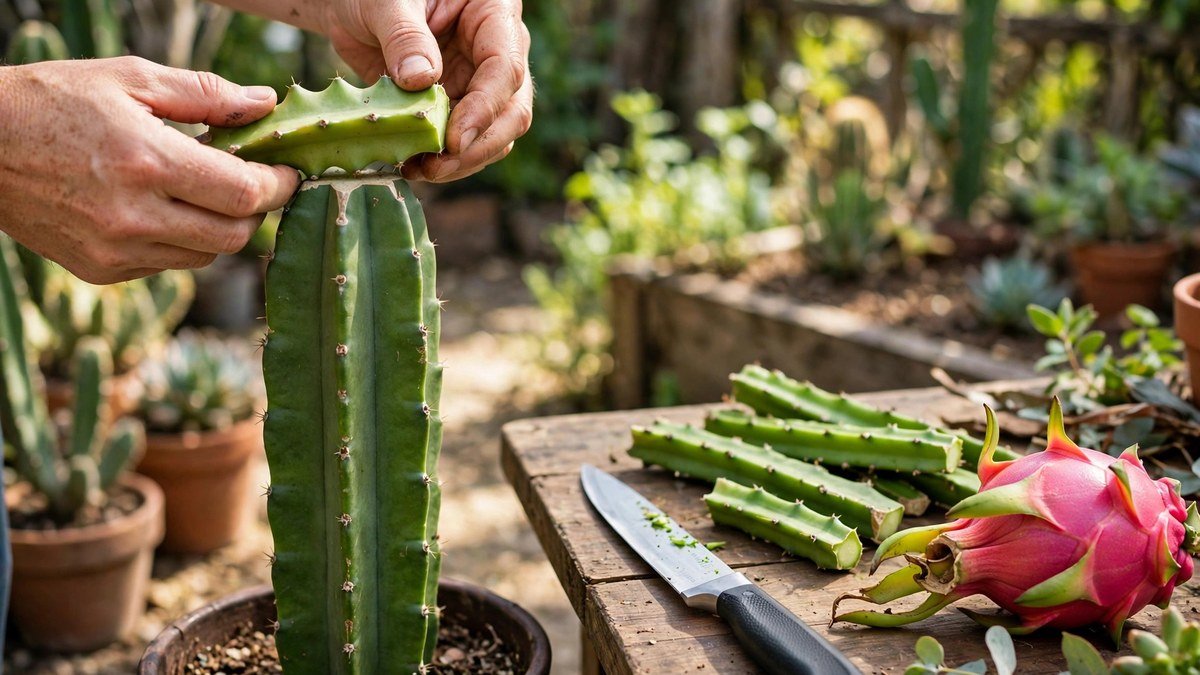
Grafting is one simple idea: join the top of one plant to the roots of another, and the two grow as a single plant. Learning how to graft dragon fruit onto cactus lets you grow several varieties on one plant, put a delicate variety on tough roots, and get fruit sooner than a seedling ever would.
It comes down to a clean cut and a good match. Get those right, keep the joint dry and shaded, and a fragile-looking graft can push out new growth within weeks. This guide covers how to graft dragon fruit onto cactus the right way, from rootstock and scion to the aftercare that decides whether the graft takes.
In This Guide
- Why graft dragon fruit at all
- What you are joining: scion and rootstock
- Choosing the rootstock: dragon fruit stem or another cactus
- Choosing and preparing the scion
- Tools and sterilisation
- When to graft
- Step by step: the cleft graft
- The flat graft alternative
- Aligning the cambium: the detail that decides everything
- Securing and sealing the joint
- Aftercare: shade, dry joints and patience
- Signs of success versus failure
- Common grafting mistakes
- Frequently asked questions
Why Graft Dragon Fruit at All
The best reason to graft is variety. One plant can carry a white-flesh variety on one branch, a red-flesh variety on another, and a yellow variety on a third, all on the same root system. That matters most for growers short on space: one pot can hold three or four varieties.
The second reason is strength. Some varieties fruit beautifully but grow on weak, disease-prone roots, and a vigorous rootstock gives them a root system they could never grow alone. A strong rootstock handles poorer soil, resists root rot better, and pushes growth faster.
The third reason is speed. A seedling can take years to fruit. A scion from a mature, fruiting plant is already adult wood, so once it heals onto a rooted rootstock it can fruit far sooner, often in its first season.
What You Are Joining: Scion and Rootstock
Every graft has two parts. The scion is the top piece, the stem of the variety you want to grow and harvest, and it decides what fruit you will get. The rootstock is the bottom piece, the rooted plant that supplies water and nutrients, and it decides how vigorous and tough the combined plant will be. After healing, the two live as one plant.
Both parts must be cacti, healthy and actively growing, because healing depends on living tissue joining living tissue. Dragon fruit is itself a climbing cactus, so it joins readily to other cacti, and the closer the two plants are related, the better the union.
Choosing the Rootstock: Dragon Fruit Stem or Another Cactus
For a first graft, the safest rootstock when you learn how to graft dragon fruit onto cactus is another dragon fruit stem. It is the same species as the scion, so the tissues match perfectly, the union heals fast, and growth is vigorous. Use a well-rooted, established plant with a thick, firm stem at least as wide as your thumb. A thin or newly planted stem is a poor rootstock.
The other common choice is a columnar cactus, such as a Cereus, which is widely used as a rootstock for dragon fruit and other cacti. It brings a thick, upright trunk and a strong root system, and it suits growers who want a tall plant or who struggle with root rot. According to UF IFAS, pitaya is a fast-growing, vine-like cactus that needs well-drained soil, so plant the rootstock in the best soil for dragon fruit before you graft onto it: a rootstock in wet, heavy soil will rot under the graft.
Pick a rootstock healthy from base to tip, with no soft spots, black marks, or pests. If the cut surface shows brown or rotten tissue inside, cut lower until the flesh is clean and green-white.
Choosing and Preparing the Scion
Take the scion from a variety you want to eat, from a healthy plant that has fruited well. Choose a firm, green stem about 15 to 20 centimetres long, mature but not woody and old. Avoid pale, thin, or diseased stems: a weak scion may fail even on a perfect rootstock.
Take the scion on the day you graft, or at most the day before, and keep it shaded so it does not dry out. Never take it weeks ahead: a scion loses moisture every day, and a dried-out scion cannot heal. Cut it with a clean blade and trim spines near the base.
Tools and Sterilisation
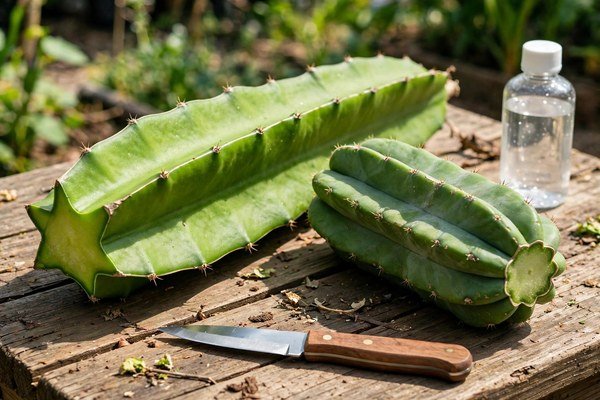
You need a sharp grafting knife or a new utility blade, rubbing alcohol or diluted bleach, grafting tape or soft plant ties, a clear plastic bag or cling film, gloves, and small labels. A sharp blade matters most, because a clean cut heals and a crushed or torn cut rots.
Sterilise the blade before every cut. Wipe it with rubbing alcohol, or dip it in one part household bleach to nine parts water, and let it dry for a few seconds. The first practical step in how to graft dragon fruit onto cactus is sterilising the blade: a dirty blade carries fungus and bacteria into the open wound, and an infected graft rots from the inside.
When to Graft
Graft in the warm growing season, when both plants are actively growing and heal quickly. The best time for how to graft dragon fruit onto cactus is late spring to early summer: the rootstock is pushing new growth, the scion is full of energy, and warmth speeds the callus that knits the two pieces together. Avoid a heatwave, when the scion can dry out before healing, and avoid winter, when dormant tissue heals slowly or not at all.
Pick a dry day and graft in the morning, so the joint has the whole day to settle. Avoid grafting just before rain, or a plant that is stressed, recently repotted, or very dry.
Step by Step: The Cleft Graft
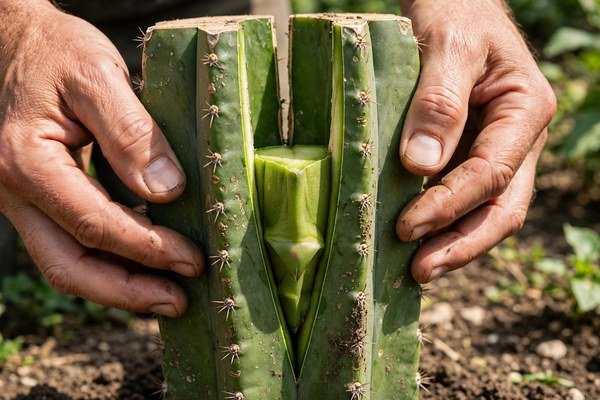
The cleft graft is the easiest method to learn, and it suits a scion thinner than the rootstock. Cut the top off the rootstock with one clean horizontal cut, leaving a flat surface, then make a single vertical split down the centre, about 3 to 4 centimetres deep, with the tip of the knife.
Next, shape the base of the scion into a wedge: cut both sides of its lower end so it tapers to a thin edge, about 3 centimetres long, like a flat screwdriver tip, in single smooth strokes, keeping the wedge even on both sides. The cleft method is the easiest way to learn how to graft dragon fruit onto cactus because the wedge locks into the split and holds itself in place while you secure it.
Open the split gently with the knife tip, slide the wedge in, and push it down until the cut surfaces meet fully and the scion sits firmly, straight and upright, with the top of the wedge level with or just below the flat top of the rootstock.
The Flat Graft Alternative
The flat graft suits a scion and rootstock of the same thickness. Cut the top of the rootstock flat, cut the base of the scion flat, and press the two faces together across their full width. With nothing locking the pieces together, hold them firmly while you wrap.
A flat graft heals well when the two faces match, but it is less forgiving: uneven faces or a loose wrap let the pieces shift and the graft fails. If the stems are the same thickness, how to graft dragon fruit onto cactus can also be done with a flat graft, and it gives a neater joint with no split to heal.
Aligning the Cambium: The Detail That Decides Everything
Under the skin of every cactus stem is a thin ring of green growing tissue called the cambium, and the graft only heals where the scion’s cambium touches the rootstock’s. The single most important detail in how to graft dragon fruit onto cactus is cambium alignment: if the two green rings do not meet, the pieces will never knit together, however tightly you wrap them.
Line the rings up on at least one side. If the scion and rootstock are the same thickness, the rings meet all the way around. If the scion is thinner, do not centre it: push it to one side so its cambium lines up exactly with the rootstock’s on that side. One side joined properly heals; a scion centred with a gap on both sides does not heal at all.
Securing and Sealing the Joint
Once the cambium is lined up, wrap the joint firmly with grafting tape, starting below the joint and winding upward so each turn overlaps the last. The wrap should be snug enough to hold the scion still and press the cut faces together, but not so tight that it crushes the soft flesh. Cover the whole joint, including the top edge of the rootstock.
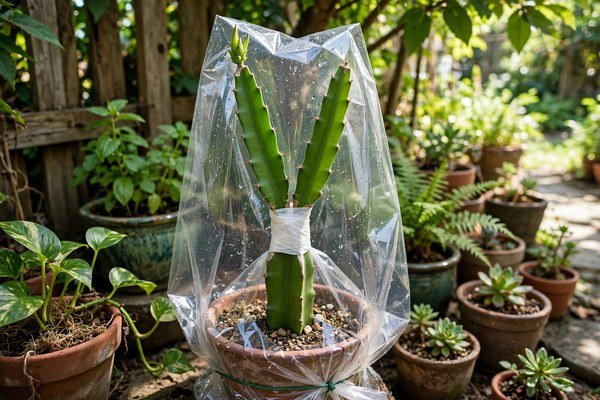
After wrapping, cover the graft with a clear plastic bag to hold in humidity, tied loosely below the joint so air can still move. The bag stops the scion drying out in the first days, when it is most vulnerable. Label the graft with the variety name and date, and tie a tall scion loosely to a stake so wind cannot break the fresh union.
Aftercare: Shade, Dry Joints and Patience
Aftercare decides whether how to graft dragon fruit onto cactus ends in a new branch or a dead scion. Move the plant into bright shade for two to three weeks: sun on a fresh graft dries the scion out before it can draw water from the rootstock. Do not twist the joint by hand: every wobble breaks the fragile new tissue.
Keep water off the joint: water the soil at the base lightly, but never splash the graft itself, because a wet joint rots. If rain is coming, move a potted graft under cover. If you are learning to grow dragon fruit in a container on a balcony, keep the pot in its shaded spot and water only the soil until the graft has taken.
After two to three weeks, remove the plastic bag: a healed graft looks dry and firm, with a pale callus around the cut. Leave the tape on for another two to three weeks, then remove it once the scion is growing or the joint feels solid. Move the plant gradually back into sun over a week, a little more each day.
Signs of Success Versus Failure
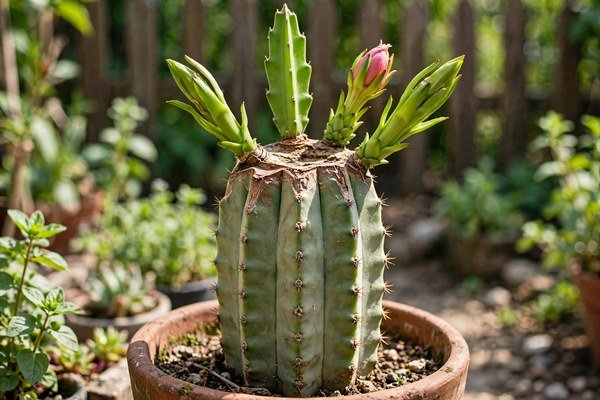
The clearest sign that how to graft dragon fruit onto cactus has worked is new growth. Within three to six weeks, a successful scion stays green and firm, swells slightly, and pushes out a fresh shoot from its tip. The joint forms a pale, dry callus, and the rootstock below stays healthy.
Failure looks very different: a failed scion turns yellow, then soft, then shrivelled, and the joint turns dark or black where rot has set in. Sometimes the scion simply falls off, because the two pieces never joined. If that happens, cut the rootstock back below the failed joint until the flesh is clean, let the cut dry for a day, and graft again with a fresh scion.
Common Grafting Mistakes
The most common mistake when learning how to graft dragon fruit onto cactus is a dull or dirty knife, which crushes the cut and invites infection. Next is grafting at the wrong time: a winter graft heals too slowly, and a graft in peak heat dries out before it takes. Misaligned cambium is the quietest killer: the graft looks perfect outside while the two green rings never touch inside. Watering the joint is another error, as is removing the tape too early.
Two more are easy to avoid: a sick or weak scion, which has no energy to heal, and a rootstock that is itself unwell or newly planted. Avoid those errors and most grafts take.
Frequently Asked Questions
What is the easiest way to learn how to graft dragon fruit onto cactus?
Start with a cleft graft on a dragon fruit rootstock: the wedge holds the scion in place and same-species tissues heal fast. Use a sharp, sterilised blade, line up the cambium on one side, wrap the joint snugly, cover it with a plastic bag, and keep it in bright shade with the joint dry for two to three weeks.
Can I graft dragon fruit onto any cactus?
No. The rootstock must be a cactus, and compatibility varies between species. A dragon fruit stem is the most reliable rootstock for a beginner, and columnar cacti such as Cereus are also widely used. Avoid thin, soft or slow-growing cacti, and any plant that is not a cactus: the tissues will not join.
How long does a dragon fruit graft take to heal?
The joint starts to knit within two to three weeks, and new growth usually appears within three to six weeks in warm weather. Leave the tape on for four to six weeks, and return the plant to full sun gradually.
Can I graft more than one variety onto the same plant?
Yes, and that is one of the best reasons to graft. Graft a different variety onto each branch of the same rootstock, and each branch will fruit true to its own variety. Label every graft, and graft only one or two varieties at a time so the rootstock is not overwhelmed.
Why did my graft turn black and fail?
A black joint usually means rot, caused by a dirty blade, water reaching the joint, or grafting in cold or wet weather. Cut the rootstock back below the blackened tissue until the flesh is clean, let it dry, and graft again with a fresh scion and a sterilised blade on a dry, warm day.
Conclusion
Grafting is a small skill with a large payoff: one plant, several varieties, stronger roots, and fruit sooner than a seedling could ever manage. Choose a healthy rootstock and scion, cut cleanly with a sterilised blade, line up the cambium on at least one side, wrap the joint snugly, and keep it shaded and dry while it heals. Once the scion is growing, care for the plant as normal: see how to grow dragon fruit.