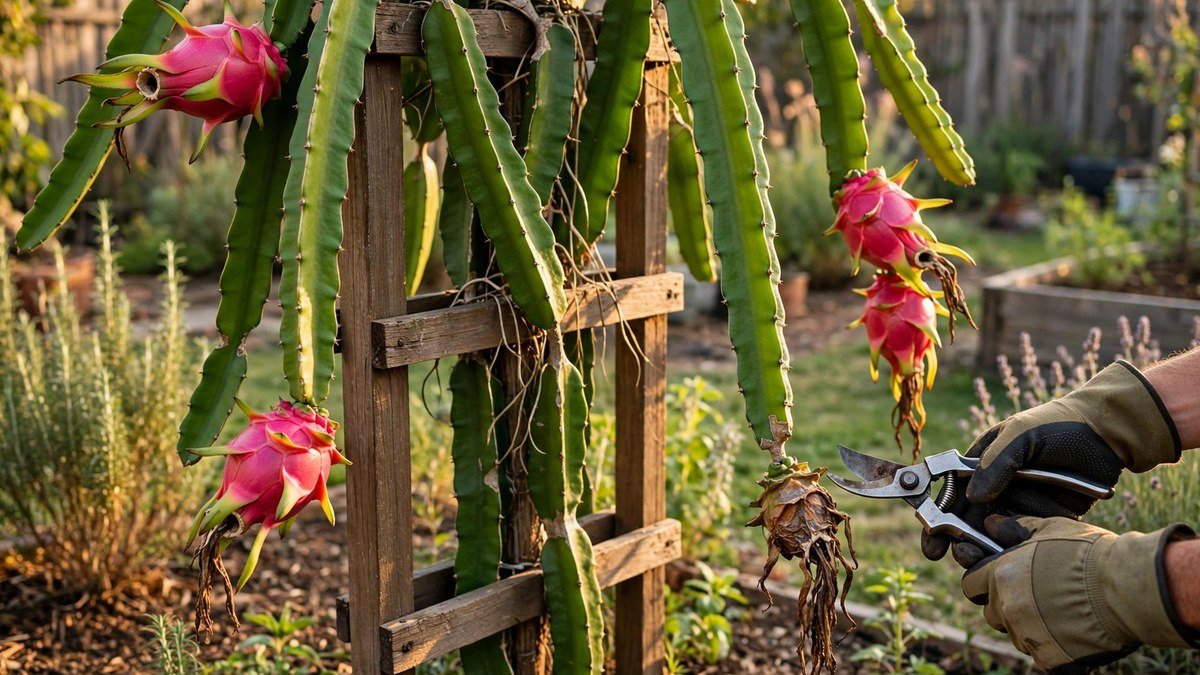
When the last fruit has been picked, a dragon fruit plant looks tired: crowded stems, empty fruit stalks, and a few yellowed tips. It is tempting to leave it alone, but the weeks right after fruiting ends are the best time to tidy it up. Learning how to prune dragon fruit after fruiting season ends gives the plant a clean shape, better airflow, and room to push out strong new stems for next season’s flowers.
This guide covers that one job only: end-of-season cleanup and shaping, in the order a careful grower would follow it.
In This Guide
- Why end-of-season pruning is different
- When to start
- What to look for first
- Tools and preparation
- What to remove first
- How to make a clean cut
- Shaping for next season
- What to do with cuttings
- Aftercare
- Mistakes to avoid
- Young versus mature plants
- Container plants
- Frequently asked questions
Why End-of-Season Pruning Is Different From Mid-Season Trimming
During the fruiting months, pruning is light: you remove a damaged stem here and there, but leave the plant mostly alone, because every cut is a wound while fruit is still forming. Once the season ends, the rules change. The plant stops spending energy on fruit, so it can spend it on healing cuts and growing new stems instead.
That shift is why how to prune dragon fruit after fruiting season ends matters more than the small snips most growers do in summer. A proper end-of-season prune removes stems that will never fruit well again, opens the middle so light and air reach every segment, and sets a shape that is easy to manage next season. According to UF IFAS, dragon fruit grows best in well-drained soil with regular, light care, and the same gentle approach applies to pruning.
When to Start: Reading the End of the Season
Do not prune by the calendar alone: seasons end at different times in different climates, and two plants in the same garden can finish weeks apart. Start when the plant tells you it is finished: the last fruit is picked, no new buds are forming, and the stems have stopped pushing out fast, soft growth. If you still see fresh buds, wait.
Prune on a dry, mild day, with several dry days ahead if you can: fresh cuts heal fastest in dry air, while cuts made just before rain stay wet and invite rot. Never prune when frost is expected within a few days, because the cut ends are the most tender parts of the plant.
What to Look For Before You Cut a Single Stem
Walk around the plant slowly before you pick up the shears, including the back that faces a wall or fence, because the worst tangles hide there. Look for four things: spent fruit stalks, old stems, damaged growth, and stems that cross or crowd each other.
Spent fruit stalks are the short, dry stubs left where fruit was attached. They will never fruit again, and they trap moisture and pests, so they come off first. Old stems have already fruited for two or three seasons: they look grey-green, woody at the base, and thinner than the new growth around them. Damaged stems show yellowing, soft patches, black spots, or shrivelled tips; cut those back to healthy tissue, or remove them if the damage runs deep. Stems growing inward or crossing each other block light and air and rub together in the wind, leaving wounds that invite disease.
Mark the stems you plan to remove with string before cutting, so you do not cut a good young stem by accident. This slow look is the heart of how to prune dragon fruit after fruiting season ends well.

Tools You Need and How to Prepare Them
Dragon fruit stems are thick and fleshy, so blunt tools crush them instead of cutting them. You need sharp bypass secateurs, a small pruning saw or loppers for the older stems, thick gloves against the small spines, a bucket for the cuttings, and rubbing alcohol to clean the blades.
Clean the blades before you start, between plants, and after every cut into a diseased-looking stem: dip them in rubbing alcohol and let them dry. This one habit prevents more disease than any spray. Test the secateurs on a scrap stem first: if the cut looks crushed or ragged, sharpen the blades, because a crushed cut heals slowly and rots easily. A clean cut on a dry day seals itself without paint or sealant, which can trap moisture underneath.

What to Remove First: The Priority Order
Work in a fixed order so you never remove a healthy stem while a dead one is still in the way. Start with the dead and damaged material: spent fruit stalks, yellowed or soft stems, and any stem with rot or deep black spots.
Next, remove the oldest stems, recognised by their woody base, dull colour, and old fruit scars. Take out about a third of the oldest growth in any one year, because the plant still needs its mature stems for structure and stored energy. Then deal with the crowded middle: stems growing inward, stems crossing each other, and stems so close together that air cannot move between them. Keep the strongest stem of each crossing pair and remove the weaker one.
Follow this order and you will remove far less than you feared, because learning how to prune dragon fruit after fruiting season ends is mostly about knowing what to leave alone.
How to Make a Clean Cut
Where you cut matters as much as what you cut. For a whole stem, cut it back to its base, flush with the stem it grows from, leaving no stub: a stub dries out, rots, and becomes a home for pests. For shortening a stem, cut just above a joint and angle the cut slightly so water runs off instead of sitting on the wound.
Hold the stem steady and cut in one firm motion: squeezing the handles slowly crushes the flesh, so commit to the cut. If the stem is thicker than your secateurs can handle, switch to loppers or the saw. After each cut, check the surface: it should be pale green and firm. Brown or black inside means the damage runs deeper, so cut further back until the flesh looks clean.
Getting the cut right is the core skill in how to prune dragon fruit after fruiting season ends, so take your time and let each cut dry before you water again.

Shaping the Plant for Next Season
A dragon fruit plant fruits best when its stems hang down from the top of its support, like an umbrella, and after fruiting ends that shape is what you are restoring. Keep three or four strong main stems rising to the top of the post, and let the side stems drape over and hang down. Remove side stems shooting straight upward, and low shoots from the base, unless you need a replacement main stem.
Aim for an open centre: stand back and check that you can see daylight through the middle and that air moves through it freely. If two hanging stems lie flat together, remove the weaker one. Shaping is the final step in how to prune dragon fruit after fruiting season ends.
What to Do With the Cuttings
Do not leave cuttings in a pile under the plant: fresh, damp pieces attract snails and slugs, and diseased pieces spread their problems back into the soil. Healthy cuttings are useful, though: let them dry in a shaded spot for a week or two until the cut ends callus over, then plant them or share them.
Diseased or rotten pieces go in the green waste bin, not the compost heap, because a home compost heap rarely gets hot enough to kill what they carry.
Aftercare: Water, Feed and Watch
Pruning is a shock, so the plant needs a quiet recovery period. Water lightly for the first week or two, just enough to keep the soil from drying out, and avoid soaking the plant or wetting the cut ends. A plant growing in the best soil for dragon fruit recovers faster, because good drainage keeps the roots healthy while the cuts heal.
Hold off on fertiliser until you see fresh growth: feeding a freshly pruned plant pushes soft, weak shoots that suffer first in cold weather, and wastes nutrients it cannot use yet. When new shoots appear, usually within a few weeks in warm weather, give a light balanced feed, and mulch the base with compost.
Check the cut ends every few days for the first fortnight: a healthy cut dries into a pale, firm callus, but a cut that turns black, soft, or weepy should be cut back a little further to clean tissue. Good aftercare is the quiet half of how to prune dragon fruit after fruiting season ends, and it is what turns a tidy plant into a productive one.

Mistakes That Cost You Next Season’s Fruit
The most expensive mistake is pruning too hard: removing more than a third of the plant in one year leaves it short of the stored energy it needs to flower, and the next harvest can drop sharply. The second is pruning too early, while buds are still forming. The third is using dirty or blunt tools, which spreads disease and leaves ragged wounds.
Another common error is cutting the new growth and leaving the old. Young, vigorous stems will flower next season, so protect them, while the old, woody stems that have fruited several times are the ones to thin out. Topping the plant, cutting all the stems to the same height like a hedge, also destroys the hanging umbrella shape and forces weak upright shoots. If you remember one rule about how to prune dragon fruit after fruiting season ends, make it this: take out the old and the damaged, and protect the young and the strong.
Young Plants Versus Mature Plants
End-of-season pruning is different for young plants. A plant in its first or second year is still building its structure, so prune it very lightly: remove only dead or damaged stems, spent fruit stalks, and shoots growing in the wrong direction. The goal is to train three or four strong main stems up the post, not to thin the plant out, and if a young plant has only one or two main stems, leave it alone.
If you are still learning how to grow dragon fruit, keep the first-year prune light and focus on training the shape rather than removing growth.
Mature plants, three years and older, can take a full end-of-season tidy-up each year. They have the root system and stored energy to recover quickly and push out strong new growth. If you inherit an old, neglected plant, do not fix it in one session: spread the work over two seasons, removing the worst dead and crowded growth in the first year and finishing the shaping in the second. The young-plant rule for how to prune dragon fruit after fruiting season ends is simple: train the shape, and remove almost nothing.
Container Plants After Fruiting Ends
Container plants follow the same rules for how to prune dragon fruit after fruiting season ends, with two extra checks. First, check the pot: a plant that fruited heavily may have pushed roots through the drainage holes, and the end of the season is a good time to check whether it needs a bigger container. Do not repot and prune hard in the same week, because the plant can only recover from one shock at a time.
Prune first, let it settle for two or three weeks, then repot if it still needs it. For container growing basics, see how to grow dragon fruit in a container on a balcony.
Second, check the support: tighten or replace ties while the plant is freshly pruned and light, and water container plants even more lightly after pruning, because pots hold moisture longer in cool weather and wet roots plus fresh cuts are a poor combination.
Frequently Asked Questions
How do I know how to prune dragon fruit after fruiting season ends without harming the plant?
Remove only dead, damaged, and spent stems, then thin the oldest growth by about a third, and never remove more than a third of the whole plant in one year. Use sharp, clean tools, cut on a dry day, and leave the young, vigorous stems alone, because those will flower next season. If you are unsure about a stem, leave it and check again next year. That cautious approach is the safest way to learn how to prune dragon fruit after fruiting season ends.
Can I prune dragon fruit in winter?
Light tidying in mild winter weather is usually fine, but do the heavy pruning at the end of the fruiting season, before cold weather arrives, because fresh cuts are tender.
Should I fertilise right after pruning?
No. Wait until you see fresh new growth, then feed lightly; feeding a freshly pruned plant pushes soft growth that cold easily damages.
What should I do with long stems that hang to the ground?
Shorten them back to a joint so they hang clear of the soil, where they would root, pick up disease, and invite snails and slugs. A stem ending a hand’s width above the ground is the right length.
How long before a pruned plant grows back?
In warm weather, new shoots usually appear within two to four weeks; in cooler weather it takes longer, which is normal while the plant rests. As long as the remaining stems stay firm and green, it will push out fresh growth when the weather warms.
A Short Checklist for Pruning Day
Wait until the last fruit is picked and no buds are forming, choose a dry mild day, and walk around the plant to mark what needs to go. Clean and sharpen your tools, remove dead and spent material first, then thin the oldest stems by about a third and open the crowded middle. Cut cleanly at the base or just above a joint, let the cuts dry, and clear the cuttings away.
Water lightly, hold the fertiliser until new growth shows, and check the cuts for two weeks. Done in that order, the job takes less than an hour on most home plants, and the plant will repay it with stronger growth and a better harvest next season.