
A dragon fruit plant that sits in still, damp air is an invitation to trouble. The thick stems hold moisture, the crowded growth traps humidity, and fungal spores find exactly the conditions they need to settle in.
Most growers reach for a spray when spots appear, but the cheaper fix comes first: moving air. Learning how to improve airflow around dragon fruit plants is one of the simplest ways to keep a plant healthy, because dry stems are far harder for disease to attack than wet ones.
This guide explains how to improve airflow around dragon fruit plants step by step, from spacing and thinning to trellis training, watering habits and pot placement. Nothing here needs special equipment. A pair of secateurs, a little space and a few small changes to how you water are usually enough to turn a damp, crowded plant into an open, healthy one.
In This Guide
- Why airflow matters for dragon fruit
- Signs your plant needs better airflow
- Spacing plants so air can move
- Thinning and pruning for open growth
- Training stems on a trellis for airflow
- Watering habits that keep stems dry
- Mulch, ground cover and air at the base
- Airflow in pots and on balconies
- Frequently asked questions
Why Airflow Matters for Dragon Fruit
Dragon fruit is a tropical cactus, and learning how to improve airflow around dragon fruit plants starts with its natural home, where it grows up trees with breezes moving freely around the stems. In a home garden it often ends up in the opposite conditions: planted tight against a wall, crowded with other plants, or left to grow into a dense ball of stems.
When air cannot move through the plant, moisture stays on the stems long after watering or rain, and that wet surface is where fungal problems begin. Anthracnose, stem rot and bacterial soft rot all spread faster in still, humid air, and a plant that never dries out is a plant that is always at risk.
Good airflow works in three ways at once. First, it dries the stems quickly after rain or watering, which removes the wet window that fungi need to germinate. Second, it lowers the humidity inside the plant canopy, so the air between the stems is closer to the air outside.
Third, it strengthens the stems themselves: plants grown in moving air develop firmer tissue than plants grown in sheltered, still spots. The UF IFAS growing guide notes that dragon fruit needs a sunny, well-drained site with good air movement, and that crowded, shaded conditions favour disease.
You can read the full guide through UF IFAS. For the problems that poor airflow invites, see our guide to dragon fruit plant diseases, which covers the common fungal and bacterial issues and how to recognise them early.
Signs Your Plant Needs Better Airflow
If you are wondering how to improve airflow around dragon fruit plants, start by looking for the warning signs. The most obvious is disease that keeps coming back in the same place: brown or black spots on the stems, soft patches that spread slowly, or fruit that rots before it ripens.
A single spot can happen to any plant, but spots that appear again and again on the inner stems, where the plant is thickest, point to trapped humidity rather than bad luck.
Other signs are quieter. Stems that stay wet hours after watering, or that still feel damp the morning after rain, are not drying properly. A musty smell inside a dense plant, or tiny flies hovering around the base, also suggests stagnant air.
Slow growth can be a sign too: a plant whose inner stems never see sun or breeze puts its energy into the outer growth only, and the centre becomes a tangle of weak, pale stems that flower poorly. If you push the outer stems aside and find a dark, damp middle, the plant is telling you it needs opening up.

Spacing Plants So Air Can Move
Spacing is the first step in how to improve airflow around dragon fruit plants, and it is the one that is hardest to fix later, so it matters most at planting time. A single dragon fruit plant needs room to spread: at least one metre of clear space on all sides in the ground, and more if you grow several plants together.
Plants set too close together grow into one another within a year or two, and once their canopies touch, the air between them stops moving altogether.
Good spacing is how to improve airflow around dragon fruit plants at the largest scale, and it costs nothing except a little planning. Keep the planting spot away from solid walls and fences on at least two sides, because a plant boxed in on three sides sits in a pocket of still air. A low fence or an open trellis lets wind through, while a solid wall blocks it.
If your garden is small, grow one plant well rather than three plants crowded together: a single open plant fruits better than three cramped ones. When you do plant more than one, stagger them rather than lining them up in a tight row, so the breeze can pass between each plant instead of hitting a solid wall of stems.
Thinning and Pruning for Open Growth
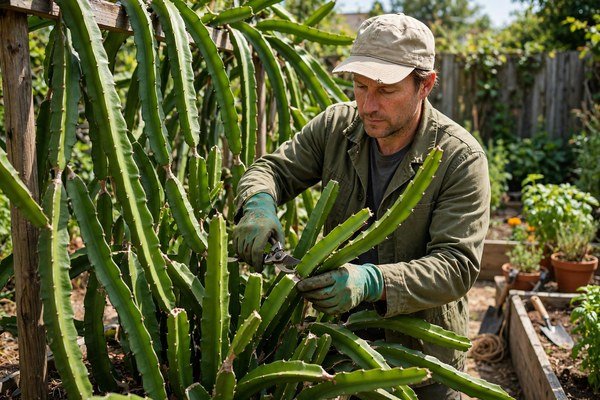
Thinning is the fastest way to put how to improve airflow around dragon fruit plants into practice on an established plant, and it needs nothing more than sharp secateurs and a little courage. The goal is to open the middle of the plant so you can see daylight through it. Start by removing stems that grow inward, stems that cross each other, and stems that lie flat against one another.
Keep the strongest stem of each crossing pair and remove the weaker one. Then remove old, woody stems that have fruited for several seasons and now shade the younger growth.
When you are learning how to improve airflow around dragon fruit plants, work a little at a time and step back often to check your progress. A good rule is to remove no more than a third of the plant in one session, and to stop as soon as light reaches the centre. Cut each stem back to its base, flush with the stem it grows from, leaving no stub to rot.
Clean the blades with rubbing alcohol between cuts into diseased-looking stems, so you do not carry infection from one stem to another. The best time to thin is at the end of the fruiting season, when the plant is resting and can heal quickly. For the right season and technique, see our guide on when to prune dragon fruit, which covers timing, tools and the cuts that matter most.
Training Stems on a Trellis for Airflow
A trellis is not only support; it is also a tool for how to improve airflow around dragon fruit plants, because a plant trained upward and outward is an open plant. Left alone, dragon fruit stems sprawl into a dense mound on the ground, where air cannot reach the middle and the lower stems stay wet.
Tied up a post or a trellis, the same plant spreads its stems in a fan, with space between each one for air and light to pass through.
Train three or four strong main stems up the post as part of how to improve airflow around dragon fruit plants, and let the side stems drape over the top and hang down, like an umbrella. Tie new growth loosely to the support with soft ties, spacing the stems apart rather than bunching them together. Remove side shoots that sprout low on the post and grow straight upward into the canopy, since these are the stems that fill the centre first.
A top frame, a wheel or a square of timber at the top of the post, spreads the hanging stems into a ring instead of a clump, which is the single best shape for airflow. Check the ties every few months and loosen any that have grown tight, because a tie that cuts into a stem creates a wound that disease can enter.

Watering Habits That Keep Stems Dry
Watering habits are part of how to improve airflow around dragon fruit plants, because wet stems in still air stay wet, while the same stems in moving air dry quickly. The simplest change is to water at the base of the plant, never over the top.
A hose or sprinkler that wets the whole plant leaves every stem damp, and in a crowded plant that moisture can sit for a day or more. Watering slowly at the soil line keeps the stems dry from the start.
Water in the morning as part of how to improve airflow around dragon fruit plants, so the plant has the whole day to dry before the cool night. Evening watering is the worst habit for airflow, because the stems stay wet all night in cool, still air, which is exactly when fungi are most active.
Water deeply but infrequently, and let the soil dry between waterings: a plant watered lightly every day has permanently damp stems, while a plant watered deeply once a week dries out properly in between.
For a full schedule, see our guide on how often to water dragon fruit, which covers the finger test, seasonal changes and the signs of overwatering. In pots, always empty the saucer after watering, since a pot standing in water keeps the soil wet and the air around the base humid.

Mulch, Ground Cover and Air at the Base
The ground under the plant matters too, and how to improve airflow around dragon fruit plants includes keeping the base clear. A thick layer of mulch piled against the stem holds moisture right where rot starts, so keep mulch a hand’s width away from the base of the plant.
A thin layer of coarse mulch further out is fine, and it helps by keeping the soil cool and suppressing weeds, but it should never touch the stem itself.
Weeds and low ground cover around the base also block air. Tall grass, dense ground cover plants and piles of fallen leaves all trap humid air at soil level, and the lowest stems sit in it permanently.
Keep a clear circle of bare soil or light mulch around the base, about half a metre across, and pull weeds before they grow tall. Fallen fruit and dead stems on the ground should be cleared away too, since rotting material at the base breeds the fungi that attack the plant above. A clean base dries fast after rain, and fast drying is the whole point.
Airflow in Pots and on Balconies
In a pot, how to improve airflow around dragon fruit plants means giving the plant room on all sides. Balconies are often sheltered on three sides by walls and railings, which blocks the breeze, and pots are often pushed tight together to save space. Move the pot a little away from the wall, at least a hand’s width, so air can pass behind it.
If you have several pots, space them apart rather than lining them shoulder to shoulder, and raise them slightly on pot feet or a stand so air can move underneath as well.
A balcony railing can help with how to improve airflow around dragon fruit plants if the plant is trained to grow over it, since the stems above the railing catch the wind while the pot stays sheltered below. Avoid placing the pot in a corner where two walls meet, because corners are the stillest spots on any balcony.
If your balcony is very sheltered, a small outdoor fan on a low setting for a few hours on humid days can make a real difference, though it is no substitute for thinning and spacing. The same rules apply indoors on a sheltered veranda: open the space, thin the plant, and let the air reach the centre.
Frequently Asked Questions
How do I start learning how to improve airflow around dragon fruit plants?
Start with the simplest steps: space plants at least one metre apart, thin out crowded and crossing stems until you can see daylight through the centre, and water at the base in the morning instead of wetting the whole plant. Those three changes fix most airflow problems without any new equipment.
Can too much wind harm a dragon fruit plant?
Strong, constant wind can dry stems and break young growth, but normal breezes are good for the plant. If your garden is very windy, a low open fence or a hedge that filters the wind is better than a solid wall, which creates still pockets on its sheltered side. Tie tall stems loosely to their support so they do not whip around.
Should I remove healthy stems just to improve airflow?
When you are learning how to improve airflow around dragon fruit plants, remove only stems that cross, grow inward, or shade the centre of the plant, and never more than a third of the plant at once. Healthy outer stems that get sun and air should stay. The goal is an open centre, not a bare plant, so step back often and stop as soon as light reaches the middle.
Does airflow matter in a dry climate?
Yes, but less urgently. In a dry climate the stems dry quickly on their own, so disease pressure is lower. Airflow still matters for even ripening and strong stems, but the priority in dry areas is usually watering and sun. In humid climates, airflow is one of the most important things you can manage.
How often should I thin my dragon fruit plant for airflow?
Do a main thinning once a year at the end of the fruiting season, and a light tidy-up whenever you notice crossing or inward-growing stems during the growing season. Young plants need very little thinning, while mature plants benefit from a yearly open-up.
Conclusion
Airflow is the quiet part of dragon fruit care: no spray, no feed, no new equipment, just space and light reaching every stem. Once you know how to improve airflow around dragon fruit plants, the rest of plant care gets easier, because a dry, open plant resists disease on its own, fruits more evenly and is simpler to inspect, prune and harvest.
Space the plants, thin the centre, train the stems upward, water at the base in the morning, and keep the ground clear. Do those five things, and your plant will spend its energy growing fruit instead of fighting rot.