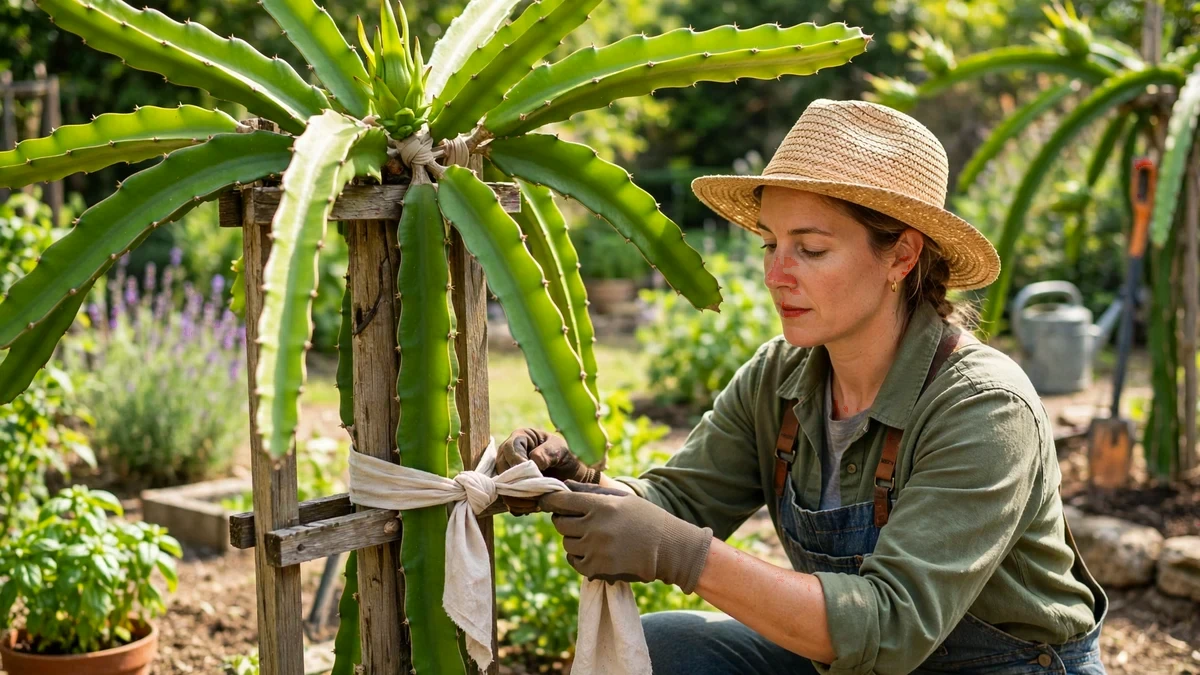
To train dragon fruit on trellis supports is to give a fast-growing climbing cactus a clear path upwards and a manageable shape at the top. Left alone, a dragon fruit plant does not grow into a neat, productive shape. It produces many stems at once, sprawls across the ground, tangles with itself, and shades its own inner growth. The result is a dense mass that is hard to prune, hard to harvest from, and prone to pests and disease.
When you train dragon fruit on trellis posts properly, the plant grows as a single strong stem to the top of the support, branches there, and hangs its fruiting stems down in an open canopy that gets light and air. That shape is easier to look after, easier to pick from, and more likely to flower well.
This guide explains how to train dragon fruit on trellis structures step by step: choosing a leader stem, tying it safely, removing side shoots, cutting the tip at the top, shaping the branches, and keeping the canopy in order as the plant grows. It assumes the trellis is already built and the plant is already in the ground or in a pot beside it. If you have not built the support yet, see the guide to dragon fruit trellis ideas first, and for planting beside a support, see how to plant dragon fruit in ground and how to grow dragon fruit in pots.
Table of Contents
- Why Training Matters
- Train Dragon Fruit on Trellis: Start with One Strong Leader
- Tying Stems Safely
- Reaching the Top: Tip Pruning and Branching
- Shaping the Canopy and Hanging Stems
- Routine Checks and Correcting Problems
- Common Training Mistakes
- Frequently Asked Questions
Why Training Matters
Training matters because dragon fruit grows fast and vigorously, and its growth habit works against the gardener who leaves it alone. UF IFAS notes that pitaya stems can reach about 20 feet (6.1 metres) long, grow about 3 centimetres a day in good conditions, and produce extensive growth that, if not pruned, becomes a dense mass that reduces light penetration, interferes with harvesting, and increases insect and disease problems.
A plant that is trained from the start avoids most of that trouble. A single leader stem uses the plant’s energy to climb quickly to the top of the trellis, where it can branch and fruit, instead of spreading that energy across many low stems that will never reach the light. Training also keeps the fruiting wood where you want it: on stems that hang down from the top frame, where flowers open at night and fruit develops in the open air, rather than on stems buried inside a tangle or trailing on the ground.
A trained plant is also safer and easier to work with. You can walk around it, see the base of the stems, check for pests and disease, and reach the fruit without climbing into a thicket. Training is not a one-time job. It is a routine that starts when the plant is young and continues through its life, with regular tying, pruning, and checking.
A plant that never flowers despite good training may have another cause, covered in the guide on why a dragon fruit plant is not flowering.
Train Dragon Fruit on Trellis: Start with One Strong Leader

The first step to train dragon fruit on trellis posts is to choose one strong leader stem and remove the rest, at least for now. When a young plant starts growing, it often produces several shoots from its base. Choose the strongest, straightest, healthiest shoot — one that is firm, green, and growing vigorously towards the post — and make that the leader.
Remove the other shoots at their base with a clean, sharp knife or secateurs, cutting close to the main stem without tearing it. This feels wasteful at first, because you are removing growth the plant worked hard to produce, but it is the standard practice described by both UF IFAS and the Hong Kong AFCD. UF IFAS explains that training involves eliminating any lateral stems along the main stem until it reaches the trellis, and the AFCD advises keeping only one leader stem before it reaches the top of the post, pruning away all branches so as to stimulate growth and enhance fruiting quality.
The reason is simple: one stem reaches the top faster than several competing stems, and it produces a stronger, straighter trunk that can carry the weight of the canopy later. As the leader grows, keep removing any side shoots that appear along its length, so the plant’s energy goes into upward growth.
Tying Stems Safely

Tying is how you train dragon fruit on trellis posts day by day, and the way you tie matters as much as how often you tie. The stem needs to be held close to the post so it climbs straight up, but it must not be strangled. Use soft, wide ties: strips of old cotton cloth, soft garden twine, lengths of old stocking, or purpose-made plant ties with a soft coating.
Avoid thin wire, fishing line, and narrow plastic cable ties, because they cut into the fleshy stem as it thickens. UF IFAS warns that wire on a trellis can cut or damage stems, and the same applies to wire ties.
Tie the stem to the post in a loose figure-of-eight loop: pass the tie around the post, cross it over, pass it around the stem, and knot it on the post rather than on the stem. The loop should be loose enough to fit a finger between the tie and the stem, so the stem can thicken without being pinched. Place a new tie every 20 to 30 centimetres as the stem grows, and check the old ties every few weeks, loosening or replacing any that have become tight.
Reaching the Top: Tip Pruning and Branching
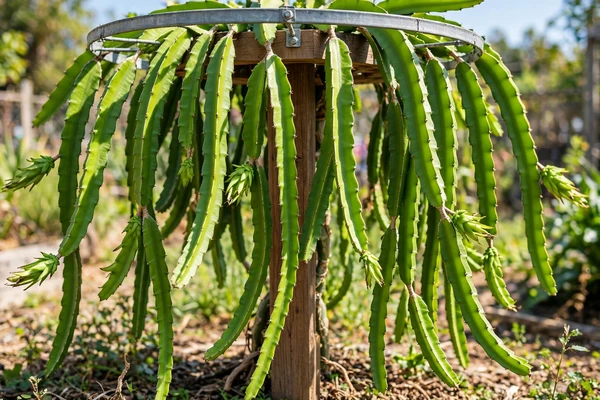
When the leader reaches the top of the trellis, the training changes. Until now the goal was upward growth; now the goal is branching. Cut the tip of the leader off just above the top frame, using a clean, sharp knife or secateurs. This is called tip pruning, and it stops the stem from growing ever higher and encourages the buds below the cut to grow into side branches.
UF IFAS describes this step plainly: soon after plants reach the top of the trellis, their tips should be cut to induce branching, and the new laterals trained and tied to the trellis. The AFCD gives the same advice: when the leader grows over the top of the support post, prune away its tip, allow lateral buds to grow into branch stems, and keep three or more branches that lie on the support ring or trellis at the top. Choose three to five strong, well-spaced branches and remove the rest, so the canopy starts open rather than crowded.
Train each chosen branch outwards over the top frame, tying it loosely to the frame so it lies flat or drapes gently over the edge. Do not let the branches grow straight up in a bundle; spread them around the frame so each one gets light and air. The cut tip will heal over in a few days in dry weather.
Shaping the Canopy and Hanging Stems
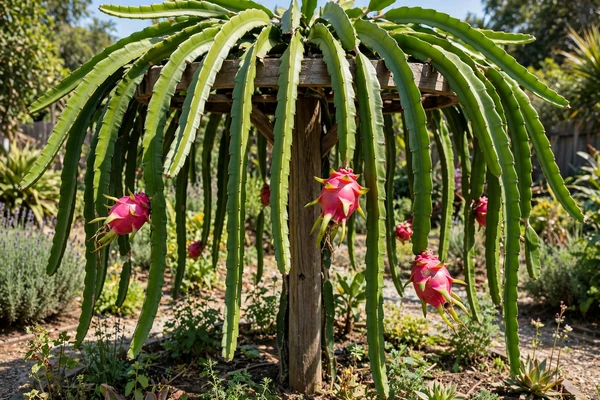
Once the branches are growing over the top frame, the job is to shape them into an open, hanging canopy. The AFCD advises allowing the branches to hang down naturally to accumulate nutrients for early flowering and fruiting, and to keep two-thirds of the branches as fruiting branches once the plant reaches the fruiting stage, nipping off the flower buds of the other branches and reducing the growth angles of the branches to promote strong fruiting wood.
In practice, that means letting the chosen branches grow out over the frame and then drape down, rather than training them to grow upright or inwards. Hanging stems flower and fruit better than upright stems, partly because the change in direction encourages flowering and partly because hanging stems get more light and air. When a hanging branch reaches about 90 to 120 centimetres long, the AFCD advises pruning away its tip so that it will flower, and notes that only after their tips have been pruned will the branches grow strong enough to support large fruits.
Space the hanging stems around the frame so they do not overlap heavily. If two stems cross, choose the stronger one and remove or redirect the other. If a stem grows back towards the centre of the plant, tie it outwards or remove it.
When you train dragon fruit on trellis frames, hanging stems flower and fruit better than upright stems, and that yearly renewal is part of the pruning routine in the guide on when to prune dragon fruit.
Routine Checks and Correcting Problems
A trained plant still needs regular checks, because dragon fruit grows fast and a small problem becomes a large one quickly in warm weather. Check the plant every week or two in the growing season and once a month in the cooler months. Look at the ties first: loosen or replace any that have become tight, add new ties where a stem has grown beyond the last one, and remove any tie that has been swallowed by a thickening stem.
Look at the stems next: remove any new side shoots from the main leader below the top frame, remove any stem that is growing in the wrong direction, and cut out any stem that is damaged, diseased, or dead. Look at the canopy: thin it if it has become dense, spread the branches if they have bunched together, and make sure no stem is resting on the ground, where it can root, rot, or be damaged. If a stem has grown too long and is dragging on the ground, cut its tip back to a healthy point and tie the remaining stem to the frame.
Regular checks are part of how you train dragon fruit on trellis supports over years. If a heavy branch pulls the frame sideways, see how to support heavy dragon fruit stems, keep growth steady with the guide on how often to water dragon fruit, and plan the work in the dragon fruit plant care calendar.
Common Training Mistakes
The most common mistake when you train dragon fruit on trellis supports is leaving too many stems. A plant with five leaders climbing at once looks bushy and vigorous, but none of the stems reaches the top quickly, and the base becomes crowded and hard to manage. Choose one leader and remove the rest. The second mistake is tying too tightly. A tight tie cuts into the stem as it thickens, weakens it, and can sever it entirely.
Tie loosely, check the ties often, and replace them before they bite. The third mistake is forgetting to tip-prune at the top. A leader that is allowed to keep growing past the top frame produces a tall, thin plant with little branching and fruit out of reach. Cut the tip when it reaches the top frame. The fourth mistake is letting the canopy become a dense tangle. Without thinning, the inner stems get no light, produce no fruit, and trap humidity that encourages disease. Thin the canopy every year after harvest.
The most common mistake when you train dragon fruit on trellis supports is leaving too many stems, and ignoring the variety is another: some varieties grow more vigorously than others, and the guide to the best dragon fruit varieties can help you know what to expect. For the wider first year, see how to grow dragon fruit.
Frequently Asked Questions
How do I train dragon fruit on trellis posts when the plant is young?
Choose one strong, straight leader stem, remove the other shoots at the base, and tie the leader loosely to the post with a soft tie every 20 to 30 centimetres as it grows. Remove any side shoots along the leader until it reaches the top of the trellis, checking the plant every week or two in the growing season.
When should I cut the tip of the dragon fruit stem?
Cut the tip when the leader reaches the top of the trellis frame. Cutting it then stops upward growth and encourages side branches to grow over the frame. Choose three to five strong branches, spread them around the frame, and tie them loosely so they can hang down and fruit.
Why are my dragon fruit stems growing in all directions?
That usually means side shoots were left on the leader, or the canopy was not thinned after branching. Remove side shoots below the top frame, choose the strongest branches at the top, spread them around the frame, and remove or redirect any stem growing inwards or crossing another stem.
How often should I check and tie a dragon fruit plant?
Check every week or two in the growing season and once a month in cooler months. Add ties as the stem grows, loosen or replace any tie that has become tight, and remove unwanted shoots while they are small. Little and often is better than one large training session once a year.
To train dragon fruit on trellis supports well is to work with the plant’s nature rather than against it: one leader up, branching at the top, and hanging stems that flower and fruit in the open air. Choose the leader, tie it loosely, cut the tip at the top, shape the canopy, and check it little and often. The plant will reward that steady attention with a shape that is easy to look after and easy to harvest from, season after season.