
How to Grow Dragon Fruit: A Complete Beginner’s Guide
If you are wondering how to grow dragon fruit at home, the encouraging news is that this tropical cactus is one of the more forgiving fruit plants you can grow, provided you give it the three things it cannot do without: a warm, frost-free spot, soil that drains freely, and a strong support to climb. Get those three right and a young plant will grow fast, flower spectacularly and fruit well.
Table of Contents
- What Is Dragon Fruit and Why Grow It at Home?
- Is Dragon Fruit Hard to Grow?
- Choosing the Right Variety for Your Garden
- Picking the Best Spot in Your Garden
- Soil and Drainage: The One Thing You Must Get Right
- How to Grow Dragon Fruit: The Planting Process
- Building a Trellis That Lasts
- Training Young Stems Up the Support
- Watering and Feeding in the First Year
- Pruning for a Manageable Plant
- How Long Until You See Fruit?
- Common Beginner Mistakes
- Frequently Asked Questions
What Is Dragon Fruit and Why Grow It at Home?

Dragon fruit, also called pitaya, is the fruit of a climbing, vine-like cactus native to tropical America. It is a fast-growing perennial with long, green, three-sided fleshy stems that climb using aerial roots. A single stem can reach around 6 metres if left unchecked, which is why support and pruning matter.
The fruit is a fleshy, usually oblong berry with bright red or yellow skin covered in leafy green-tipped scales. Inside, the pulp may be white, red or magenta, studded with tiny black seeds. The flavour is mild and lightly sweet, and the fruit is usually eaten fresh, chilled and scooped from the skin. It tolerates heat and dry spells better than many fruit crops, but it needs a trellis built before it grows large and frost protection in cooler regions.
Is Dragon Fruit Hard to Grow?
Most beginners when learning how to grow dragon fruit, find dragon fruit easier than they expect, provided they respect its limits. The plant is vigorous and cuttings root readily, so establishment is usually straightforward. The difficulty comes later, when a small plant becomes a heavy, sprawling mass that can pull down a weak support.
The main challenge is structural. A mature plant can weigh several hundred pounds on its trellis, so the support must be built like a small piece of garden furniture, not a flimsy stake. The second challenge is climate: dragon fruit grows best in tropical and subtropical conditions and is damaged by freezing temperatures, so gardeners outside warm regions should grow it in a container that can be moved under cover, or in a greenhouse. Disease is largely a consequence of water — excess moisture encourages root and stem disease — which is why drainage is the single most important factor in keeping the plant healthy.
Choosing the Right Variety for Your Garden
Variety choice matters when learning how to grow dragon fruit because varieties differ in flesh colour, flavour, growth habit and, most importantly, pollination needs. Some cultivars are self-fertile and set fruit with their own pollen, while others are self-incompatible and need pollen from a different variety. UF IFAS notes that self-incompatibility has been reported in several nursery cultivars and is not always well documented, so ask your nursery directly about the variety you buy.
If you only have room for one plant, a self-fertile variety is the safer choice. If you have room for two or three, planting different genetic types improves fruit set and fruit size, because cross-pollination between different types generally gives better results. Our guide to the best dragon fruit varieties compares popular types by skin and flesh colour, growth habit and pollination needs.
Picking the Best Spot in Your Garden
Dragon fruit, when learning how to grow dragon fruit, needs full sun, or almost full sun, for the best growth and fruit production. A spot with at least six hours of direct sun a day is a good target, and in very hot, dry regions a little afternoon shade can help prevent sunburn on the stems. Too much shade slows growth and reduces fruiting, so a shady corner is not a good place for it. Our guide to dragon fruit sunlight requirements explains how to balance sun exposure with protection.
Choose the warmest part of your garden, one that does not flood or stay wet after rain, and avoid hollows where cold air collects. Keep the plant well away from trees, buildings and power lines — UF IFAS recommends at least 4.5 to 6 metres. If your soil is heavy clay or the water table is high, plant on a raised mound 60 to 90 cm high, or in a large container. Our guide to the best climate for dragon fruit covers temperature needs in detail.
Soil and Drainage: The One Thing You Must Get Right
Dragon fruit is adapted to a wide range of soils, provided they are well drained. It grows well in the well-drained, sandy soils of south Florida, and thrives in soil high in organic matter or where manure has been added. What it cannot tolerate is soil that stays wet around its roots: waterlogged roots are prone to rot, and a plant that looks healthy on top can collapse quickly once root damage sets in.
Sandy loam with good aeration is a good general target, with a pH roughly between 5.5 and 7.5. After heavy rain, the soil should drain within a few hours, not stay soggy for a day. If your garden soil is heavy clay, improve drainage before planting — dig a wide hole, mix in coarse material and compost, or build a raised bed or mound. For containers, use a free-draining potting mix in a pot with large drainage holes; see our best soil for dragon fruit guide for mixes and pH.
How to Grow Dragon Fruit: The Planting Process
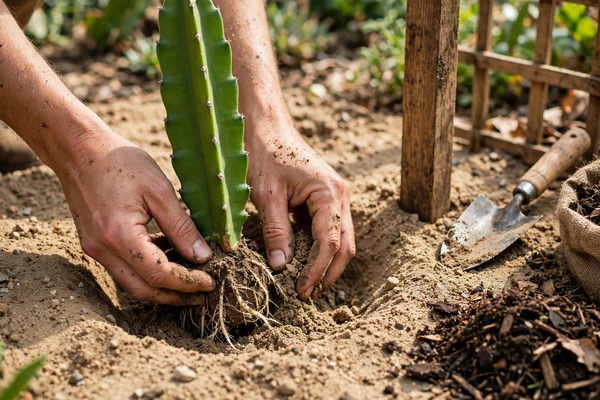
Start with a rooted cutting rather than a seed. Cuttings are the standard propagation method: they grow true to the parent variety and fruit much faster. Seed-grown plants vary from the parent and can take up to seven years to fruit, according to UF IFAS. If you want to try cuttings yourself, our guide on how to propagate dragon fruit from cuttings covers preparation, curing and rooting.
Buy a plant with a healthy, firm stem and no soft or discoloured patches, and plant in the warm season so it establishes quickly. For planting in the ground, dig a hole three to four times the diameter and three times as deep as the plant’s container, mix compost into the soil, set the plant at the same depth it was growing at, backfill gently, and water well.
For containers, use a pot of at least 20 to 25 litres, with the trellis post set in before you add the plant. Keep the soil lightly moist while it establishes and shade it in the hottest part of the day for the first few weeks. See our guides to planting dragon fruit in the ground and growing dragon fruit in pots.
Building a Trellis That Lasts
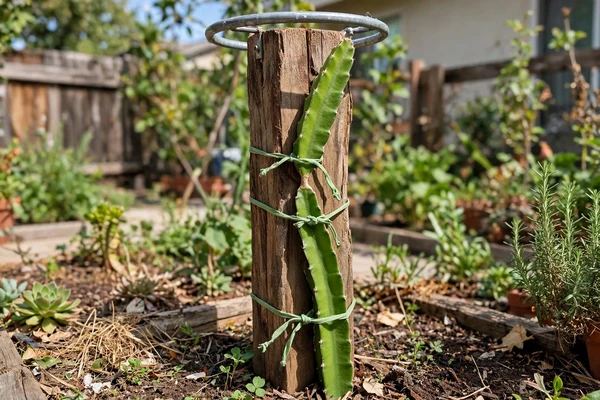
The trellis is the most important piece of equipment in dragon fruit growing, and it is the one beginners most often underestimate. A mature plant is heavy, and a weak trellis will buckle under it. Build the support before the plant needs it, not after it is already large, because retrofitting a support around a heavy mass of stems is difficult and risks breaking the plant.
The most common home design is a single strong post, 10 to 15 cm in diameter and around 1.5 to 1.8 metres high, with a square or circular frame at the top — sometimes made from reinforcing bar — over which the stems drape. Avoid bare wire for tying stems, as it can cut into them; cover any wire with plastic hose. Our guide to dragon fruit trellis ideas compares common designs.
Training Young Stems Up the Support
Once planted, when learning how to grow dragon fruit, guide one main stem up the post and remove side shoots until it reaches the top — a small, regular task through the first growing season. Tie the leader loosely to the post with soft ties and prune away laterals, so the plant’s energy goes into climbing rather than spreading at the base.
When the leader reaches the top, cut its tip so it branches, then train the new laterals over the top frame and let them hang down — hanging stems fruit best. Tip-prune laterals at roughly 90 to 120 cm long so they strengthen and flower. See our guide on how to train dragon fruit on a trellis.
Watering and Feeding in the First Year
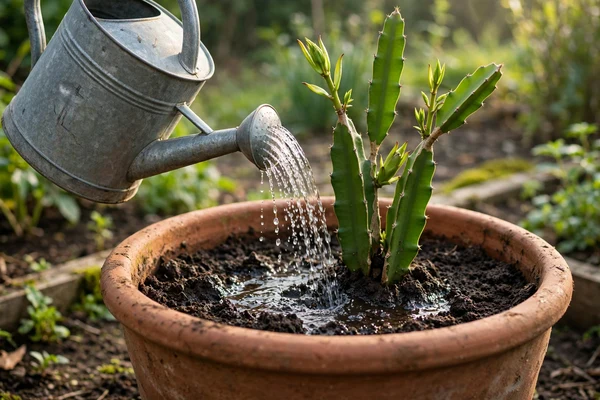
Dragon fruit is a cactus, but it is not a desert plant, and its water needs surprise many beginners. It can withstand dry periods, yet it has a fairly high water requirement during active growth, and a dry spell during flowering and fruiting can reduce production. At the same time, excessive soil moisture causes bacterial and fungal disease. The balance is to water regularly but never let the soil stay soggy.
In the first year, water when the top few centimetres of soil feel dry, watering deeply so moisture reaches the shallow roots in the top 5 to 15 cm. In hot weather that may mean every few days; in cooler or rainy weather, much less. Cut back in winter and early spring — a drier period encourages flowering — then water regularly from flowering to harvest. See our guide on how often to water dragon fruit.
Wait about a month after planting before fertilising. In the first year, light applications of a balanced fertiliser every two months are enough, plus compost around the base, kept away from the stem. Increase amounts gradually and feed mostly in the warm growing season. See our best fertilizer for dragon fruit guide.
Pruning for a Manageable Plant
Pruning keeps a dragon fruit plant productive rather than a tangled mass. Once established, production pruning means removing damaged, diseased or dead stems, stems that reach the soil, and stems that crowd the canopy and block light. A dense tangle reduces light, makes harvesting difficult and increases pest and disease problems.
A vigorous plant may need pruning one to three times a year, soon after harvest. Remove pruned stems from the area; healthy ones can be used as new cuttings. Treat cuts on large stems with fungicide to reduce stem rot risk. See our guide on when to prune dragon fruit.
How Long Until You See Fruit?
This is the question every beginner learning how to grow dragon fruit asks, and the honest answer is that it depends. Cuttings grow very fast — up to about 3 cm a day in warm conditions — and many produce fruit within 6 to 9 months of planting, according to UF IFAS. Those figures assume warm weather, good soil, enough sun and a variety suited to your conditions. A shaded, cold, waterlogged or starved plant will take far longer, and may not flower at all until its conditions improve.
Seed-grown plants can take up to seven years to fruit, and the fruit may differ from the parent. Once fruiting starts, a three- to four-year-old plant can produce a substantial crop in a good year, and a planting can remain productive for around twenty years with proper care. See our guide on how long dragon fruit takes to fruit.
Common Beginner Mistakes
Most dragon fruit failures when learning how to grow dragon fruit come from a short list of avoidable mistakes. First, planting in soil that stays wet — fix drainage or grow in a pot before you plant. Second, a weak trellis: a thin bamboo stake will not hold a mature plant, and rebuilding a support under a heavy canopy is far harder than building it properly at the start. Third, planting too close to a wall, fence or tree, where the plant overwhelms its neighbour.
Other mistakes include overwatering in winter, which can encourage rot; planting in too much shade, which gives lush stems but little fruit; and forgetting about pollination. Many beginners also skip pruning, and within two seasons have a dense, tangled mass that is hard to harvest and prone to disease. A little regular attention avoids all of this.
Frequently Asked Questions
Can I learn how to grow dragon fruit from a supermarket fruit?
Yes, the seeds usually germinate, but the plants vary from the parent and can take years to fruit. For reliable fruit, buy a named variety as a cutting.
Does dragon fruit need another plant to produce fruit?
It depends on the variety: some are self-fertile, others need pollen from a different variety. Planting two or three different types improves fruit set. See our dragon fruit pollination guide.
Why is my dragon fruit growing stems but no flowers?
Usually the plant is still young, short of sun, or has not had the drier winter rest that encourages flowering. Check sunlight first, then watering, and give it time — a cutting must reach the top of its trellis and branch before it flowers well.
Can I grow dragon fruit indoors?
It can be started indoors, when learning how to grow dragon fruit, but it is not a good long-term houseplant: it needs very strong light, warmth and a tall support, and grows too large for a typical room. In cool climates, grow it in a container outdoors in summer and move it under cover for winter.
7 thoughts on “How to Grow Dragon Fruit: A Complete Beginner’s Guide”